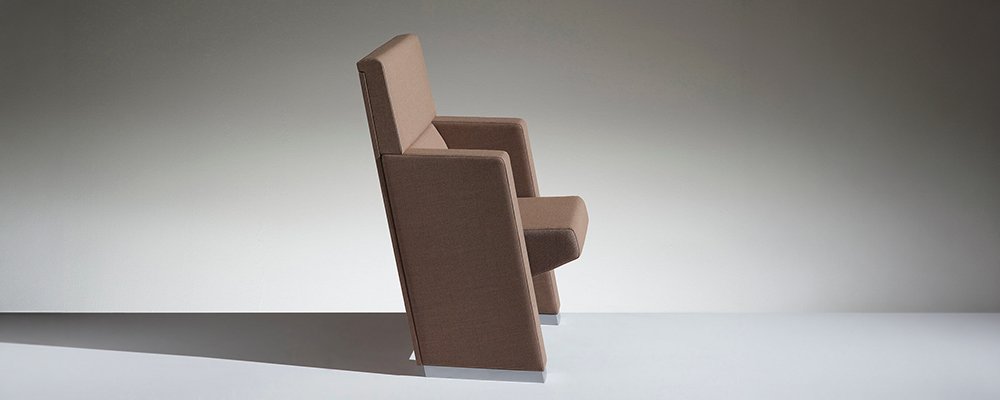
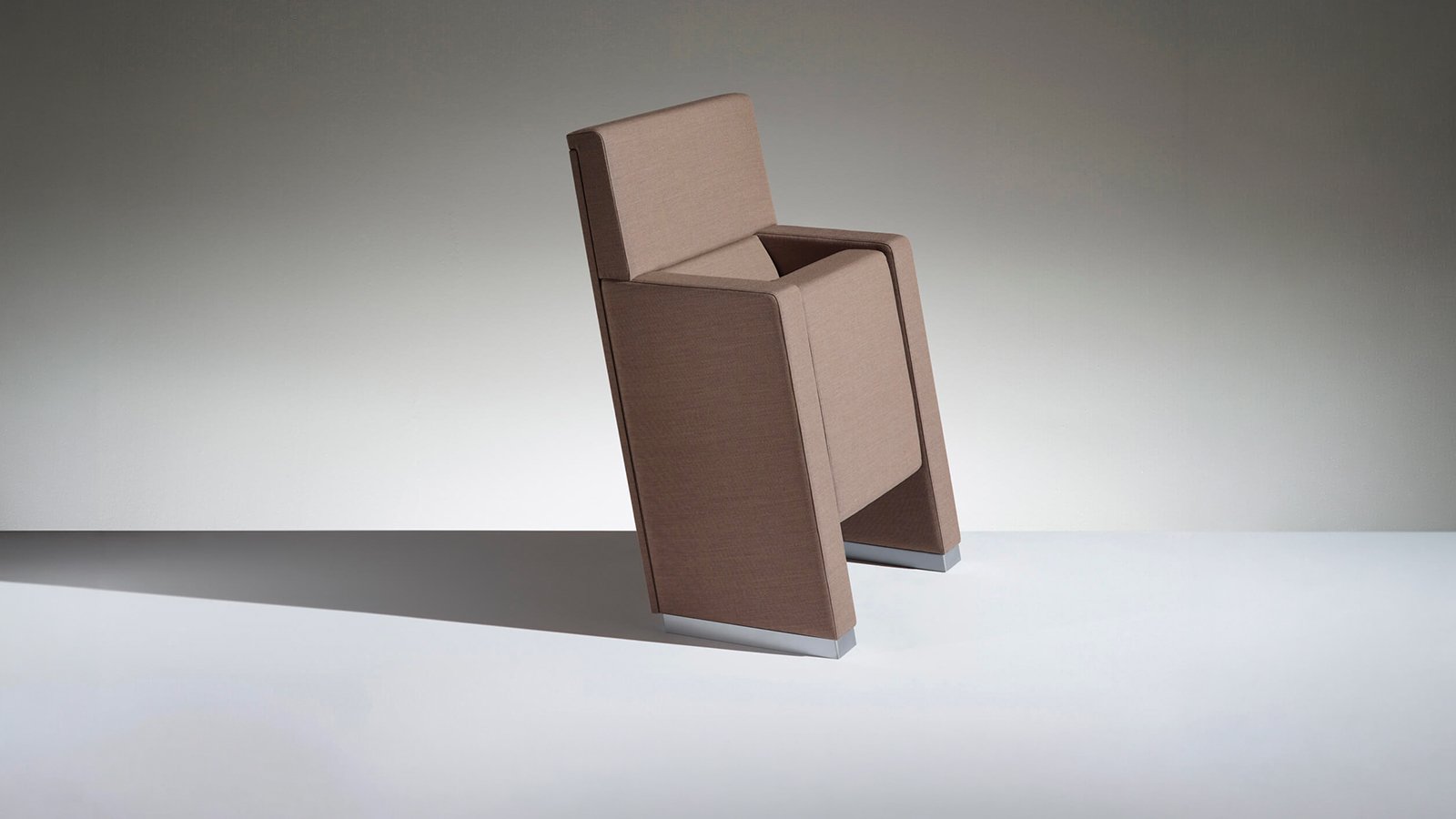
Auditorium chairs L213 by Lamm with T200 writing tables in the first row

Auditorium chairs with a writing table on its own base: the T200 and L213 by Lamm

Lamm
L213
L213 An icon of Italian design
From ₹ 2,500

Prefer a tailored configuration?

Trade terms for professionals and design studios

In every lecture hall the first row is the one nobody has solved. The rows behind can write on a table fixed to the seatback in front; the first row faces the stage. L213, the chair that Lamm's research and development office designed for auditoriums, conference halls and classrooms, answers it with an accessory of its own: the T200, a tip-up writing table on a single base, placed in front of the chair and independent of it.

The combination is drawn in the manufacturer's dimensioned sheets: chair plus T200 occupies 104.5 cm in depth when the side is inclined and 102 cm when it is straight, measured to the far edge of the table. The table tips up when it is not needed, so the front row can be a plain line of auditorium chairs for a ceremony in the morning and a working row for an examination in the afternoon.

That flexibility is why La Mercanti suggests L213 for institutions whose halls double as teaching spaces: the same chair accepts a tablet stowed inside its side and a folding table at the back of the seat, so one seating model covers every row, including the one that university furniture usually treats as an exception.

L213 itself is a full-height chair whose load-bearing sides, inclined or straight, come in fabric, leather, oak or beech; the seat tips up by gravity and a stamped-steel foot holds it to the floor. It serves convention halls and multipurpose rooms as readily as theatres, a wider side is available, and where a project requires it the Floor Technology system from Lamm sinks the chair below the floor. The T200 simply makes sure the first row is not left out.

Technical information based on data declared by the manufacturer.

Collection: L213
Manufacturer: Lamm — Lamm S.r.l., San Secondo Parmense (Parma), Italy
Design: R&D LAMM (the manufacturer's research and development office)
What it is: armchair for conference halls, auditoriums, educational and multipurpose rooms; full-height load-bearing sides, inclined or straight, also available in increased width
Seat and backrest: plywood internal structure; padding in shaped, non-deformable, fire-retardant polyurethane foam (manufacturer's declaration)
Seat tip-up: by gravity, with a counterweight
Rear of the backrest: visible plywood in oak or beech finish, or completely upholstered and covered
Sides: load-bearing, inclined or straight, plywood structure with metal inserts; fully upholstered and covered in fabric, faux leather or leather, or in painted wood with oak or beech finish; thickness 8 cm (standard) or 10 cm (increased width)
Side with writing tablet: tip-up foldaway writing tablet in black stratified HPL, die-cast aluminium joint, folds away into the side, anti-panic movement
Floor-anchor feet: moulded sheet steel with a scratchproof, anti-corrosion epoxy powder coating in semi-matt black RAL 9005, semi-matt silver, embossed bronze or embossed graphite; fixed to the floor
Installation: on horizontal or sloped flooring or on steps, in straight or curved rows (standard minimum radius 8 m)
Centre-to-centre distance: 53 or 56 cm with the standard side; 56, 58 or 60 cm with the increased-width side (technical sheet)
Row spacing: 90 cm; free passage with the seat tipped up 33 cm (inclined side) or 36 cm (straight side); 93 cm with the seatback table; curved rows 90 cm or more
Heights: overall 97 cm · seat 45 cm · side tablet at 65 cm (inclined side) or 67 cm (straight side) · seatback table at 70 cm
Overall depth: 75 cm with the inclined side · 83 cm with the straight side
Seatback table (accessory): tip-up, anti-panic movement, slow and cushioned closing (patent pending); top in HPL laminate, beech, oak or black
T200 table (accessory): tip-up writing table on a single base; overall footprint with the chair 104.5 cm (inclined side) or 102 cm (straight side)
Floor Technology (on project): the manufacturer's foldaway system that moves the whole body of the seat to a horizontal position under the floor
Accessories: row identification element · seat numbering · under-seat panel and backrest panel in painted wood, oak or beech finish · provision for electric power supply (socket on demand) · provision for audio/video devices (on project) · added armrest in painted solid wood, beech or oak · accessory system that moves the chairs on castors when not in use (chairs with floor-fixed feet, in straight rows)
Coverings: ten — Inca, King, Trevi CS, Silvertex, Extrema Au, Luna CS, Revive 1, Remix 2, Steelcut Trio 3, leather
HPL laminates (seatback table): beech, oak, black · Stratified HPL (side tablet): black
Painted wood (sides, rear of backrest, panels): beech, oak · Painted solid wood (armrest): beech, oak
Foot paint: black, silver, bronze, graphite
Padding: CertiPUR® certified
Wooden components: low formaldehyde emission
Testing: tested according to European standards (the manufacturer declares no standard numbers)

La Mercanti Srl — trusted supplier for design and contract projects since 1997.
San Benedetto del Tronto (AP), Italy · +39 0735 753833 · info@lamercanti.com
Supply, quotations, specifications and project support across India and worldwide.

Share the finishes you wish to evaluate

₹ 30,000

Amount adjusted against your first order

FAQ

How high is the writing surface in the side of an L213?

It depends on the side: the tablet sits 65 cm above the floor with the inclined side and 67 cm with the straight side, according to the manufacturer's dimensioned drawings. The chair itself is 97 cm high with the seat at 45 cm, so the surface lands at elbow height for an adult.

Which fabrics can L213 be covered in?

Ten coverings in all: nine fabrics plus leather, the fabrics being Inca, King, Trevi CS, Silvertex, Extrema Au, Luna CS, Revive 1, Remix 2 and Steelcut Trio 3. The same card applies to the seat, the backrest and, where upholstered, the sides and the rear of the backrest.

Why do the sides of L213 not flex when someone leans on them?

Because the plywood structure inside each side carries metal inserts at the points where the seat and the backrest load it. The side is the load-bearing element of the chair; the upholstery or the oak and beech finish is only its skin.

Who designed L213?

Lamm's own research and development office, which the manufacturer credits as R&D LAMM; there is no external designer. Lamm describes the result as a rational design, built on attention to detail and the neatness of its modules.

Can an armrest be added to L213?

Yes, as an accessory: an added armrest in painted solid wood, beech or oak, fitted on top of the side. La Mercanti recommends it for halls where delegates stay seated through long sessions and the sides are specified in wood.

How many L213 chairs fit in a row: the count before the order

The way to work out the number of L213 chairs in one row, starting from the clear length, the centre distances the manufacturer allows and the end sides.

Measure the clear row length

Start from the free length between the two aisles, not from the width of the hall: L213 is fixed to the floor and the end sides are part of the count. Keep every row in the same unit and measure at floor level.

Pick the centre distance

With the standard side, 8 cm thick, Lamm allows 53 or 56 cm between centres; with the increased-width side, 10 cm thick, the technical sheet gives 56, 58 or 60 cm. The wider spacing is for halls where the audience sits through long sessions.

Do the division

Clear length minus the thickness of the two end sides, divided by the centre distance: the whole number is the seat count. The remainder goes into wider aisles, never into tighter seats.

Check the passage between rows

At 90 cm between rows, a tipped-up seat leaves 33 cm with the inclined side and 36 cm with the straight one; if seatback tables are planned, the row spacing becomes 93 cm and the depth sum is recalculated.

Fix quantities row by row

On stepped floors the rows differ in length, so the count closes one row at a time: seats, centre distance and side type for each. That list is what La Mercanti carries into the order.