
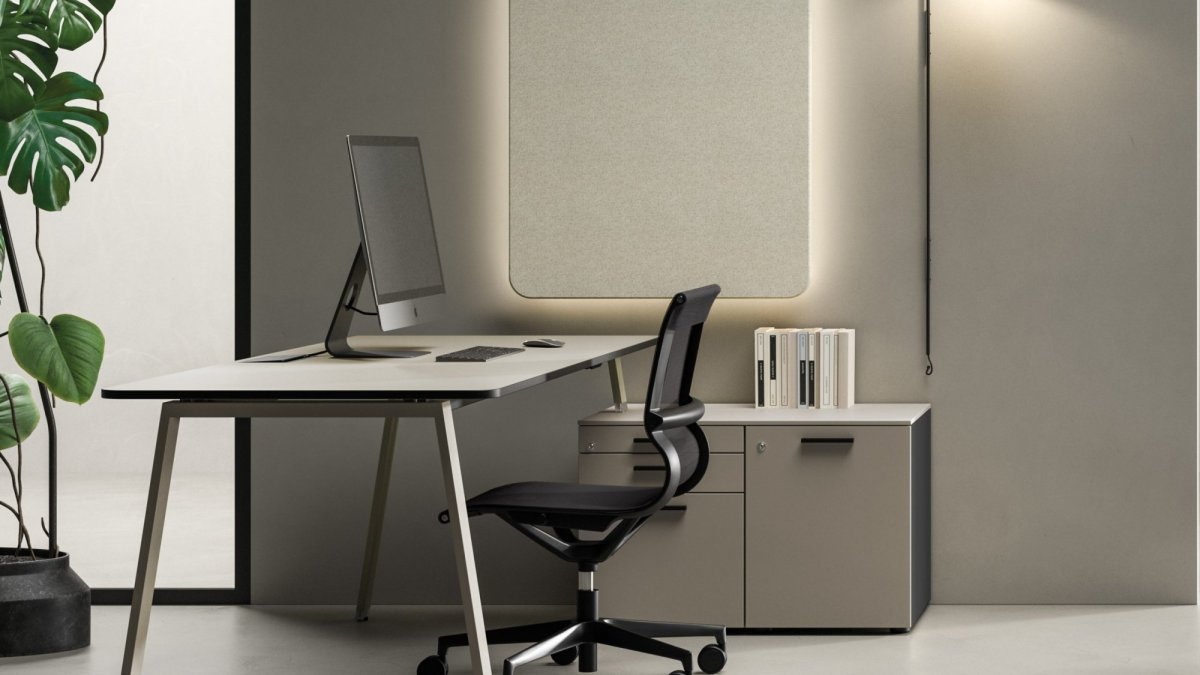
An Indian woman born in 1996 stands, on average, 152.6 cm tall. Europe's desk standard, EN 527-1:2011, was drawn around a user population that begins at 149.3 cm, the height of the shortest European women it sets out to cover. Thirty-three millimetres separate the two figures, and they explain more about desk height in an Indian office than any catalogue does. The standard puts a non-adjustable desktop at 740 mm, give or take 20 mm, and asks a desk that moves for seated work to travel at least from 650 to 850 mm. For a population that sits at the shorter end of the range the standard was built on, the question to ask of a 740 mm desk is rarely whether it is high enough.
Indian offices sit at the short end of a European standard
The figures come from NCD-RisC, the NCD Risk Factor Collaboration, whose 2016 paper in eLife traced adult height country by country over a hundred years. Indian men born in 1996 average 164.9 cm and Indian women 152.6 cm. Italian men of the same year average 177.8 cm and Italian women 164.6 cm, so the difference is close to 13 cm for men and 12 cm for women. It was not always so wide. For those born in 1896, an Indian man averaged 162.0 cm and an Italian man 164.7 cm, less than 3 cm apart. Over the following hundred years Italian men gained 13.1 cm; Indian men gained 3.0 cm and Indian women 4.6 cm.
A standard is a compromise across a population, and EN 527-1 says openly which population it had in mind: European office users, leaving out the shortest 5 per cent of women and the tallest 5 per cent of men, which gives a stature band of 1,493 to 1,913 mm. The average Indian man falls well inside that band. The average Indian woman sits just above its floor. When planning an office in India around European desks, that is the arithmetic to begin with.
When the chair goes up, the feet come off the floor
At a desk that cannot move, the height is corrected from the seat. A shorter user raises the chair to reach the desktop, and at that point the soles of the feet may no longer rest on the floor. The advice of the US Occupational Safety and Health Administration, in its guide to computer workstations, runs in exactly this order: if the work surface cannot be lowered, raise the chair; if needed, provide a footrest. The same guide warns that a desk set at the wrong height can lead to awkward postures, with the arms stretched out towards the keys and the shoulders lifted. Italian law, for its part, writes the footrest into its rules for display screen work, to be made available to anyone who wishes to have one.
Raising the seat also brings the thighs closer to the underside of the desktop. This is where two less-read lines of EN 527-1 earn their place in a specification: clear space for the legs of 800 mm in depth and, beneath a non-adjustable top, 850 mm in width; and a maximum edge thickness of 70 mm on such a top, 55 mm on one that adjusts.
For an Indian floor of fixed desks, then, we would plan the footrests together with the chairs.
What Indian law says about the desk, and what it leaves out
Since 21 November 2025, workplace safety in India has been governed by the Occupational Safety, Health and Working Conditions Code, 2020, which came into force together with the other three labour codes and repealed, among other enactments, the Factories Act, 1948. We searched the full text published in the Gazette of India for anything a desk buyer could use. The Code gives no measurement for a desk, a chair or a screen, and it contains no provision on work at a computer. The word "computer" appears once, in the definition of a factory, to say that the mere presence of an electronic data processing unit or a computer unit does not make premises a factory if no manufacturing process is carried on there. The only seating the Code mentions is for employees obliged to work in a standing position.
The duties that do reach an office are general. Section 6 requires every employer to ensure that the workplace is free from hazards which cause or are likely to cause injury or occupational disease, and to provide, as far as is reasonably practicable, a working environment that is safe and without risk to health. An establishment, for these purposes, is any place of industry, trade or business employing ten or more workers. Detailed standards are for the Central Government to declare by notification under Section 18; we have not found one on computer work. The labour codes also require employers to give every worker above the age of 40 a free annual health check-up.
There is a further silence. The Code's Third Schedule lists 29 notifiable diseases, from lead poisoning and silicosis to occupational cancer, and none of them is musculoskeletal. We have found no national count of work-related back, neck and shoulder disorders in India of the kind Italy or Great Britain publish. The closest picture is a meta-analysis by Mishra and colleagues in the Journal of Occupational Health, which pooled Indian studies from 2005 to 2023 and estimated the twelve-month prevalence of work-related musculoskeletal disorders at 76 per cent, with low back pain at 60, neck pain at 40 and shoulder pain at 36. The studies differ in method and cover sectors from agriculture to health care, mining and banking, so the figure is not an official statistic and says nothing specific about desks. What it does show is how often these complaints turn up in the Indian studies that have looked for them.
For an HR head or an EHS manager, a general duty without a measurement means the employer has to show what was done. A short note, desk by desk, of the settings chosen for its user is the kind of evidence we would keep; its legal value is for counsel to judge.
The catalogue height is not the installed height
Once we have fitted a desk, its top generally sits 3 to 5 cm off the catalogue figure. At the upper end that is more than double the 20 mm tolerance EN 527-1 permits for non-adjustable tops. The mistake we find on site is a desktop left out of level, resting on glides that nobody adjusted after unpacking. It is corrected at installation, before the user sits down. Specifications can close the point in one line: installed height, checked with a spirit level, recorded beside the catalogue value.
Director and MD tables follow their own logic. Their height varies model by model, so it has to be read from the data sheet of the chosen piece before anyone picks the chair.
When we did have a desk made to measure, it went the other way from the Indian average. It was for a very tall client who changed his desk; the replacement was made by the manufacturer to his measurements.
Adjustable desks help, within limits the research has measured
For desks that move, the standard requires travel of at least 650 to 850 mm for seated use and 650 to 1,250 mm where people alternate between sitting and standing. The lower end matters in India: a desktop that comes down towards 650 mm can let a shorter user keep the chair low and the feet on the floor, with no footrest at all. Where one desk serves several people through a single day, that range lets the same surface be set for each of them in turn. The evidence on standing is modest. In the 2018 Cochrane review of workplace interventions, time spent seated at work fell by roughly 100 minutes daily over the first quarter with sit-stand desks and by 57 minutes from month three to month twelve; the reviewers graded their certainty as low and had nothing to report past twelve months. In a 2006 paper in Applied Ergonomics, Wilks, Mortimer and Nylén found the standing function under-used by people who otherwise approved of their new tables. SMArT Work, a trial among NHS hospital staff in England reported by the BMJ in 2018, did measure a daily reduction of 83 minutes at the one-year mark, but its participants also received a seminar, feedback and coaching. The desk alone is not what the trial tested.
We begin with the people
Before we draw a floor of office tables, we ask who will sit at them, how tall they are, how long they stay seated each day, and whether a seat is assigned or shared. The answers decide whether a fixed 740 mm top is enough or whether the range has to come down towards 650 mm, and which ergonomic office chairs will do the adjusting. In a country where the law names no height, the measurement that counts is taken on installation day, with the user seated and a spirit level on the desktop.
For many Indian users at a European desk, the first thing to measure runs downwards, from the seat to the floor.
Quick answers
Does Indian law set a height for office desks? The OSH Code, 2020 does not, and we have found no notified standard that does. The height usually quoted comes from EN 527-1:2011, a European standard that puts a non-adjustable desk at 740 mm, give or take 20 mm.
Does the OSH Code, 2020 regulate computer workstations? No. The Code contains no measurement for desks, chairs or screens and no provision on work at a computer; employers remain bound by the general duty in Section 6 to keep the workplace free from hazards and safe for health.
Is a 740 mm desk suitable for shorter users? It can be, if the chair is raised to the desktop and a footrest supports the feet. A desk adjustable down to 650 mm can make the footrest unnecessary.
How tall is the average Indian adult? According to NCD-RisC (eLife, 2016), Indian men born in 1996 average 164.9 cm and Indian women 152.6 cm.
Are musculoskeletal disorders a notifiable disease in India? No. None of the 29 diseases in the Third Schedule of the OSH Code is musculoskeletal.
Why does an installed desk differ from its catalogue height? Once fitted, a desktop generally sits 3 to 5 cm away from its catalogue figure in our experience, which is why the desktop should be levelled on its glides and checked once it is in place.