Prefer a tailored configuration?
Trade terms for professionals and design studios
Prefer a tailored configuration?
Trade terms for professionals and design studios
Along with every Klivia, Kastel supplies a small key, and it has a single purpose. The synchronised mechanism built into the seat already regulates the intensity of its recline automatically; the key allows a further adjustment of that intensity for a user who wants the chair to respond differently. Kastel, which works out of San Vendemiano, near Treviso, calls the mechanism a self-adjusting syncron and lists the key as standard equipment, not as an accessory to be ordered later.
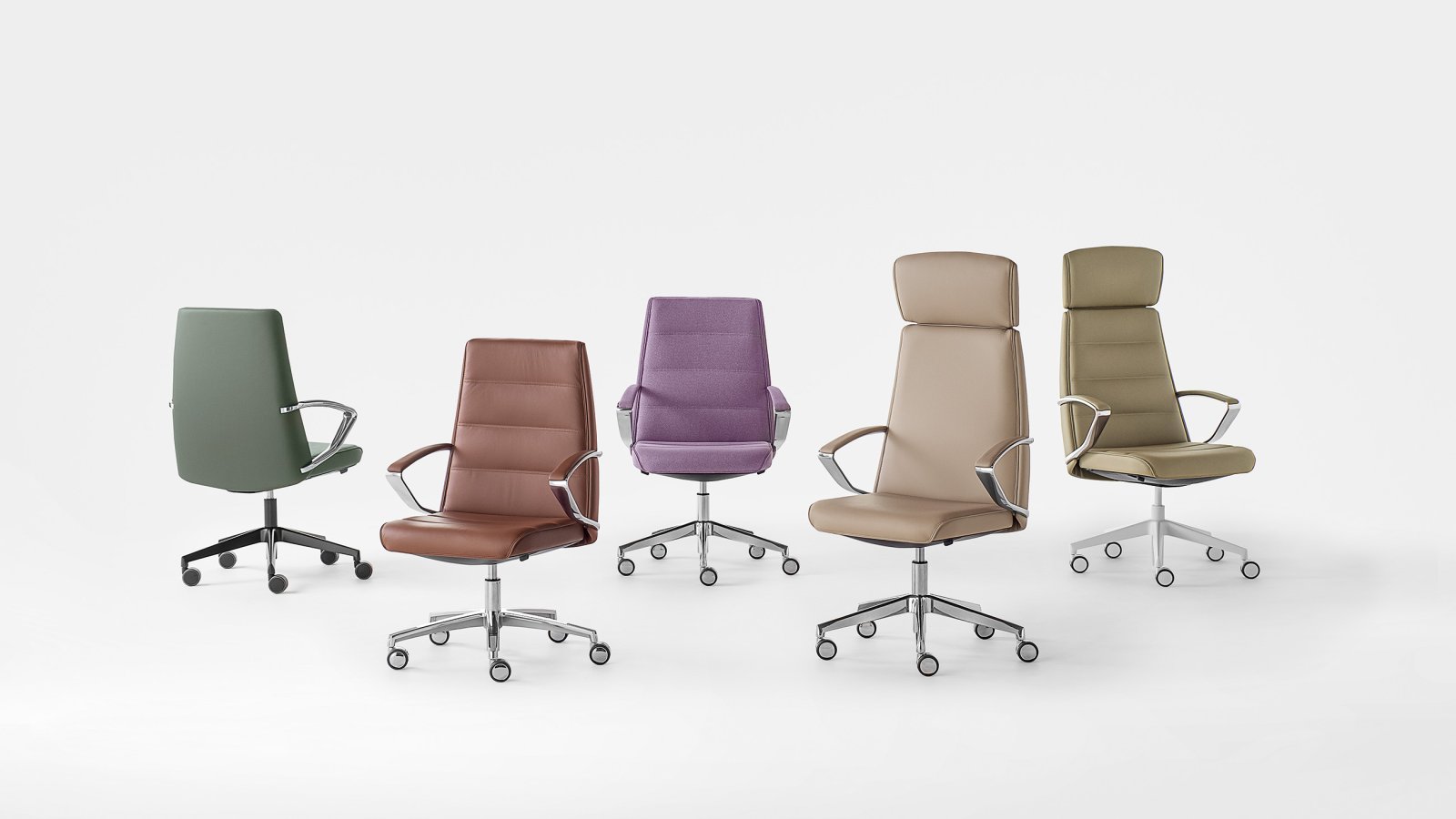
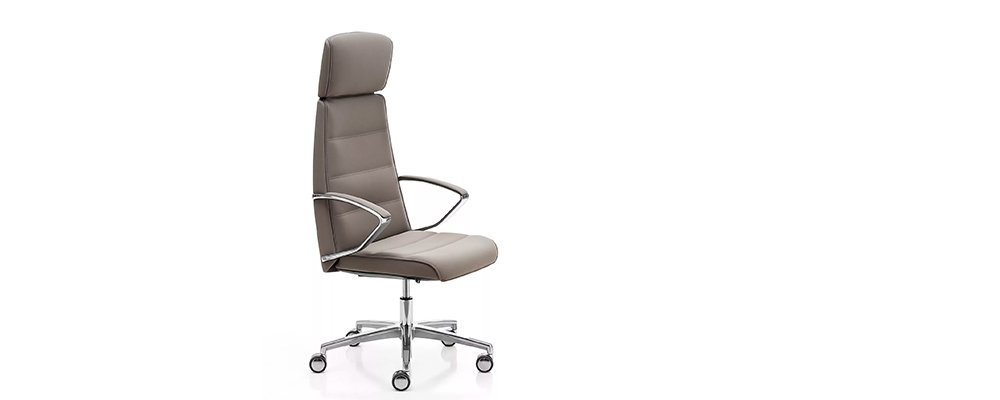
In the family of boss chairs it takes the full-size role. With the high back it measures 119–131 cm overall, on a footprint of 65 × 60 cm. Underneath the cushion the seat is technopolymer, the back combines curved multilayer and a birch counter-panel, and both are padded with non-deforming polyurethane foam. The arms are die-cast aluminium, polished and capped with a padded multilayer top, and the mechanism body is steel.
Read it from the floor upwards. At the bottom, five-spoke bases come in nylon (black, white, grey) or in aluminium, polished, black, white or chromed, and the four-spoke AL4 stands on chrome glides instead of castors. Higher up, the padding is plain or carries linear stitching. At the top, the medium back finishes at 90–102 cm, and that is the version we set in front of the desk for visitors or around a meeting table, while the high back stays in the director’s cabin. La Mercanti hands over the key together with the chair and shows what it adjusts.
Share the finishes you wish to evaluate
Between 40 and 52 cm above the floor. The gas lift moves the seat through that range on both the high-back and the medium-back version, which lets one chair serve a taller or a shorter user at the same desk.
Two. The padding can be plain, a smooth surface, or it can carry linear stitching. Kastel offers both on the high back and on the medium back, so the choice is purely about the look.
AL3 and AL5: polished aluminium five-spoke bases, Ø 654 mm, each fitted with a chrome piston and chrome castors, so the metal stays bright from the column down to the floor. These are the two bases where the castors are not the standard ones.
EN 1335 type C. The reference is printed on the technical sheet Kastel publishes for Klivia, the same sheet that covers both backrests and both padding styles, so it is not tied to one particular version.
Each code joins a back height to a padding style: KLV18LS is high and plain, KLV28LS medium and plain, KLV58LN high with linear stitching, KLV68LN medium with linear stitching. The letters LS mark plain padding, LN the stitched one.
Fifteen collections in three categories, and a screen that only approximates colour: five steps to settle the upholstery of Klivia before the order goes in.
Kastel warns that its website pictures are only indicative. The real samples in the swatch folder settle colour and texture, so the choice begins there rather than with a screen.
The first category holds two collections: Planet, a faux leather, and 3D Fabric, a polyester fabric. Planet is also the cover linked to the fire approval described in the last step.
Here sit Skill/Secret, a faux leather, and five fabrics: Jet, Mirage, Cura, Xtreme and Trevi. Lay them side by side in the folder and compare them with the samples of category A.
The last group lists Extrema AU, Valencia and Extrema Ikon, all faux leathers, along with the fabrics Fenice, Poseidon, Cyber and Jungla. Write both the collection and its category on the order.
For projects in Italy, Class 1IM is available only on request and only with Planet from category A. In projects abroad, whichever fire rules apply are verified case by case.