Let's discuss your project
Trade terms for professionals and design studios
Let's discuss your project
Trade terms for professionals and design studios
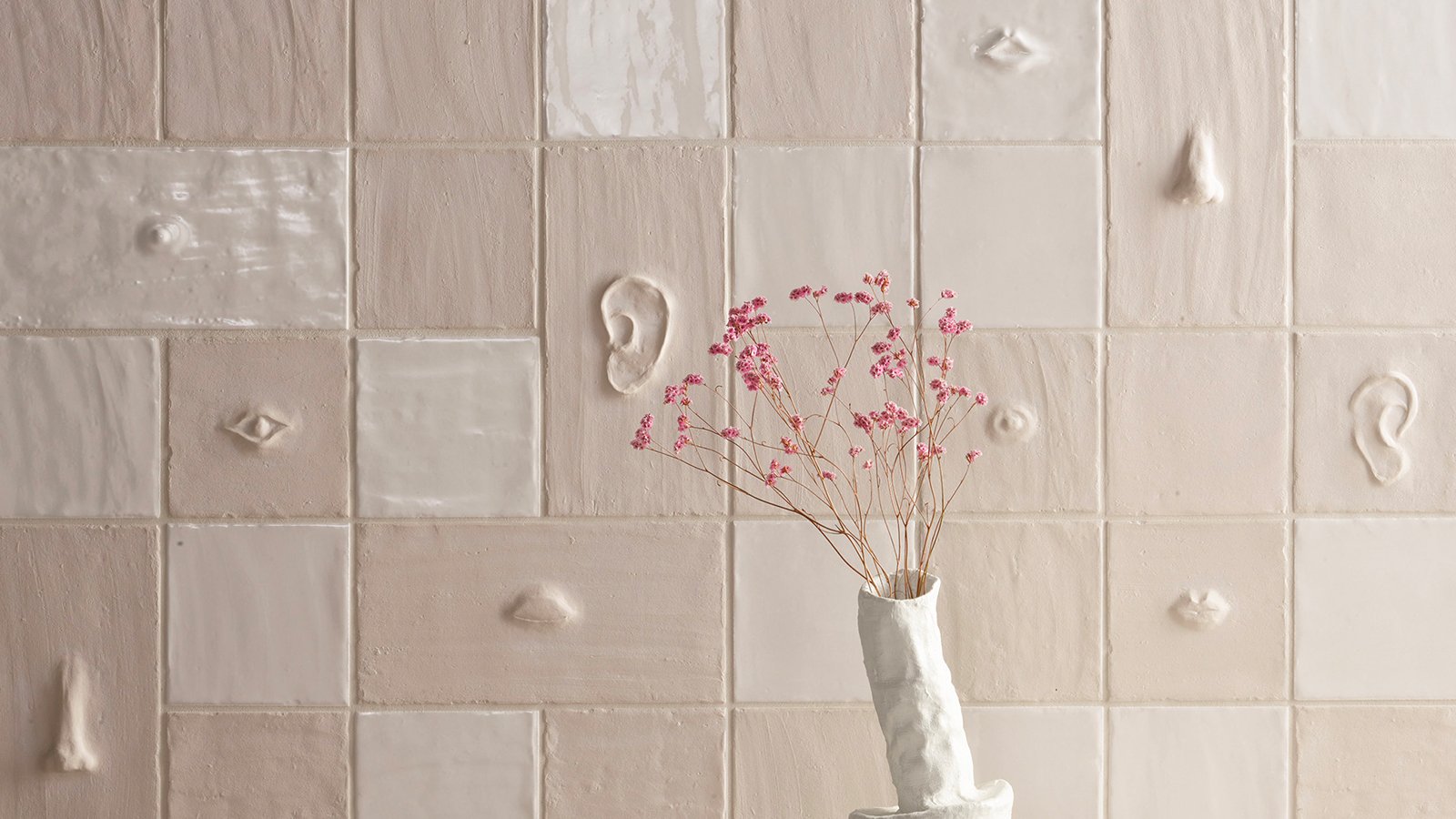
A quarter of the wall in 15×15 cm, half in 15×30 cm, the last quarter in 30×30 cm: that is Layout 1, one of six proportions Mutina suggests for the Plain Tiles of Faces & Figures. Layout 4 is calmer, with 20% of 15×30 cm and 80% of 30×30 cm. The three sizes are meant to meet on one surface, and wherever they do, a 4 mm joint becomes compulsory rather than merely advised, so the modules keep their rhythm across the wall.
The collection is the first collaboration between Faye Toogood and Mutina, and it grew out of the encounter between body and clay. The result is a range of designer ceramic tiles whose surface is uneven on purpose: undulating, lightly scratched, with asymmetric edges, small cracks and roughness. Underneath sits unrectified porcelain stoneware, 10 mm thick and produced industrially, while the figures have been reduced to archetypes. In a director’s washroom, a panel of Eyes framed by Chalk grounds turns a plain wall into a piece of sculpture.
Beyond the grounds, the system has four more parts. Plain Tiles cover Chalk, Clay, Sand or Mud, every one offered Matt or Glossy. Figure brings two organic 20×30 cm shapes in Matt alone. Ears, Eyes, Noses, Mouths and Nipples make up the subjects in relief and, together with the Face mix of eight pieces, are produced in Chalk; Body is a terracotta brick offered in Chalk or Cotto. Glossy may cover a floor only inside a home, Matt works on floors outdoors as well, while subjects, Face and Body belong on walls only. La Mercanti prepares the tile count for each size from the chosen layout, so the order already reflects the final wall.

Share the finishes you wish to evaluate
No. Eyes, Ears, Mouths, Noses, Nipples and Face are rated for wall cladding only, indoors or outdoors. On a floor, Faces & Figures relies on the Plain Tiles grounds and on Figure.
The Matt surface has a DCOF of 0.78 and pendulum values of 65 dry and 60 wet. Both are measured on the Matt porcelain, which is the finish Mutina rates for floors both indoors and outdoors.
The porcelain pieces reach stain resistance class 5 and class A for acids and bases. Both values are declared by Mutina for the Plain Tiles, for Figure and for the relief subjects alike.
Body is rated F2 for severe exposure to freezing. It may therefore clad exterior walls, and Mutina adds that it must still respect the building rules that apply in the country where it is installed.
Body is handmade terracotta, so a tolerance of ±5 mm is declared. Each brick is meant to be slightly different from the next, an effect Mutina takes from the irregularity of dry-stone walls.
Mutina gives precise rules for grouting and for the end-of-site clean. Five steps to finish the porcelain pieces and the Body brick correctly.
Work on no more than 0.5 m² at a time, as Mutina instructs. The same rule applies to every porcelain piece, from the Plain Tiles grounds to Figure and the relief subjects.
On the Glossy versions, Mutina asks for a fine-grained grout. It concerns the glazed Plain Tiles as well as the Eyes, Ears, Mouths, Noses, Nipples and Face pieces chosen in Glossy.
For Figure, Mutina names Mapestone PFS 2 or Ultracolor Plus as the recommended grouts. Select one of them before work begins on the floor or wall area covered in Figure.
On the Body brick, grouting is optional and purely aesthetic. Agree in advance whether the joints between the terracotta pieces will be filled or left open.
After a cementitious grout, clean with a buffered acid product such as Deterdek Pro by Fila at 1:5. After an epoxy grout, use an alkaline detergent such as Fila CR10.