Let's discuss your project
Trade terms for professionals and design studios
Let's discuss your project
Trade terms for professionals and design studios
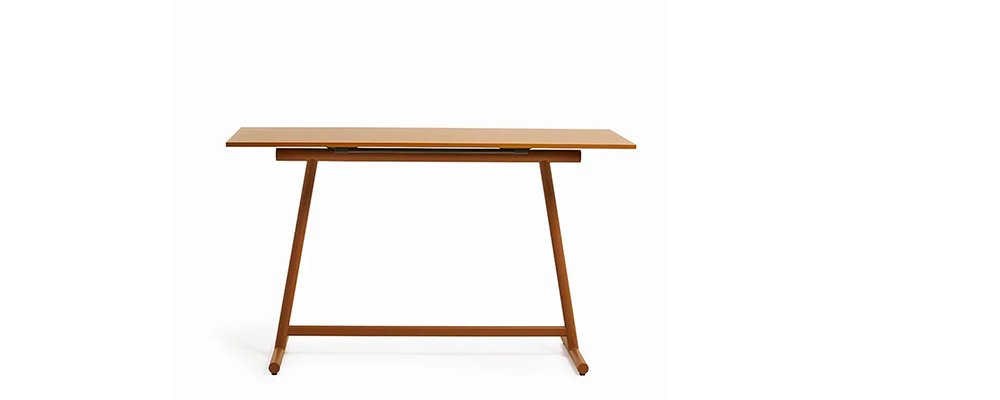
At 105 cm, the high rectangular KISO is the member of the family we treat as a standing table: the place for a ten-minute review over a laptop or a printed drawing, with nobody pulling up a chair. When the review ends, the surface is turned on edge and the table steps back towards the wall, 145 cm tall and slim in profile. That double life is why it sits under furniture for collaborative work on this site.
Its top comes in two lengths, 160 or 180 cm, always 68 cm deep. Tomoya Tabuchi built the whole family around one metal tube joining the legs: it holds the top, contains the mechanism behind the rotation and, as an option, carries a power socket with USB-A and USB-C ports. Once folded, several can be nested together, and each variant can be ordered with castors, with integrated power or with both. Powder-coated steel for the frame, and for the top a choice that runs through oak, lacquers, HPL and Fenix.
The other two members of the family, the half-moon and the large round, sit at 74 cm for seated work. We see the trio in conference rooms and boardrooms where a seated review in the morning gives way to short check-ins on foot in the afternoon. La Mercanti asks the client which of the week's meetings happen on their feet, and plans the high tables around those.

Share the finishes you wish to evaluate
Six. Three are wood: blanched oak in one shade, open-pore lacquered wood and lacquered wood, each in 16 colours. Three are technical: HPL 10 mm with a black core in two colours, Fenix HPL 10 mm and Fenix laminate, nine colours each. Wood brings warmth to a client-facing room; HPL and Fenix are the choice we suggest for training rooms where many hands use the surface every day.
The metal tube that links the legs. Lapalma says it houses the mechanism that allows the surface to rotate; the sheet describes where the mechanism sits, not how it works. For a specifier this means rotation, support and, if chosen, power are found in the same steel element, the structural core of the family.
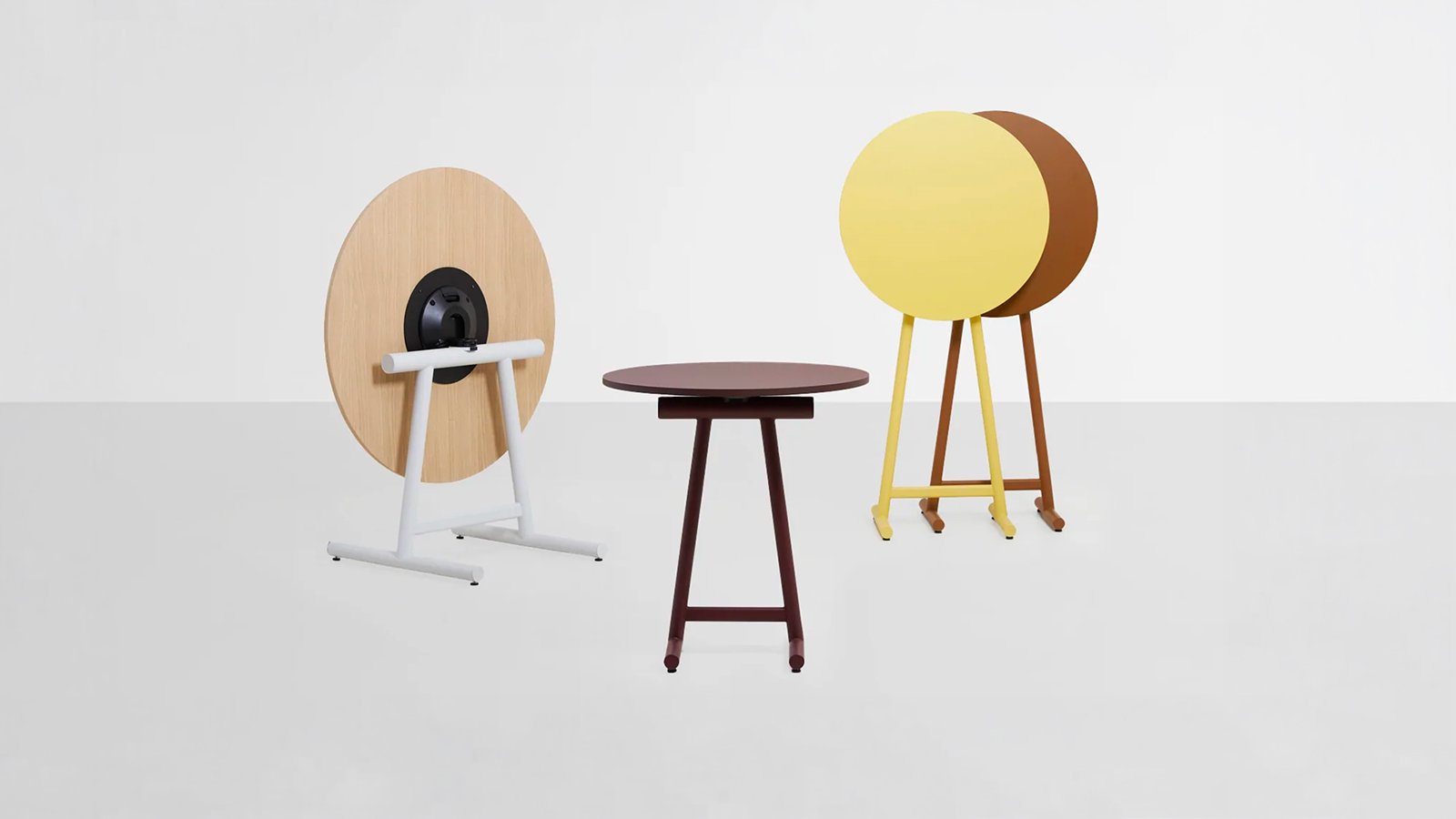
Not in the pictures. In the photographs and the side drawings of the sheet, the closed table stays upright on its own base, top vertical. In the group photograph two closed rounds even stand one behind the other with their bases overlapping. A closed table can therefore wait in the middle of a room as well as against a wall, which helps on floors with glass partitions and little solid wall.
By the frame. The Lapalma sheet asks to hold the product by its structure when lifting or moving it. If the tables change place often, castors are an option on every variant, alone or together with integrated power. Our advice is to brief the housekeeping team on this one rule, together with the cleaning notes on the same sheet.
The word itself: kiso is Japanese for base or foundation, and Lapalma uses it to name the principle of the project. That foundation is the metal tube, the structural core shared by the half-moon, the round and the high rectangular. Because all three start from the same element, they can be mixed in one room and still look like one family rather than three purchases.
A meeting room that hosts a seated review at ten and a workshop at four needs furniture that changes with it. Five moves to run that day with the three KISO variants.
For the morning, open the KISO half-moons and large rounds: both work at 74 cm, the height of a chair. In our view the round suits a smaller group. Set them out before people arrive, so the meeting starts on time.
The high rectangular, at 105 cm, is the surface we use for short check-ins on foot: a plan on the top, people around it, no chairs to move. In a room that switches pace after lunch, one or two of these are enough to change the tempo of the afternoon.
When the room needs open space, the top of each table rotates from horizontal to vertical with one movement. Closed, the tables are taller than when open: 120 cm for the half-moon, 124 for the round, 145 for the high rectangular. Keep that in mind when choosing the spot where they wait.
Closed tables nest one into another: in the Lapalma photograph two rounds stand in a row with their bases overlapping. Line them up along one wall or in a corner, so that the floor stays free for a workshop, a presentation or a team lunch.
At the end of the day, unplug anything connected to the integrated socket or USB ports before moving a table. Move it by the frame, as the sheet asks, or on castors if they were specified. Leave the room in the layout of the first meeting the next morning.