Let's discuss your project
Trade terms for professionals and design studios
Let's discuss your project
Trade terms for professionals and design studios
Around a top of 110 cm, every chair is the same distance from the centre, and that is the whole point of the round P124 in the FORK family: a meeting table for quick reviews and client discussions with no far end to run things from. Underneath, a single four-way joint in die-cast recycled aluminium gathers four legs of drawn aluminium tube, elliptical in section, and a fixing plate holds the top. Shortlisted alongside longer meeting and conference tables, it earns its place with one base at the middle, so chairs can be drawn in from any side.
The same base serves the 90 cm version of the P124, and in both sizes the top is 20 mm thick, with a bevelled edge lacquered in the colour of the surface. Finishes go from bleached oak and dark walnut oak to black open-pore wood, white lacquer and black or white Fenix; the legs are powder-coated or veneered in wood. FORK carries the name of Tomoya Tabuchi and the date 2016.
Around the P124 sit the smaller P120 rounds of 60 to 80 cm, the taller P121 and P125 that bring a top to 110 cm, the P127 and P128 conference tables from 160 to 240 cm, oval or rectangular, and outdoor EP models for balconies and courtyards. We see the round one in small conference rooms and in the cabin of a director who meets people at a table, not across a desk. La Mercanti draws the circle on the client's plan with the chairs already pulled out around it.

Share the finishes you wish to evaluate
FORK was designed by Tomoya Tabuchi, a Japanese designer, and Lapalma dates the family to 2016. For an architect preparing a specification or a tender document, the name and the year identify the collection precisely. The 2D and 3D files of every variant are available for designers, along with a library for pCon.planner, so the table can go into the layout at its real size.
Lapalma's instruction is plain: hold it by the structure, never by the top, whether you are lifting it or moving it a short distance. Set it down so it rests evenly on all its legs, and avoid loading it unevenly. The sheet also notes that the company is not responsible for damage to delicate floors, so on marble or a soft wooden floor we would lift it rather than slide it.
Indoors the family has tops in two shapes for the meeting tables, oval or rectangular on the P127 and P128, and circular tops on the P120, P121, P124 and P125. Outdoors the EP series is made in round or square versions only. A project can therefore keep the boardroom in oval or rectangle and use rounds and squares on the terrace, with the same family look.
Lapalma refers to the tree as it is seen in Japanese culture: a symbol of a person living in harmony with nature, rooted in the earth and open to the gifts of the sky. The legs are described as inspired by branches, and the brand speaks of a meeting between Italian craftsmanship and Japanese minimalism. For a client, it is a story that can be told in one line when the table is presented.
Six: bleached oak, dark walnut oak, black open-pore wood, white lacquered wood, black Fenix and white Fenix. The oak tops are built on birch plywood, the lacquered and Fenix tops on MDF, and the edge is always lacquered in the colour of the top. Thickness is 16 mm on the P120 and P121 and 20 mm on all the others, which is worth noting in a bill of quantities.
Both conference models, P127 and P128, are offered in four sizes with either outline. Five steps to decide between curved ends and square corners, from the sizes to the base and the floor plan.
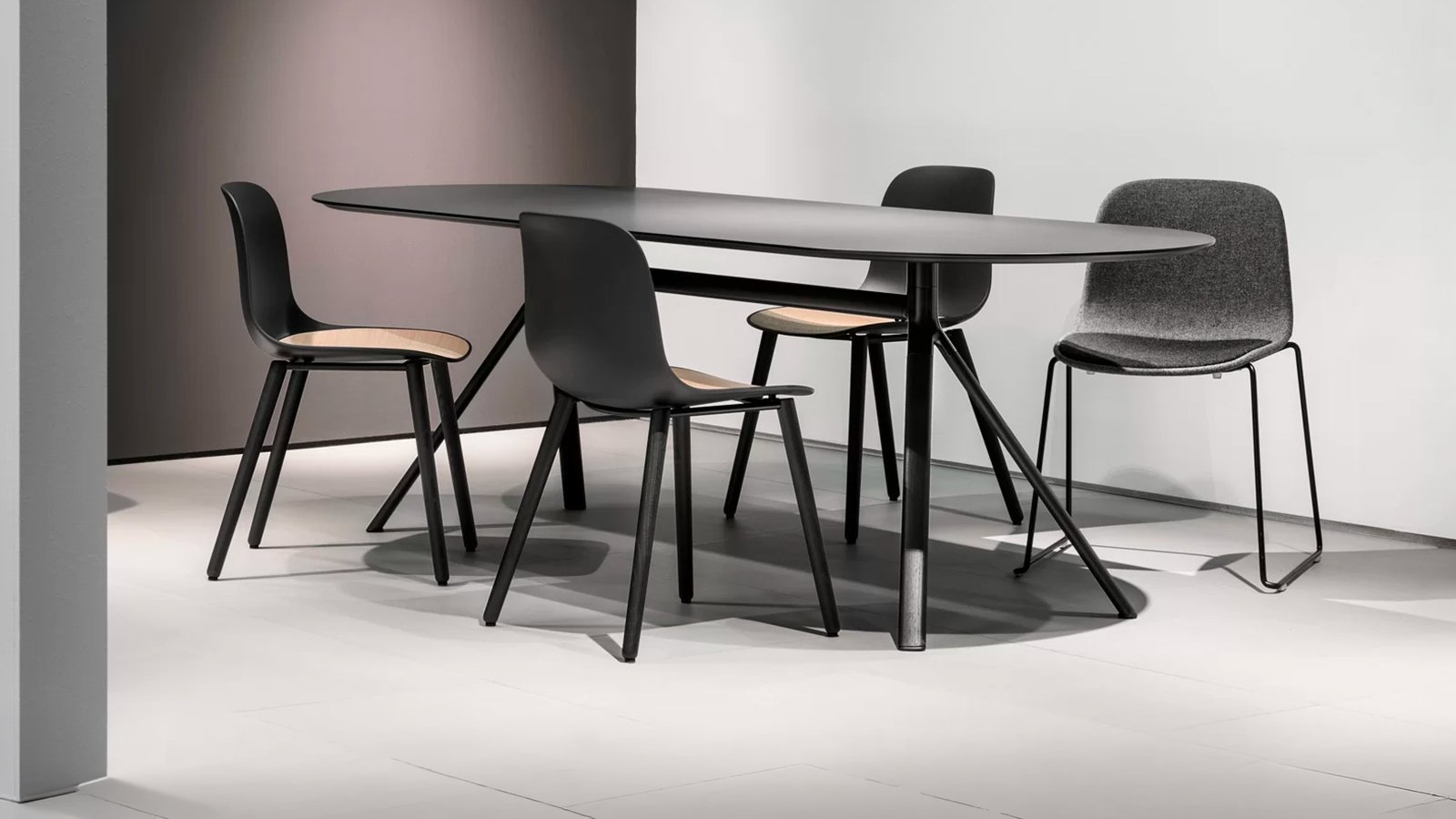
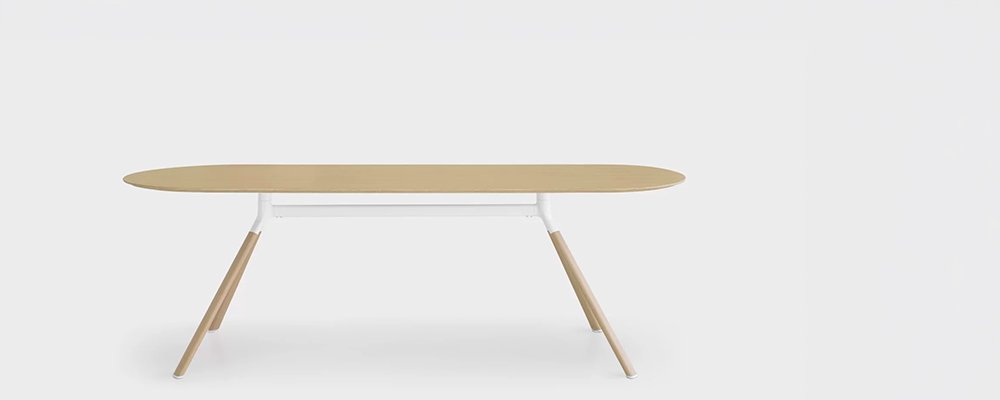
The FORK P127 is made in 160 × 80 and 180 × 90 cm, the P128 in 200 × 90 and 240 × 90 cm, all 74 cm high. Each size comes as an oval, a long shape with straight sides and half-round ends as the drawing shows, or as a rectangle. The choice of outline does not change the size you order.
In our reading the oval suits rooms where people walk behind the chairs: the half-round ends leave no corner at hip height and make it easier to get past the head of the table, which helps in a narrow room or where the door opens close to one end.
The rectangle, in our view, gives a clear place at the head for whoever leads the meeting, and its straight ends can be pushed against a wall or against a second table. It is the shape we would suggest when the room may later be joined to the one next door.
Both shapes use the same base: two three-way joints in die-cast recycled aluminium with an extruded aluminium bar between them. In Lapalma's drawing the bases stand 140 cm apart on the P127 and 180 cm apart on the P128, so the long sides stay clear between them.
Every variant has 2D and 3D drawings for designers, plus a pCon.planner library. Placing the oval and the rectangle on the same plan, with chairs drawn in, shows quickly which one leaves the room easier to use.