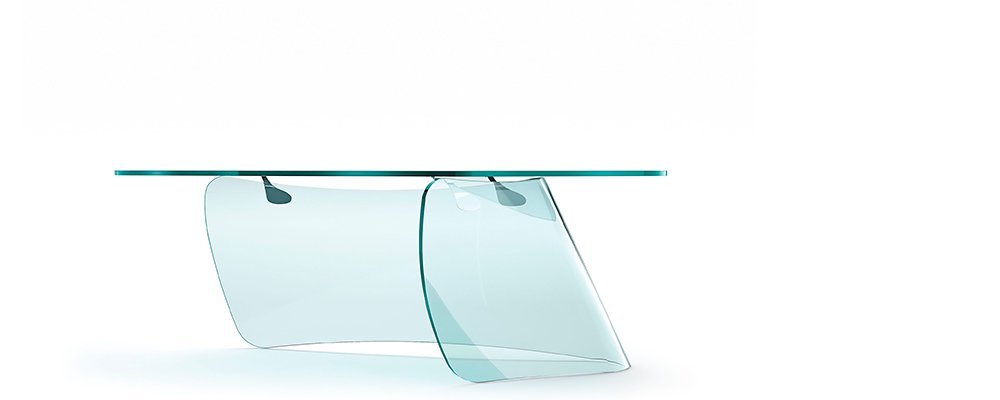
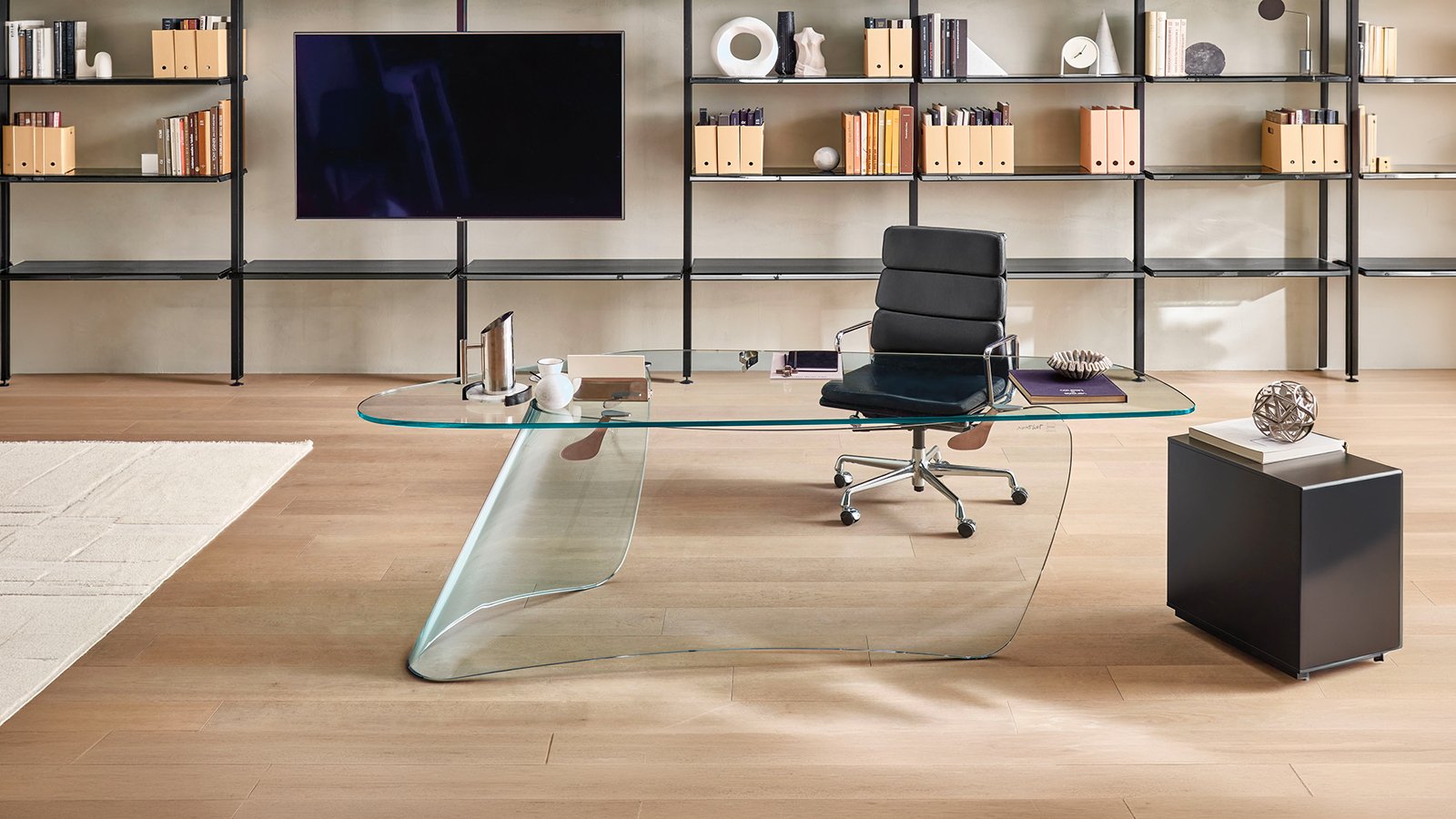
Office with light wood flooring and a black wall unit, Graph by Fiam in three-quarter view

Tempered is said of one part only: the 15 mm glass top of Graph by Fiam

Fiam
Executive desk only
Graph An icon of Italian design Executive desk only
₹ 8,58,000

What did you have in mind?

Trade terms for professionals and design studios

Read Fiam's technical sheet for Graph line by line and the word tempered turns up once, attached to one part: the top. It is transparent glass, 15 mm, tempered: the sheet that holds files, laptop and phone all day. The base is described in other words, as curved glass of 19 mm, and the two descriptions should never be merged in a purchase order or a tender document. Xavier Lust designed the desk, and Graph earns its place in any comparison of signed designer office tables for a director's cabin.

What the top rests on is glass as well. Fiam's drawings show the curved base as a band of glass turned back on itself, and stainless steel connecting plates join it to the top, visible straight through the sheet. Anyone comparing office tables in glass should ask what the working surface will carry: Fiam declares 100 kg on the top. The outline is a free form with rounded corners, broader at one end, so the working side all but chooses itself.

Two sizes: 250 × 91 cm for a large cabin and 220 × 80 for a compact one, both 74 cm high, with a choice of Standard or Extralight. Our place for Graph is with a managing director or a senior partner who keeps the desk for work and holds meetings at another table; in our view the top deserves more thought than the size. With every client, La Mercanti begins by listing what will rest on that glass on an ordinary working day.

Technical information based on data declared by the manufacturer.
  • Name: Graph
  • Manufacturer: Fiam
  • Design: Xavier Lust
  • Type: glass desk
  • Dimensions (L × D × H): 220 × 80 × 74 cm · 250 × 91 × 74 cm
  • Base: curved glass of 19 mm
  • Top: 15 mm transparent glass, tempered
  • Top-to-base connection: stainless steel connecting plates
  • Glass: Standard or Extralight
  • Top load capacity: 100 kg
  • Weight as stated by Fiam: 125 kg (220 cm) · 141 kg (250 cm)
  • Model: registered
La Mercanti Srl — trusted supplier for design and contract projects since 1997.
San Benedetto del Tronto (AP), Italy · +39 0735 753833 · info@lamercanti.com
Supply, quotations, specifications and project support across India and worldwide.

Share the finishes you wish to evaluate

₹ 30,000

Amount adjusted against your first order

FAQ

Where does the base actually meet the floor?

Directly. The pictures Fiam publishes show the curved glass of the base coming all the way down and resting straight on the floor, so the meeting of glass and flooring is part of what a visitor sees. That is why we suggest a finished, uncluttered floor around it: in the room shot a pale rug lies beside the base rather than under it, and the glass stands on the wooden boards themselves.

Before Graph comes up to the office, what should be checked?

The route and the floor. Fiam gives the weight as 125 kg for the 220 cm desk and 141 kg for the 250 cm one. Our advice is to walk the way in beforehand, from the building entrance through the lift, the corridors and the last door, and to note what the floor will be where the desk stands, stone, timber or tile. A five-minute check at this stage saves a difficult afternoon later.

Does the glass run past the base at the two ends?

Yes. Fiam's side drawing shows the top overhanging the base at both ends; no figure is given for how far, so we quote none. In use, whoever draws up a chair at either end meets glass rather than the base, with clear space beneath it. For a cabin where a visitor sits at the side, it is a detail worth checking on the drawing before the position is fixed.

What does someone standing over the desk see through it?

The whole base. In Fiam's overhead photograph the curved glass reads whole through the top, together with the steel plates that join the two and the floor beneath. From a mezzanine, or simply for someone standing at the desk, the base becomes the pattern on the surface. We would keep papers and devices away from its tightest curve, where the view through is at its best.

Which size suits a cabin better, 220 or 250?

It depends on the floor in front of the desk more than on the wall behind it. Fiam makes Graph 220 cm long and 80 deep, or 250 long and 91 deep, both 74 cm high, so the longer one is also 11 cm deeper. Our advice is to measure the clear passage between the front edge and the door, and to remember that 30 cm of extra length needs a room that can hold it comfortably.

Working at Graph every day, starting from where the laptop goes

Graph gives you a glass surface with a stated load and an outline with a broad end and a slim one. Five steps to set it up for daily work, beginning with the laptop.

Settle the laptop first

On Graph the top is a free form with rounded corners, broader at one end than at the other. Put the laptop on the broad end: in our reading of the shape that is the working side, with room for papers either side of the screen, and it leaves the slim end clear for whoever sits across.

Keep the load in proportion

Fiam declares 100 kg on the top. A monitor, a lamp, the laptop and a day's files sit well within that figure. It matters when something heavy is meant to stay for good, a stone object or a row of archive boxes; such things are better placed on a cabinet beside the desk, leaving the 15 mm tempered sheet for work.

Plan the cable drop

Under a clear top every lead stays visible, all the way to the floor. Decide where the floor socket will be before the desk is placed, and on which side the laptop cable comes down; a short, direct drop close to the base reads far better than a loop crossing the open floor.

Leave air between objects

On a glass top, whatever is left lying around is seen from below as well, by anyone in the room. Our advice is to keep only what the day needs: a lamp, the laptop, one folder, a pen holder like the steel one in Fiam's photograph. Everything else belongs in a cabinet elsewhere in the room.

Give the slim end a use

The slim end of the top is where, in our reading, a visitor draws up a chair. Keep it free of the working kit: a document to discuss, a notepad, nothing that has to be cleared away when someone sits down. It is the stretch of the desk your guests will see from closest.