Let's discuss your project
Trade terms for professionals and design studios
Let's discuss your project
Trade terms for professionals and design studios
Design by Vaghi R&D is the whole credit on Assia EV. There is no studio behind the chair: it was drawn by the research and development office inside the factory at Bovisio Masciago, in Brianza, the house born in 1964 as the Vaghi brothers' upholstery workshop. The people who drew it are the people who make it, and that is where these ergonomic chairs for workstations begin, before any adjustment is listed.
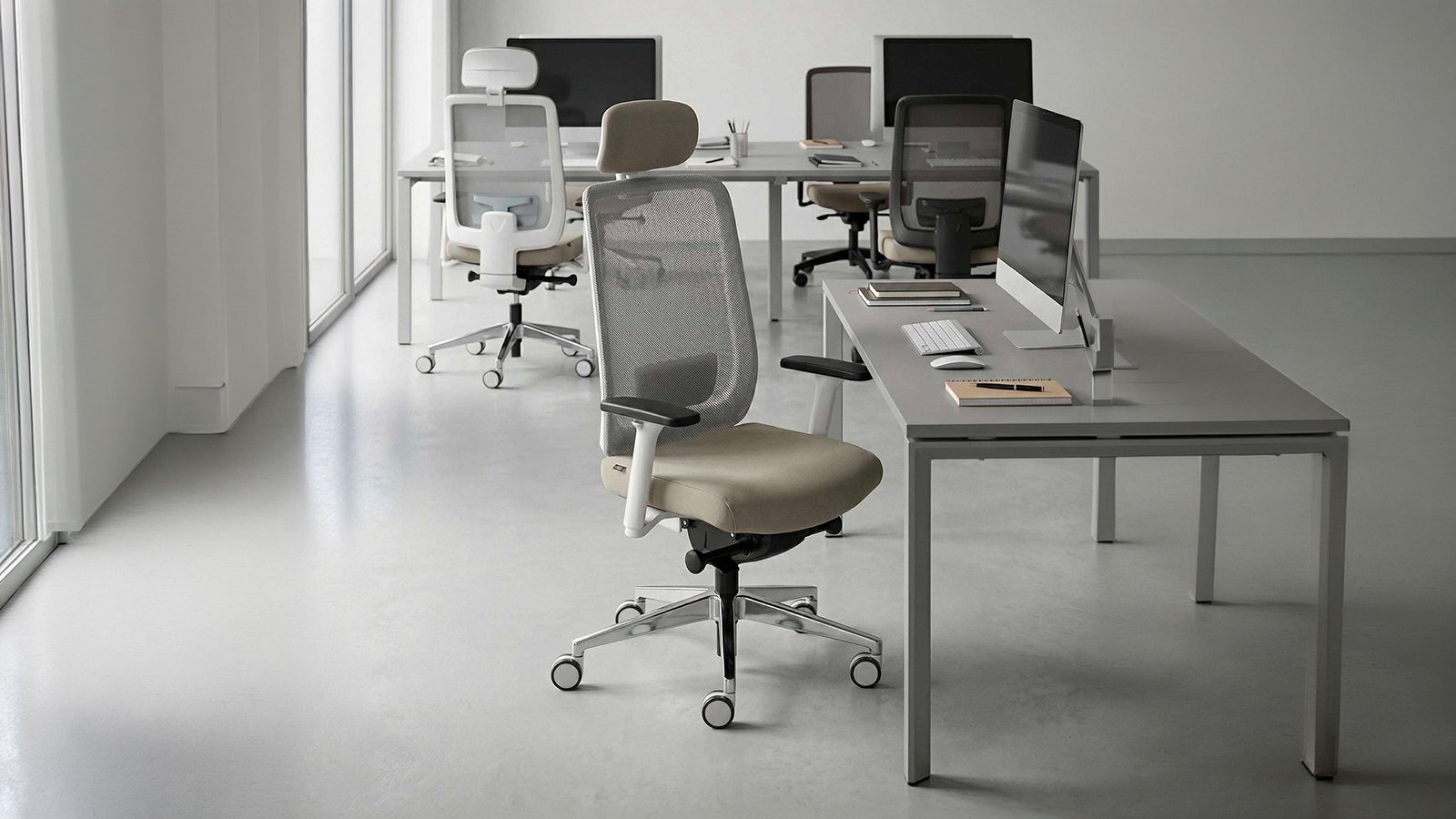
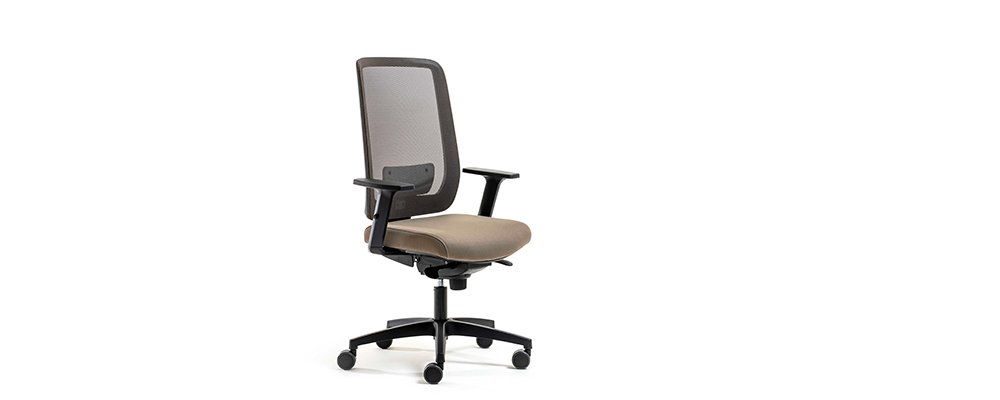
What that office drew: a mesh backrest of medium height, adjustable in height and reclining, a grey polypropylene lumbar support that slides in height and carries a position indicator, a padded seat that swivels and rises. The mechanism comes either weight-activated or with a tension adjustment, and the anti-return safety is part of each. Armrests adjust in height, the headrest in height and tilt. In the Vaghi photographs three black chairs with sand-coloured seats stand at light oak island desks, open-plan workstation rows behind screen-printed glass.
Listed by gross weight, heaviest first: the armchair that carries headrest and armrests at 21 kg, the armchair with armrests at 18.5 kg, the chair without armrests at 17.5 kg, each offered in a white or a black series with the same name on the design line. La Mercanti tells the facility team who drew the chair before telling them what it does, because a manufacturer's own design office stays on the drawing after the launch.

Share the finishes you wish to evaluate
The R1 mesh. Vaghi's line reads that Assia EV is approved in class 1 IM with the R1 mesh, the flame-retardant weave in Trevira CS offered in five colours; it is an Italian ministerial approval that follows the mesh, not the chair alone, so it is quoted with the mesh code beside the model. The seat carries the class of whatever fabric is chosen for it, and several in the Vaghi programme are class 1 IM fabrics themselves. A specification that needs the approval names the R1 for the back and picks a class 1 IM covering for the seat.
Two. The plastics of the white series are RAL 9003, those of the black series RAL 9017, and the same two shades cover the polyamide base, the painted aluminium base and the headrest structure, so a white chair is white from the castors to the top. Polished aluminium is the third base finish and belongs to neither shade. The lumbar support is the one part outside the pair: grey, RAL 7047, on both series. A buyer matching chairs to an existing floor has two codes to quote, not a colour name.
Seven. The standard mesh of Assia EV, category RE, is a technical weave in 100 % polyester, 430 g per metre, rated at 100,000 Martindale cycles, and Vaghi offers it in black, lead grey, antique bronze, light grey, blue, red and green. It is the mesh fitted when nothing else is specified, and the only one of the three without a flame-retardant declaration; R1 and RS are the ones to name when a fire class is required. The colour is written as the last part of the mesh code, after the 13RE, one code per chair.
Vaghi gives the footprint of every Assia EV build as 680 × 680 mm, the circle of the five-star base; on the dimensioned table the seat with armrests measures 490 mm across the front and the backrest 435 mm. Two different measurements with two different labels: the first is the base on the floor, the second the width of the seat and of the back above it. The same 680 × 680 is printed for the armchair with headrest, the armchair with armrests and the chair without, so the footprint does not change with the build chosen.
Vaghi declares both coated coverings free of phthalates. Guatemala, category A, is 88 % PVC, 8 % polyester and 4 % cotton at 910 g, class 1 under UNI 9175, rated 100,000 cycles; Rio, category B, adds 1 % PU to a similar build at 938 g and carries class 1 IM plus EN 1021, also 100,000 cycles. The phthalate line is the one to quote where a specification asks for it, and it is printed by the manufacturer, not inferred. Both are seat coverings only: the back stays in one of the three meshes.
Weight-activated or tension-adjusted synchro, the T option with seat depth, anti-return safety, a lumbar support in height or in height and depth, its optional padding: how the Assia EV equipment is put together.
Assia EV moves on one of two synchronised mechanisms. The weight-activated one, in Vaghi's words, adapts automatically to the weight of the user, with nothing for the sitter to set; the other is the synchro with tension adjustment, where the resistance of the tilt is set by hand on the person's own weight. Seat and backrest tilt together on both, and both are listed for every build.
Where the seat should slide in depth, the order asks for the T: the synchro mechanism with a device for adjusting the seat in depth, as Vaghi names it, taken in place of the tension-adjusted synchro. It is the one way to move the seat relative to the backrest, since the seat is otherwise adjustable only in height, and it is an option on all three builds.
A safety anti-return system comes with every Assia EV mechanism, listed by Vaghi beside the synchro and the tension adjustment. Its purpose is the release: if the lock is let go while someone is leaning back, the backrest does not snap forward. It is not an option and has no letter in the code; it is part of the mechanism whichever of the two synchros is chosen, with or without the T.
Standard is a grey polypropylene lumbar support that moves up and down the mesh and carries a position indicator, so the height it was set to can be read and set again. Ordered as the 2D version, in the series written for it, the support adjusts in depth as well, pressing more or less into the back. The grey stays the same in both; nothing beyond the support changes with the choice.
The bar can be fitted with an optional padding, code E LR 1 D in the Vaghi programme: a cover in flame-retardant fabric, grey, that sits over the polypropylene and adjusts in height with it. It is ordered as its own line after the chair code, together with the mesh code and the seat category, and it is listed for the height-adjustable lumbar support, the standard one, as the option it belongs to.