Prefer a tailored configuration?
Trade terms for professionals and design studios
Prefer a tailored configuration?
Trade terms for professionals and design studios
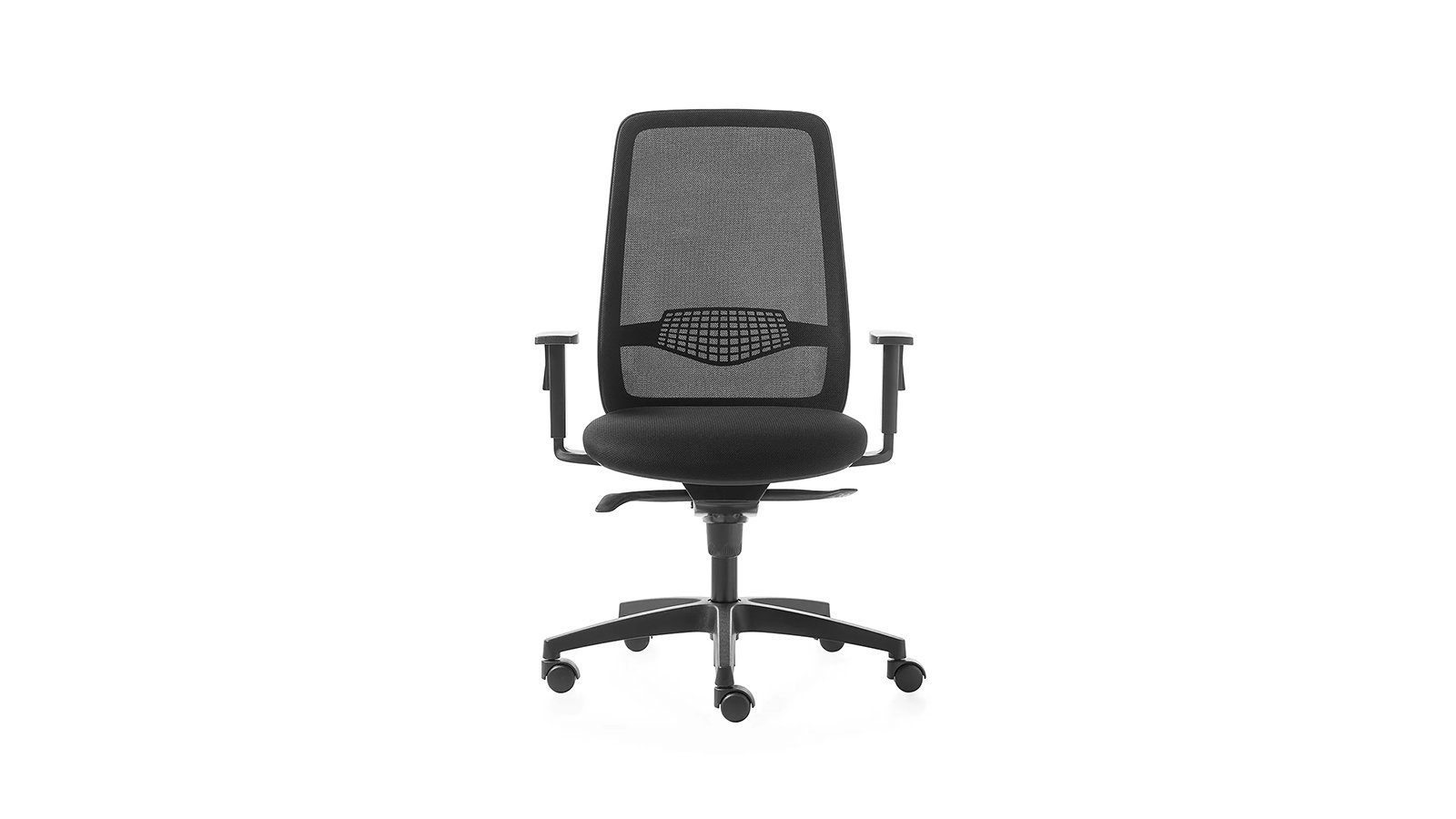
Pack a mixed delivery of Key Go chairs and the boxes will not all weigh the same. A KYG125 or a KYG225 goes out at 16 kg per carton; a KYG128 at 17 kg. Kastel gives the two figures without comment, and the codes sit side by side on the price list: the one that weighs more is also the one with 2D adjustable, extendable soft-touch arms and a mechanism whose seat slides forward and back for depth.
Kastel groups it with ergonomic office chairs because of what it lets the user change: seat height goes from 42 to 51 cm on gas, a synchro movement of seat and back comes with a load-intensity regulator, one control locks or frees the rocking, and the lumbar support moves in height. The back frame is reinforced polypropylene clad in a 3D polyester mesh, described by Kastel as fire-retardant; the seat is rigid polypropylene under non-deforming polyurethane foam. Height runs 100 to 109 cm and the footprint is 68 × 57 cm, figures that matter when desks are laid out in an open-plan workstation area.
By code, then. KYG125: black mesh, adjustable 1D arms in nylon, castors that brake on their own and carry no rubber. KYG225: the same chair in light grey. KYG128, black only, takes the 2D arms, the depth-adjusting seat and rubberised castors without brakes. Kastel also lists as an accessory a Jet fabric seat cover that can be removed, plus a single rubberised castor that brakes, code 040080. Away from the workstations we place Key Go in meeting rooms, or keep one at a desk for visitors from another team. La Mercanti totals the boxes and their weight for the whole delivery.

Share the finishes you wish to evaluate
Castors that brake by themselves and have no rubber tread, mounted on the black reinforced nylon base. The black and the light grey version with 1D arms share this castor as standard, so they behave the same on the floor.
Reinforced nylon, which Kastel also describes as reinforced polypropylene. The 3D polyester mesh is fitted over this frame, and the structure is the same on all three codes, whether the mesh is black or light grey.
Yes, in height. The lumbar support is built into the mesh back and can be raised or lowered to meet the user. It is part of every Key Go, so there is nothing extra to order for it.
Yes. Kastel offers a removable seat cover as an accessory, in four Jet variants, 30J to 33J, all in fabric category C. It goes over the padded seat and is ordered as a separate line, beside the code of the chair.
EN 1335-1:2020, type B. Kastel lists the standard among the references on the Key Go data sheet and on the product page, next to the D.Lgs. 81/08 reference, for all three codes of the chair.
Five steps for placing Key Go on a floor plan: footprint, seat range, overall height, colour by zone and where the KYG128 earns its place.
Start by marking each chair at 68 × 57 cm, width by depth. All three codes take the same area, so one block can be repeated across the plan without redrawing it for each version.
The seat travels from 42 to 51 cm on its gas lift. That range is the same on every code, so the desks drawn on the plan can be read against a single pair of figures for the whole floor.
Whatever the seat setting, Key Go measures 100 to 109 cm overall. Both figures go into the section drawings, next to the 68 × 57 cm footprint already marked on the plan.
The same chair comes in black or in light grey mesh. On a large floor, the two colours can mark different teams or areas while the model stays the same.
Where users need to set seat depth as well, plan the version whose seat moves forward and back. Mark those desks on the plan so the count of each version is clear before ordering.