Prefer a tailored configuration?
Trade terms for professionals and design studios
Prefer a tailored configuration?
Trade terms for professionals and design studios
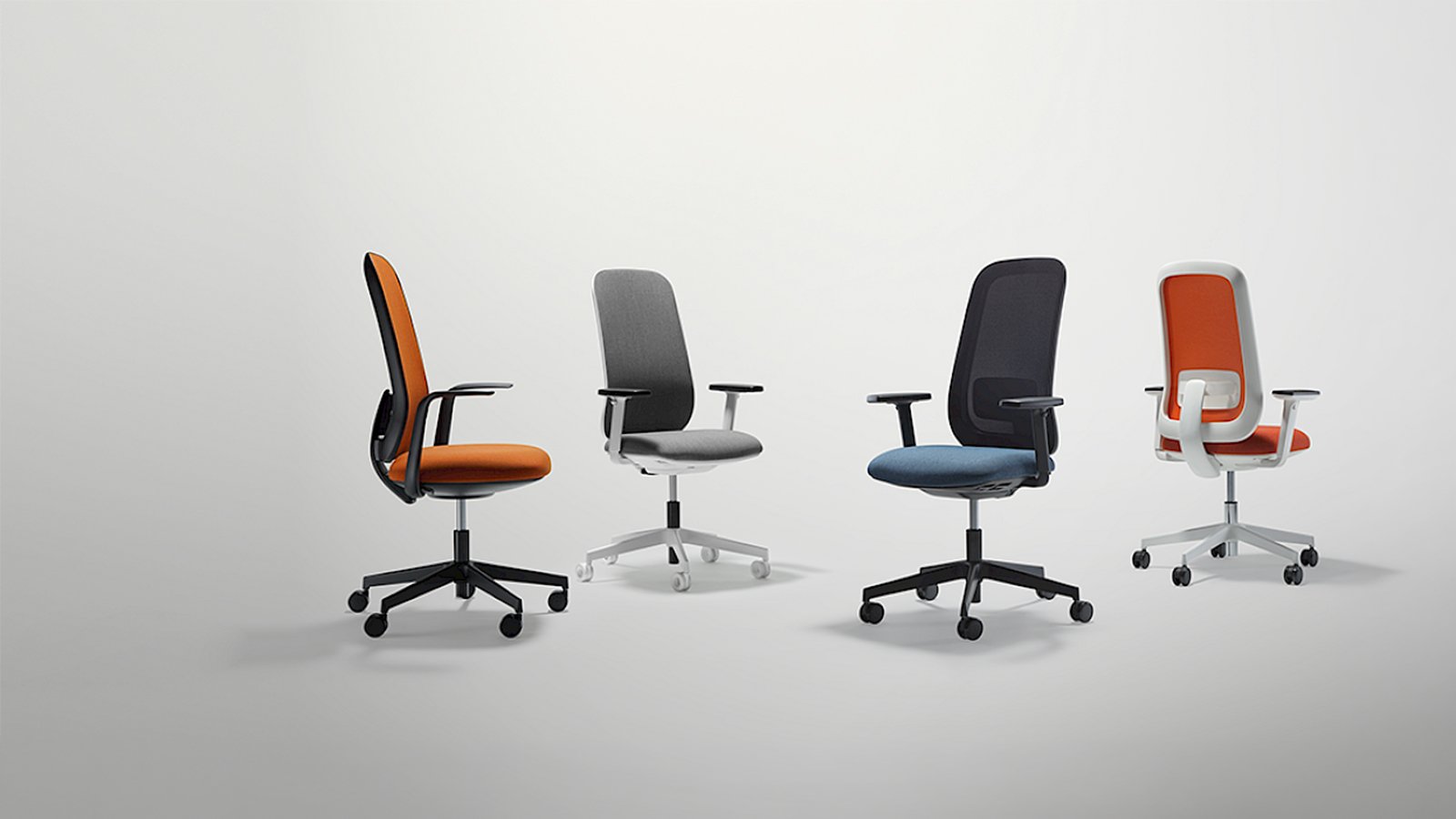
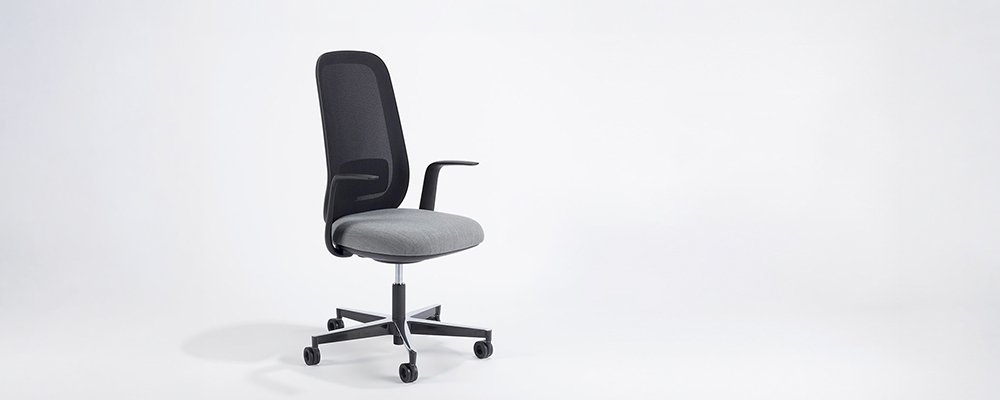
Many working days now begin in a spare room or a corner of the living room. Sitland had that in mind when it presented Skate as a chair for the office and equally for the corner of the home where one works or studies, citing two reasons: it is simple to use, and its minimal lines do not turn a domestic room into a back office. A mesh back in black or white, or a fabric back chosen from the collection, lets the same chair look at home next to a bookshelf or a dining table pressed into service as a desk.
What makes it an ergonomic office chair is hidden in plain sight. A press anywhere on the disc under the seat sets the height, a Sitland patent; the lumbar support moves 105 mm while you remain seated. The Active version rocks on DAT®, a patented mechanism with no tilt levers, and the Synchro version slides its seat forward and back and locks its synchronised recline in four positions. Its three designers drew it for Sitland in 2020.
Read the range by room. At home the choice comes down to a white or black frame, a mesh back and arms that match the desk, or none at all. In the office the order adds base, castors and arm type: three Active types, three Synchro types. Because Sitland names the Active for group work and co-working, open-plan workstations can share the model used at home. On the floor plan that goes with the quotation, La Mercanti marks which desks receive a Synchro.
Share the finishes you wish to evaluate
Econa is the name Sitland gives to the products it designs around a lower environmental impact. Skate carries the Econa mark on every page of the price list, and its data sheet reports 21 % recycled material and 71 % of suppliers located within 50 km.
Because it needs no setting for its movement. Sitland describes the Active mechanism as adapting to the user’s weight without levers, which makes it suited to collaborative workspaces and co-working, where a different person may sit in the same chair each day.
Yes. Both versions come with a black or a white structure. On the white one, the polyamide back frame, the arm supports and the nylon base are white, while the tops of the armrests remain black.
A polypropylene inner part with high strength and elasticity, padded with cold-foamed flexible polyurethane that does not lose its shape. The foam is fire-retardant to the Italian class 1IM.
Not always to the shade. Sitland states that tone can vary between production batches within a tolerance of ±5 %, which it considers normal; ordering a fleet’s covers together keeps them from the same batch.
The Synchro version of Skate has five adjustments, listed by Sitland as height, seat depth, mechanism lock, lumbar support and armrests.
Press anywhere on the disc beneath the seat: the height adjustment works from any side, a Sitland patent. On the Synchro the seat moves between 385 and 515 mm.
The Synchro seat is depth-adjustable, from 445 to 520 mm overall depth. It is the adjustment that sets this version apart, as the Active seat does not slide.
The self-weighing synchronised mechanism can be locked in four positions, and its anti-shock system is part of the same lock. Leaving it unlocked lets seat and back move together.
The lumbar support adjusts in height and is moved while seated, over a travel of 105 mm. It sits behind the mesh or fabric of the back and works the same way on both versions of the chair.
1D arms change height only; 2D arms also change width, 460 to 520 mm apart; 4D arms pivot left and right and slide in depth. Their soft TPU top sits 170 to 240 mm above the seat.