Let's discuss your project
Trade terms for professionals and design studios
Let's discuss your project
Trade terms for professionals and design studios
A chair that can be taken apart is a chair that can be kept. Sitland prints two lines for Skipper, 100 % repairable and 100 % disassemblable, beside 50 % recycled materials going in and 78 % recyclable coming out. For a facility head in Pune with a floor of ergonomic workstation chairs, the first line matters in year three, when a part, not the chair, needs attention.
The chair itself is Sitland's first coloured task chair, developed at the Sitland research and development centre: backrest frame, base, 4D armrests and headrest structure in five colours, mesh matched to them. That backrest is always mesh, with a lumbar support adjustable in height; the seat is fabric or mesh; the three mechanisms work from one set of dimensions.
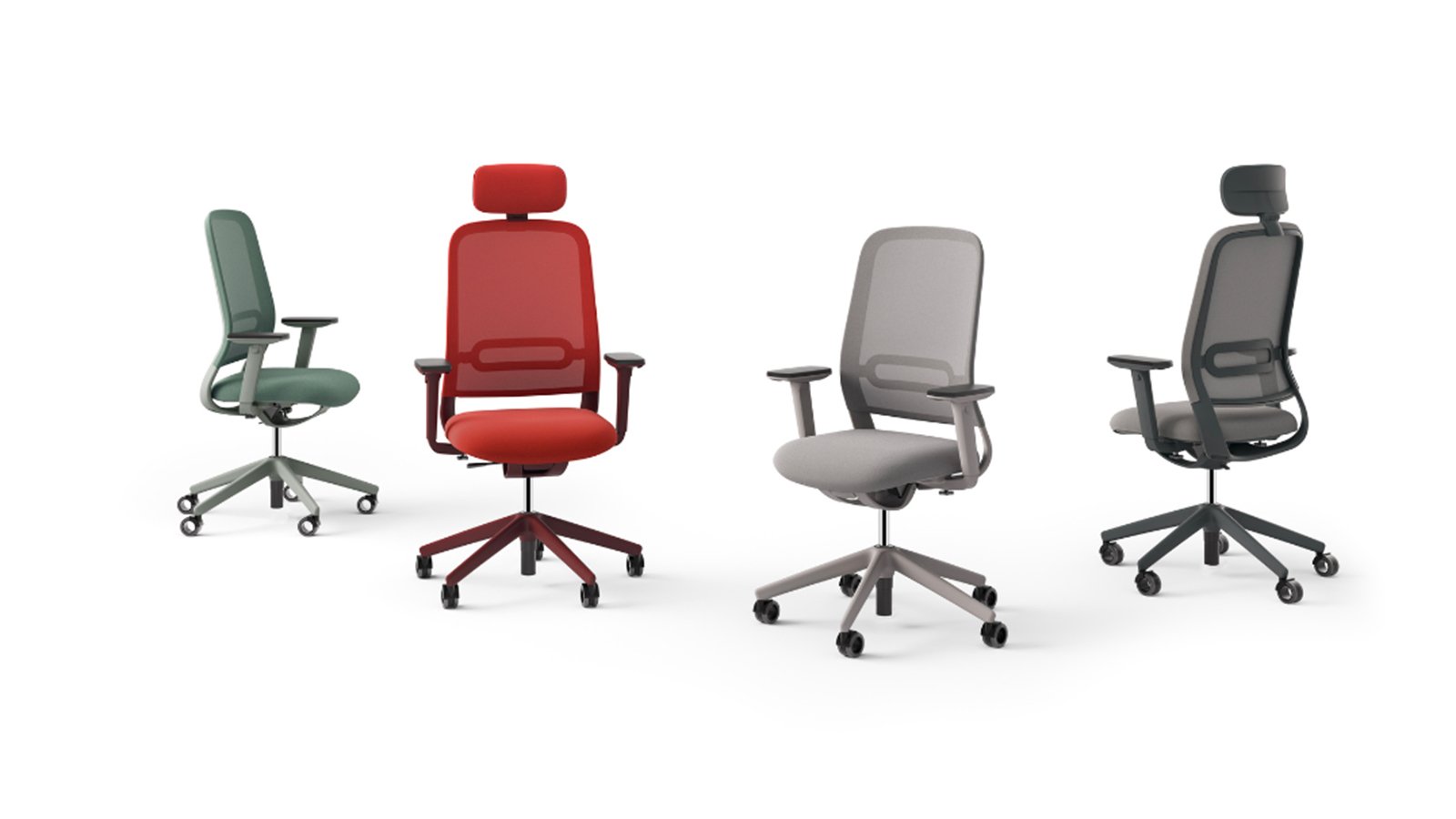
Ordered by colour, there are five Skippers. Black is the classic; in the Sitland pictures sandstone carries light grey mesh, lichen runs green-grey through frame and seat, brownish red sits at a four-seat bench, and anthracite carries night-blue mesh. Each takes any mechanism, a fabric or mesh seat, 2D black or 4D colour-matched armrests, and the optional headrest. The same pictures gather six around a meeting table, so a Skipper can also sit among chairs for meeting rooms as the same model. La Mercanti puts Sitland's repairability declaration into the offer for the facility team, so a chair that can be repaired actually gets repaired.

Share the finishes you wish to evaluate
On Skipper the colour lives on the structure, and Sitland's finish table lists four places where it lands: the backrest frame and lumbar support, the base, the 4D armrests and the headrest structure, each available in black, sandstone, lichen green/grey, brownish red or anthracite. The mesh of the backrest is then matched to the frame, so a lichen chair reads lichen from the base up. What stays neutral is the 2D armrest, offered in black only, and the seat, which takes whatever fabric or mesh is chosen. One word on the order, the frame colour, settles four components at once.
The sentence is Sitland's, from the Skipper brochure: the seat and backrest adapt to the body, supporting you all day long. Behind it stands declared equipment rather than a slogan: a synchronised mechanism in one of three forms, a mesh backrest with a height-adjustable lumbar support, a seat whose height and depth Sitland publishes as ranges, an optional headrest that adjusts in height and tilts. The product page adds «even during the most demanding days». For an office running long hours it is those ranges, not the adjective, that decide whether the chair fits at six in the evening.
The pictures are explicit: six Skipper chairs in blue mesh on dark frames around a long table in a white open space. Sitland presents Skipper as a task chair, and what the images show is that same chair, with its swivel base on castors and its synchronised mechanism, pulled up to the table. It is a plausible use for a chair built to carry a body through a long session at a desk, and it keeps one model across the floor, which the facility team will thank you for at the first service call. The order does not change: mechanism, frame colour, seat, armrests, headrest, exactly as for the desk.
CAM stands for Criteri Ambientali Minimi, the minimum environmental criteria Italian public bodies apply when they buy furniture. Sitland prints the word beside the Skipper certifications, next to EN 1335-1:2020 type A, as an indication for the Italian market. For a buyer in India it is not a certificate to file; it belongs to Italian public procurement, not to an Indian tender. Read it as a sign that the manufacturer has prepared the chair for tenders at home, and as context for the environmental figures Sitland publishes on the same page. Quote it as Sitland's indication, nothing more.
Two of the fabrics Sitland proposes for the Skipper seat come from the mill Gabriel and are credited to a designer each: Medley by Mette Krebs Petersen, 100 % polyester, and Chili by Inger Mosholt Nielsen, 100 % post-consumer recycled polyester, flame retardant, which the product page notes as meeting sustainability criteria. The credit matters in a market that reads labels: a seat fabric with an author is a line an interior designer can put in a presentation. Both are seat fabrics only, since the backrest is mesh on every Skipper, and the combinations follow the Sitland programme.
A brochure gives Skipper three mechanisms, two seat finishes and a set of ranges. A chair gives you a body in it. Here is what to check, in order, when a Skipper is in the room and you have fifteen minutes.
Start the Skipper test with the two mechanisms side by side. On Syncro the backrest answers your weight as you lean, and the lock holds the working position; on Syncro Plus the brochure adds a micrometric adjustment and five lock positions to choose from. Lean back on each without touching anything first. Whoever notices the difference wants the Plus; whoever does not has saved a decision.
Turn the chair round and find the oval window in the mesh backrest: that is the lumbar support, adjustable in height. Sit, lean back, and move it until the push lands where your lower back curves inward. On a mesh back the support is the one solid point of contact, so a few centimetres make the difference between a chair that props you and one that nags you. Note the position; it is personal.
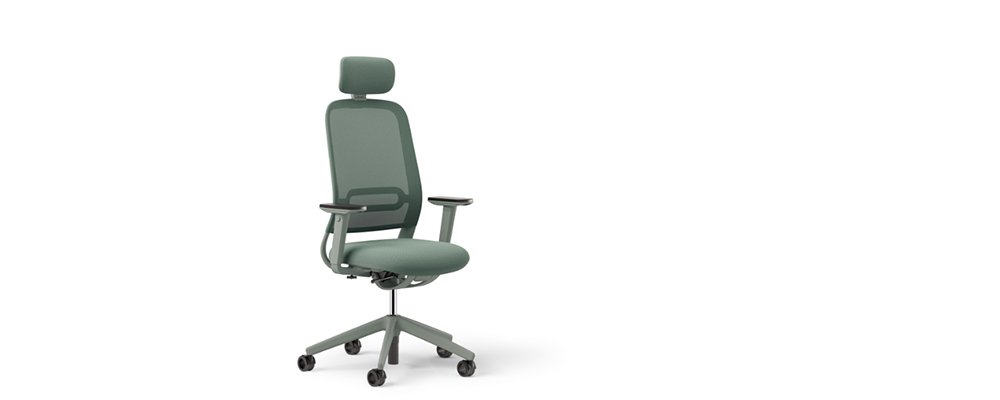
Where the Skipper has a headrest, raise it until the pad meets the nape rather than the back of the skull, then tilt it a few degrees forward. Recline: the head should find it without searching. Try the mesh version and the upholstered one; they adjust the same way, but the upholstered one has a visible seam and a cushion, while the mesh one reads as a continuation of the backrest.
Rest a forearm on the 4D armrest and move it in all four directions: up and down, in and out, forward and back, and rotate the pad. Set the height so the shoulder drops; then slide the pad inward until the elbow is supported. Compare with the 2D armrest, black only, which gives two of those movements. On a colour-matched chair the 4D is the one that carries the frame colour.
Finish with the seat. Sit on a fabric Skipper and then on a mesh one, each for a full minute. Mesh gives one surface from seat to backrest and lets air through; fabric gives a padded platform and a second texture under the mesh back. Neither is better; one is right for the room and the hours spent sitting. The collection for a fabric seat is chosen afterwards, from those Sitland proposes.