
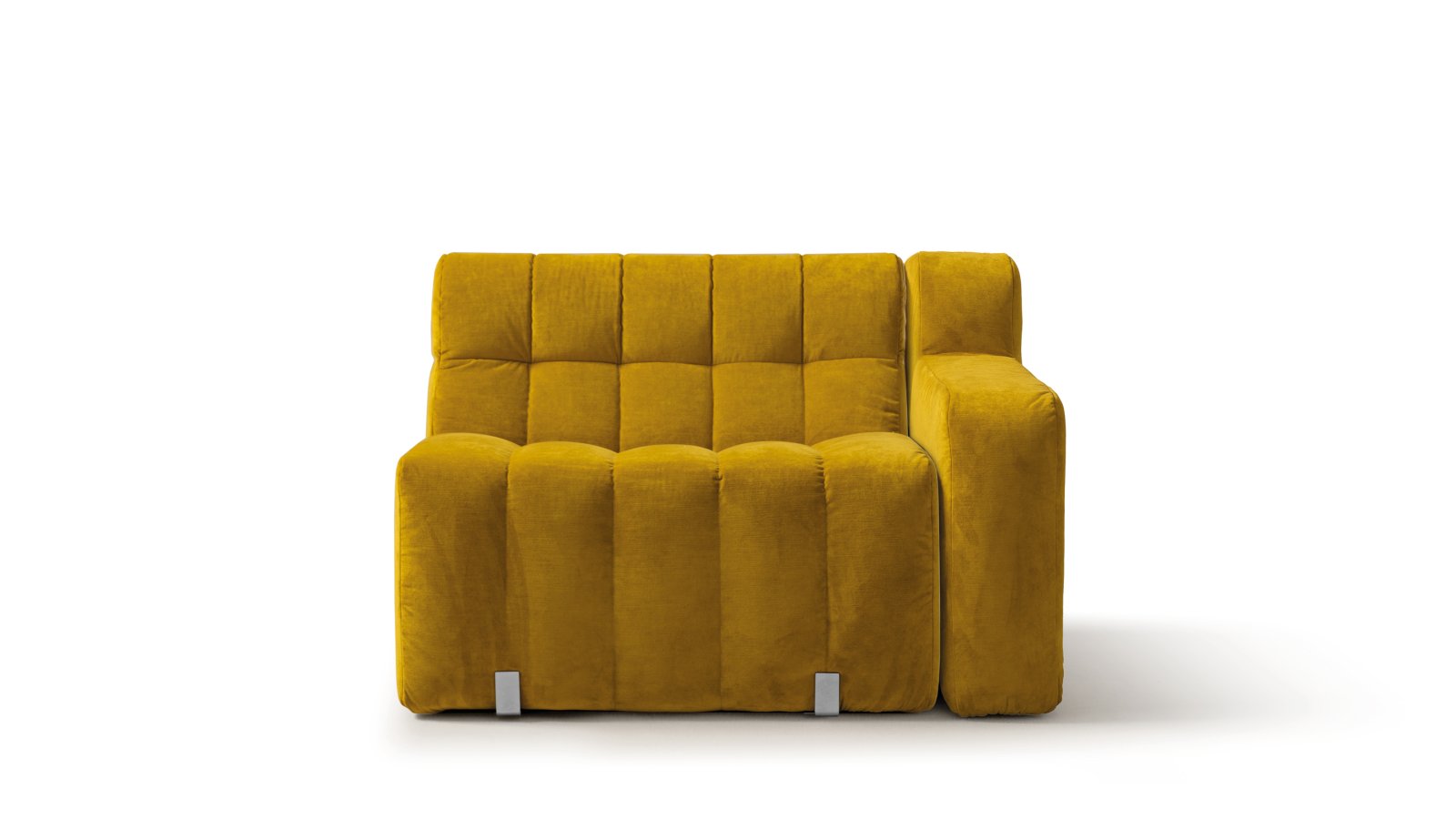
One seat, an armrest on either side: Tokyo by Quinti as a complete armchair for the cabin
Let's discuss your project
Trade terms for professionals and design studios
Take one Tokyo seat and put an armrest on each side of it. That is the whole armchair. Seat and backrest together measure 90 cm across and 100 cm front to back, each armrest adds 20 cm at the same depth, and the three elements are all 73 cm high, the one height the data sheet gives. Quinti photographs two of them on its first page, beside a longer row, and the data sheet names the armrest as the element that completes a composition. The series sits on our page of lounge sofas for offices under the same two codes that build the row.
Design Gualtiero Sacchi. Each of the two elements is cold-foamed polyurethane throughout, foamed at the density the maker considers right for comfort; the sheet lists no internal frame, no wood and no metal under the cover. The rounded vertical sections that give the armchair its soft look belong to seat and arms alike.
From the single piece to the row: add seats between the same two armrests and it is a sofa; the data sheet runs the row to four. Put an armrest between each seat instead and the row becomes separate places for people waiting, next to the chairs for the waiting area; for public rooms the price list carries an IM column. Quinti also describes the modules as easy to carry, dismantle and set up again.
La Mercanti lists the standalone armchair as one seat plus two armrests, so the cabin receives a complete piece.
Collection: Tokyo, Lounge Collection of the Quinti price list
Manufacturer: Quinti Sedute Srl, Cesa (Arezzo), Italy
Design: Gualtiero Sacchi (the price list prints «Gualtiero Sacchi + CG»)
What it is: modular armchair, a modular system of two elements: seat with back and armrest element
Elements: QX090000100 seat with back · QX0900BR000 armrest
Structure and padding: entirely cold-foamed polyurethane of suitable density; broad rounded vertical sections; base on feet
Armrest: closes the composition or is placed between two seats
Seat, dimensions: width 90 cm, depth 100 cm (seat 80 cm), height 73 cm (seat 45 cm)
Armrest, dimensions: width 20 cm, depth 100 cm, height 73 cm
Weights and volumes: seat 30 kg and 0.70 m³; armrest 8 kg and 0.20 m³
Covering categories: 2 · 3 · 5 · 7 · 8 · IM
Coverings available: Ecopelle (cat. 2); Velours, Ecopelle Soul, Jet, One Recicle, Lyra, Chili, Dream (cat. 3); Cocoon, Lana, Glamour, Technicolour, Main Line, Pelle (cat. 5); Pelle Premium Up/Elegance, Monochrome Sett, Bouclet, Velluto Decontracté (cat. 7); Pelle Seta, Zero (cat. 8). Excluded by the price list: Crepè, Laser, Melange, Pelle cat. 6, Horo
Leathers: Pelle cat. 5, bovine; Premium Up/Elegance cat. 7, full grain, 1.2-1.4 mm; Seta cat. 8, full grain, 1.8-2 mm, aniline-tanned; all EN 1021-1/2
Declared tests: 1IM approval; CAM (table «Tests carried out on seating» of the price list)
Safety: Regulation (EU) 2023/988 (GPSR)
Care: fabrics as per the fabric sheet of the colour card; leather with a damp white cloth and water only, test on a hidden area and wait 24 hours
Files available: technical data sheet, STP model, HR images
Guarantee: 6 years from delivery, as declared by Quinti
Documents and Catalogues
Share the finishes you wish to evaluate
FAQ
Which coverings from the Quinti card are ruled out for this series?
Five of them. The materials table in the Quinti price list marks Tokyo as not feasible in Crepè, Laser, Melange and Horo, and in Pelle of category 6; everything else on the card may be ordered. The leather point matters in a tender: Pelle is specified for Tokyo in category 5 only, and the price list has no category 6 column for the series at all. La Mercanti checks the chosen covering against those names before confirming.
Is Tokyo covered by the European product safety regulation?
Yes. The third page of the Quinti data sheet states that all the seating it offers is safe under Regulation (EU) 2023/988, the General Product Safety Regulation known as GPSR. For an Indian buyer that line goes into the file exactly as Quinti writes it, with the regulation number, and nothing is added to it: no other test or norm is declared for Tokyo in the sheet or the price list, so none is claimed on the specification.
Can Tokyo serve a waiting area with separate places?
It can, by the arrangement rather than by a special version. The data sheet assigns the armrest two roles, closing a composition or sitting between one seat and the next; used the second way, the row is divided into places, one seat each, with the armrest as the divider. The price list also opens an IM column for the series, which is the one we point to for public rooms. So the waiting room order is the same seat and the same armrest as the lounge order, counted differently.
What Martindale counts do the Tokyo fabrics reach?
From 30,000 cycles for the Ecopelle of category 2 to 100,000 for One Recicle, Lana and Dream. In between, Quinti’s fabric data gives Cocoon 35,000, Velours 50,000, Lyra and Chili 60,000, Jet, Glamour and Technicolour 80,000. The figure sits on each fabric’s own sheet in the card, next to its composition, and goes into the specification as printed.
What is known about the feet under the Tokyo seat?
Only that they exist. The price list line for the seat ends with the words «base on feet», and neither that line nor the data sheet adds anything: no material, no dimension, no finish. We therefore write «base on feet» and stop there. The heights the documents do give are two: 45 cm to the seat surface and 73 cm overall, shared by seat and armrest.
How to build the technical file for Tokyo by Quinti from the documents we send
La Mercanti sends the Tokyo data sheet, the STP model and the HR images with the proposal. Five steps to put them in one folder with the codes, the coverings allowed and the tests Quinti declares.
Ask for the Tokyo documents
Tell La Mercanti which arrangement you have in mind, for instance one armchair or a row of seats with armrests, and we send the three files that exist for Tokyo: the three-page data sheet, the STP model and the HR images. Naming the arrangement lets us send the images that match it rather than a generic set.
Confirm codes and coverings
In the proposal La Mercanti lists the two codes, QX090000100 for the seat with its back and QX0900BR000 for the armrest, with their measurements, weights and the covering categories allowed for the series, six in all with IM among them. Before confirming, the fabric or leather chosen is checked against one of those categories.
Attach the declared tests
A tender for a public building asks for the tests. For Tokyo Quinti declares the 1IM approval and compliance with CAM, nothing else, and no other standard is claimed. La Mercanti supplies the manufacturer’s documentation to attach, so the file quotes Quinti’s own statement rather than a general one.
Place the STP in the drawing
The STP model is the three-dimensional file an architect imports into the drawing to check the footprint of a seat and an armrest before any confirmation. No 2D or DWG file is declared for Tokyo, so the drawing starts from the STP, kept under the original file name tokyo-stp.zip.
Date and attach the folder
The folder that goes with the tender holds the data sheet, the STP model, the chosen HR images, the proposal with the two codes and the manufacturer’s test documentation. Each document carries the date on which it was received from us, so that anyone checking the file later knows which edition of the Quinti documents it refers to.