What did you have in mind?
Trade terms for professionals and design studios
What did you have in mind?
Trade terms for professionals and design studios
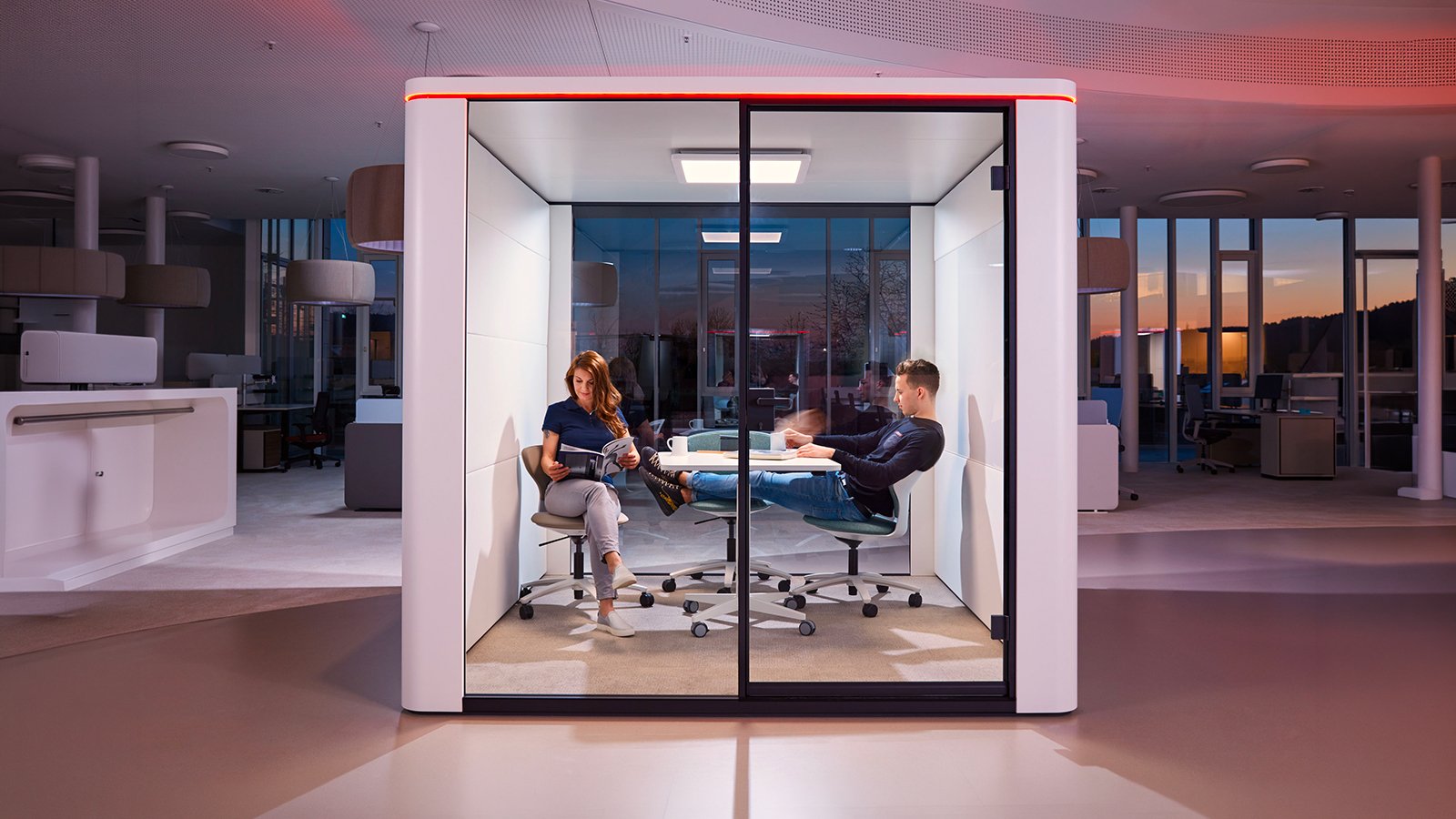
As soundproof office pods go, se:cube by Sedus stands out for one line of the data sheet: its ventilation is independent of the building: fresh air comes in above the ceiling light, fans push stale air out above the wall, and sensors for presence, temperature and CO2 keep it running without anyone touching a switch. se:cube max goes a step further, with no base and no connection to the structure.
What it does need is power and height, both easy to check: a room at least 2.6 m high for se:cube, 2.8 m for se:cube max. Set among the open-plan workstations, it gives back a private room. Under DIN EN ISO 11957 the S declares a reduction of 27 dB D'p,w and the larger system 29 dB(A), though Sedus itself is careful to say that outside noise is much reduced, not removed.
Pick by use. Phone calls, focused work and web conferences: the S, for one person. Sofas and a shared table: the new XM at 2 m², up to two people, in the Diner layout. Focused work and working in pairs: the M, up to four. Video conferences, brainstorming and meetings: the L, up to six. For meetings, workshops or a temporary single cabin, the max S takes up to four; the max M and max L, up to six and eight, can also serve as a temporary two-person cabin. Before proposing a size, La Mercanti checks the power supply and clear height of the actual room.

Share the finishes you wish to evaluate
The se:cube max L measures 4000 × 4000 × 2400 mm, which is 16 m² for up to eight people. Sedus lists it for meetings, workshops and a temporary one or two-person cabin. It is always supplied empty, so tables and seating are chosen freely, and the air inside is changed completely in 2.5 minutes with the fans at full power. Allow for 2.8 m of clear height and an assembly of 1.5 to 2 days, because a room of this size is a project of its own.
In Germany. Sedus Stoll AG, founded in 1871, is based in Dogern with a second production site at Geseke, and se:cube itself comes from Sedus Systems at Geseke. The design is by the in-house Sedus Design Team. Sedus adds that about two-thirds of its steel, aluminium and wood is bought in Germany. If your procurement team needs an origin line for its file, the short and accurate wording is Made in Germany, with La Mercanti as the party you deal with.
As a temporary one. In its brochure Sedus writes that for se:cube, planning according to workplace guidelines is not required, as these are temporary workstations, and that se:cube max is intended for meetings and workshops. That is the manufacturer's own classification, so treat it as a starting point and check it against the rules applying to your premises. It also suggests a sensible pattern of use: people step in for a task and then go back to their desks.
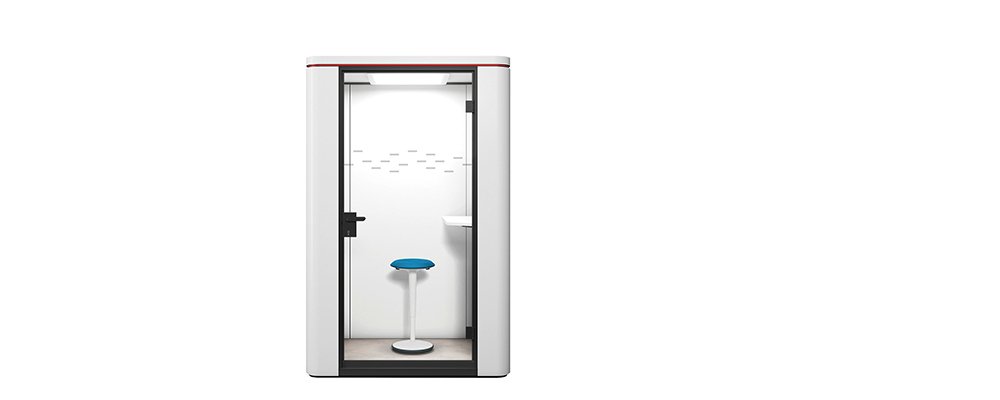
No. Sedus lists phone calls, focused work and video or web conferences for it, always for one person. The se:cube S measures 1500 × 1000 × 2400 mm. It declares 27 dB D'p,w, and Sedus declares a full air change in 43 seconds. Its WebCon setting has a height-adjustable table, 680 to 1180 mm, and indirect lighting that keeps your face visible on camera. If two people will often share the space, Sedus has the new XM, with sofas and a table for two, and lists working in pairs under the M.
se:cube has a floor of its own, finished in Interface Composure carpet, available in over 30 colours and described as CO2 neutral. se:cube max is different: it has no base. Sedus notes that the floor is one of the things that influences the acoustic result, so the floor finish is worth discussing along with the size rather than after it.
A se:cube can change position without being dismantled, using Sedus lift technology. These five steps cover the job on an ordinary office floor, from emptying the unit to testing it again.
Start by emptying the se:cube: loose chairs, laptops, papers, anything on the coat hook and in the utensil compartment. If a monitor sits on an arm, take it down and pack it separately. The reason is simple: nothing inside should be left to slide about once the cube begins to shift, and a clear room also makes the inside glass easier to watch.
Switch off and disconnect the supply where it enters the unit, which as standard is at the floor, though ceiling and wall feeds are also possible. Label each lead, including RJ45 if it is used, and note the position of the old floor box. It takes five minutes and saves a lot of guessing when the cube reaches its new place.
Sedus states two people for the job, using its lift technology, and about an hour and a half for the Size L; Generation 3 also offers integrated castors as an option. Keep the same two people from start to finish rather than rotating helpers in, and agree beforehand who calls each move. Pick a time when the floor is quiet, such as a weekend morning, so that nobody is working around you.
Walk the route first and then again with the cube. The L is 2500 × 2500 mm in plan and 2400 mm tall, so door openings, pantry corners and low-hanging ducts along the way matter more than the distance. Clear printers, plants and visitor chairs from the path, and keep an eye on the glass sides at every turn.
In the new spot, restore the power and check the basics in order: the light should come on as you step in, the fans should start, and the display, if fitted, should read air quality and CO2 again. Close the door and listen for a moment. Then put the furniture back and let the first user report anything that feels different.