
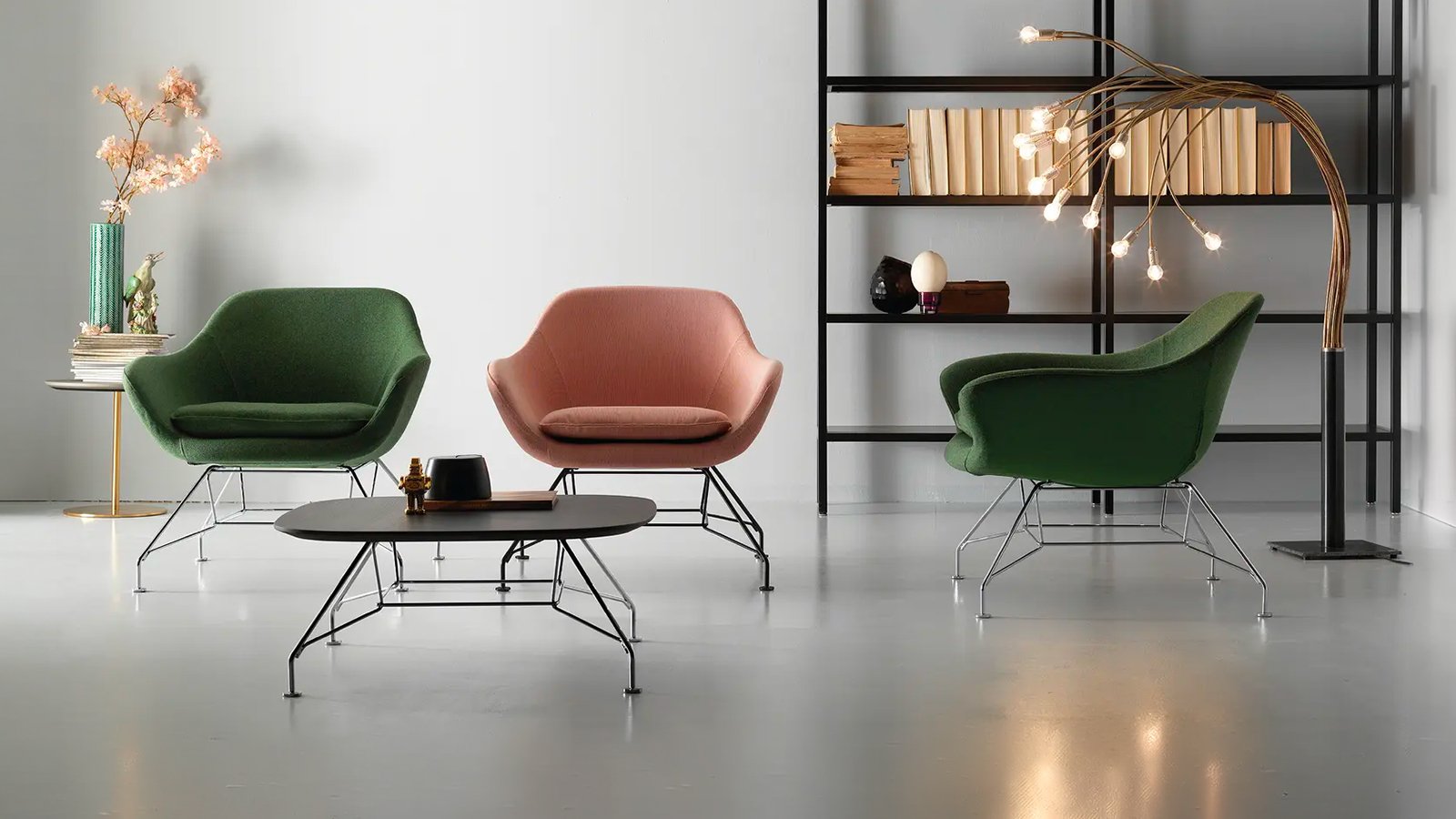
50 cm of seat in an 80 cm chair: Manta by Quinti, the visitor armchair with walls
Let's discuss your project
Trade terms for professionals and design studios
Measure the seat of Manta and you get 50 cm; measure the chair and you get 80. The fifteen centimetres on each side are not armrests bolted on, they are the upholstered walls of the shell, foamed cold in polyurethane together with the cushion, curving around whoever sits down. In a busy reception that difference decides how a row feels: each visitor gets a seat and a boundary, without a partition in sight.
Among the visitor armchairs for reception we bring from Quinti, this is Marco Cocco’s lounge piece: an 80 cm square, 79 cm tall, the seat 57 cm deep and 46 cm off the floor, built on a steel skeleton strapped with elastic bands. Five bases carry that shell: tube legs in chrome or black, a levelling framework, legs in painted wood, a self-centring swivel and runners in solid oak, and every one takes the headrest.
Quinti declares it for office waiting areas and contract jobs and, with the same words, as an armchair for the home; it sits in the manufacturer’s Hospitality range and in our office lounge collection alongside the sofas. Two accessories and one variant complete it: a down-filled quilted pad to rest on the chair, a 100 × 100 cm table topped in marble or wood, and foams approved to class 1IM for fire-rated interiors. La Mercanti counts the row in multiples of 80, not of 50.
- Collection: Manta, upholstered lounge armchair
- Manufacturer: Quinti Sedute Srl, Cesa (Arezzo), Italy
- Design: Marco Cocco
- Type: lounge armchair for waiting areas, contract and home use
- Dimensions: 80 × 80 × 79 cm; seat 50 cm wide, 57 cm deep, 46 cm high
- With headrest: 112 cm high, same footprint
- Four-leg base X0880: tubular steel, chromed (CR0) or black painted (NN0); 20 kg, 22 kg with headrest
- Lattice base X0881: steel framework, chromed or matt black, on adjustable feet; same heights and weights as the four-leg base
- Wood base X0882: painted wood in walnut (NO), natural (RN), Moka (RM) or open-pore black (NP); 19 kg, 21 kg with headrest
- Swivel base X0883: die-cast aluminium, four spokes, self-aligning return, polished (GRA) or black (GRN); 81 cm high, seat 48 cm; 22.6 kg, with headrest 25 kg and 114 cm
- Rocker base X0884: solid-oak slides, natural with white frame (RN0) or Moka with black frame (RM0); 95 cm deep, 77 cm high; 20 kg, with headrest 22 kg, 110 cm and seat 47 cm
- Packed volume: 0.60 m³ per armchair
- Frame: internal metal skeleton with elastic support straps
- Padding: cold-foamed polyurethane, cushion included; seat cushion half polyurethane, half memory
- Fire-safe version: available with 1IM-approved fire-retardant foams
- Declared tests: 1IM approval; CAM compliance (Italian public procurement criteria)
- Accessories: goose-feather quilted mat X088C000; round or square table X088TNN0/X088TCR0, 100 × 100 × 34 cm, lattice frame on adjustable feet, top in NC/RN/RT/NP wood finish or marble, 0.45 m³
- Upholstery: categories 2, 3, 5, 6, 7, 8 and IM; Crepè, Pelle cat. 6 and Velluto Decontracté not available
- End of life: designed to be disassembled for reuse or recycling
- Safety: declared compliant with EU Regulation 2023/988 (GPSR)
- Declared uses: office and contract waiting areas; home armchair
- Reference: Oriflame, Stockholm, 2018
- Origin: Made in Italy
Documents and Catalogues
Share the finishes you wish to evaluate
FAQ
What does the four-leg steel base of Manta look like?
Four legs in tubular steel, chromed or painted black, under the same 80 × 80 cm shell: code X0880, 79 cm high with the seat at 46, 20 kg. It is the plainest of the five bases and the one that leaves the floor visible between the legs. In a reception where chairs are lined up in numbers, that openness is what keeps a row from reading as a solid block.
Who is Marco Cocco, the designer behind Manta?
An industrial designer born in Campobasso in 1974, trained at the Politecnico di Milano. From 2000 he worked with Milanese architecture and design studios on furniture, objects, exhibitions and graphics; in 2007 he opened his own studio near Milan and began designing for companies such as Alivar, Caimi Brevetti, Estempore, Klab Design, Reflex, TwentyFirst and Quinti. In the Quinti catalogue Manta is the only piece that carries his name.
Does the Manta table stand on the same base as the chair?
On the same idea: a lattice frame in steel, chromed or painted black, with adjustable feet, like the X0881 version of the armchair. The table is 100 × 100 cm and 34 cm high, square or round, and packs into 0.45 m³; its weight is not published. The top comes in marble or in the four wood finishes of the armchair’s painted legs: walnut, natural, Moka and open-pore black.
What holds the shape of a chair that is all foam?
A metal skeleton. Inside the cold-foamed polyurethane Quinti places a metal frame fitted with elastic support straps, which the data sheet credits with increasing seat comfort; the foam is moulded around it, cushion included. That is why Manta keeps the same profile on five very different bases: the base changes, the skeleton does not.
How high does Manta become with the headrest fitted?
112 cm, against 79 without it, on the tubular, lattice and wood bases; 114 on the swivel base and 110 on the rocker. The footprint stays 80 × 80 and the weight grows by about 2 kg. Quinti describes the headrest as applicable to every version, so a reception can mix both heights in one row.
How to receive, unpack and move Manta armchairs on delivery day
What Quinti prescribes for handling Manta on site: one crate per chair, the weights by version, where to grip the shell, how to set it down and how to check the codes before the packaging goes.
Count the crates, one per Manta
Every Manta ships in 0.60 m³, whatever the base and whether or not the headrest is fitted: ten chairs are six cubic metres at the goods entrance. The table travels separately in 0.45 m³. The numbers go on the delivery note before the truck is booked.
Know the weight before lifting
The painted-wood version is the lightest at 19 kg; the tubular, lattice and rocker versions weigh 20 kg; the swivel base is 22.6 kg. With the headrest each one gains about 2 kg, up to 25 kg for the swivel version.
Grip the structure, not the cover
Quinti’s instruction for lifting or moving is to grasp the product firmly by its load-bearing structure and never by the fabric or the cushion, which can be cut or torn. The shell is carried as one piece; nothing is pulled by the headrest.
Set it down on all four points
The chair is designed to be used resting on its four legs or on its base, with no off-centre loads: on arrival it is placed level, the lattice version on its adjustable feet, the rocker on both slides. Nobody stands on it or uses it as a step.
Check the finish against the code
Before the packaging goes, check the code against the order: the last letters say the finish, CR0 chromed, NN0 black, NO0 walnut, RN0 natural, RM0 Moka, NP0 open-pore black, and a final P means the headrest version. A row that mixes finishes is checked chair by chair.