What did you have in mind?
Trade terms for professionals and design studios
What did you have in mind?
Trade terms for professionals and design studios
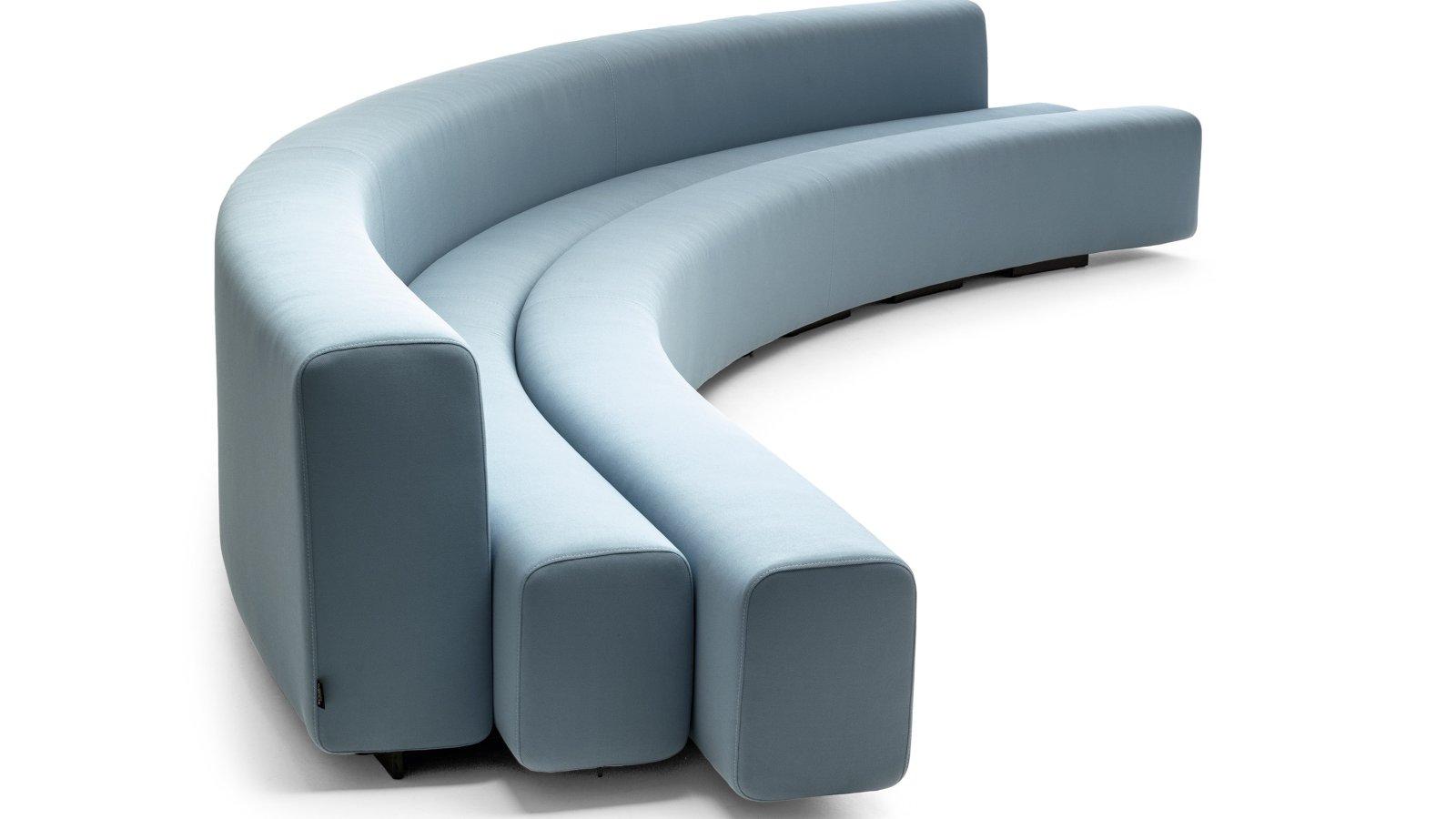
The LaCividina price list prints a net weight beside every code, and the column tells its own story. The shortest Osaka sofa, 180 cm, weighs 61 kg; the 630 cm piece weighs 229 kg. Each extra half metre adds between 14 and 24 kg of steel and foam. This is not a sofa that a receptionist drags across the floor to make room for a trolley; it is placed on the plan, assembled where it stands, and it stays.
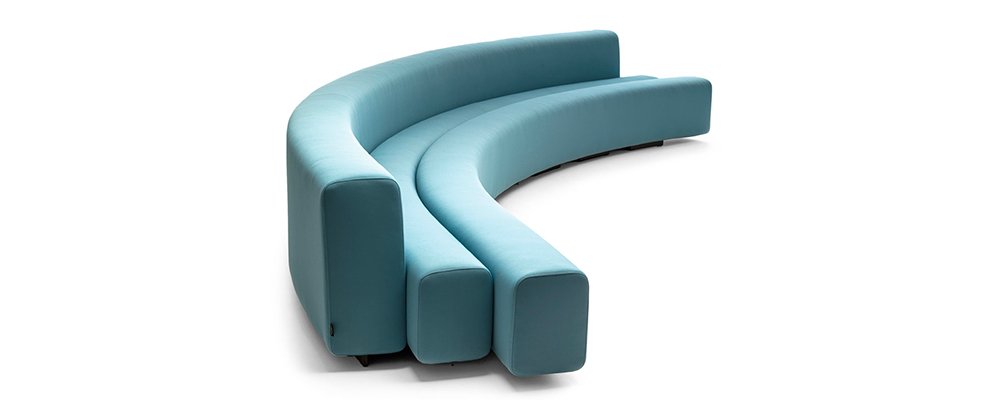
In an Indian lobby that permanence is an asset. Visitor chairs that can be pushed out of line look tired within a month; a curved band of seating that cannot be moved keeps the geometry the architect drew. Pierre Paulin designed that band in 1967 with winding, organic lines, and the 2013 reissue keeps the shape while building the frame for public use.
The same family offers a backless bench in the same ten lengths, straight modules to join the curves and an Outdoor version for covered terraces; in informal areas the sofa codes take the role of lounge seating beside the reception desk. The weight also decides the delivery. La Mercanti writes the net and gross figures of each Osaka element on the transport order, checks the lift capacity with the building and books the crew accordingly.

Share the finishes you wish to evaluate
More than half of its weight. Every code in the LaCividina list carries the French classification «sous famille >50% métal», which means the frame outweighs the foam and the cover together. It is the reason the longest sofa passes two hundred kilograms and why the seating stays where it was placed.
67 cm deep and 78 cm high, with the seat at 42 cm, on every one of the ten lengths. The bench has its own section, 78 cm deep and 42 cm high, so a sofa element and a bench element can follow one another in a run without a step.
Because on a curved seat the stitching is the line that takes the pull every time someone sits down. LaCividina declares seams reinforced with a carbon fibre support on Osaka, together with a frame reinforced for public areas and flame-retardant foam laid in different densities.
Pierre Paulin drew it in 1967 for Expo 1970 in Osaka, Japan, and the sofa carries the name of that city. The English product page says it was «developed for Expo 1970 in the city after which it is named».
The manufacturer publishes 2D and 3D CAD, BIM/Revit models and families, a finishes library and an online planner for the composition. La Mercanti sends the files with the quotation so the seating can be placed in the project model before the codes are confirmed.
An Osaka run is ordered code by code. Five steps turn the plan into a list LaCividina can build from.
Walk the drawing of the Osaka composition in one direction and number each element. A curve and the straight piece after it are two different codes, and the order should follow the floor, not the invoice.
For every numbered Osaka element write 8801-8810 if it has a back or 8811-8820 if it is a bench. The last digit follows the length: 01 is 180 cm, 10 is 630 cm.
Repeat the length in centimetres next to each Osaka code. It costs nothing and it catches a wrong digit before the frame is cut.
State the stretch fabric and its category one time for the whole Osaka run, unless a two-tone scheme is intended; in that case mark the colour element by element.
La Mercanti sends the numbered plan together with the list, so LaCividina can check that the sequence of Osaka codes matches the drawing before confirming the order.