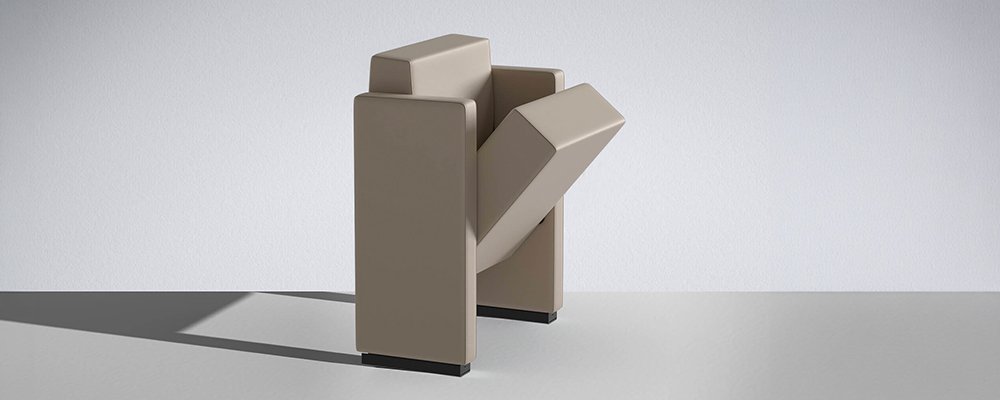
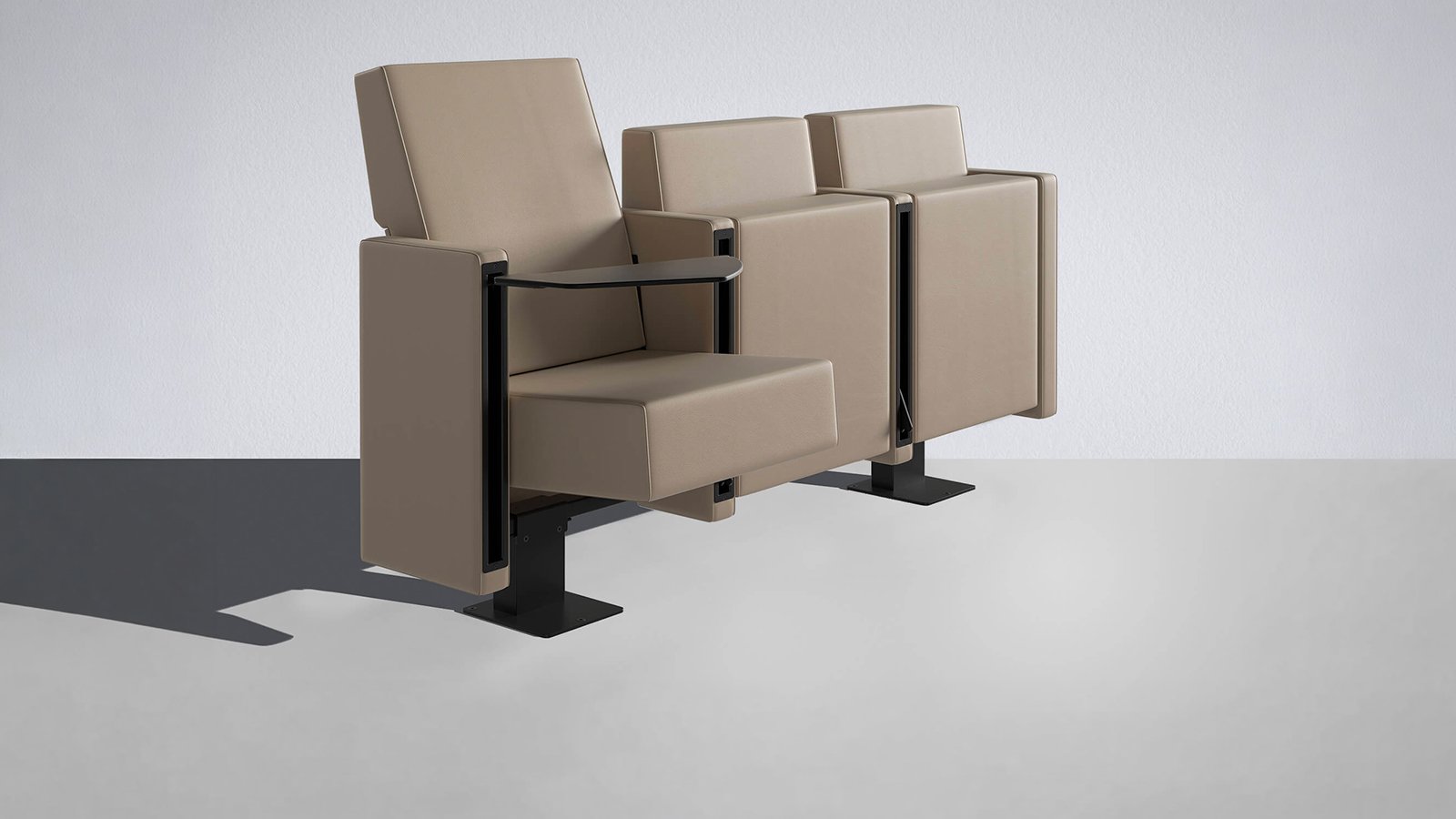
Rows of Mura auditorium chairs by Lamm on a stepped floor

Flat, raked or stepped: Mura by Lamm, the auditorium chair that lets the floor decide

Lamm
Mura
Mura An icon of Italian design
From ₹ 2,800

Let's discuss your project

Trade terms for professionals and design studios

Before the seat count, the section. A university hall may be flat; an institute auditorium is often raked; a convention centre is built in steps. Mura is installed on a flat floor, on a slope and on steps alike, in rows straight or curved, and the chair itself does not change from one to the other. What the floor decides is how the rows are set out: 85 cm between rows on a level floor in the manufacturer's drawings.

Each of these auditorium chairs stands on padded sides 30 cm deep that rise from the floor, fixed through a steel foot finished in epoxy powder; the row closes to that same 30 cm when the seats tip up. Within the row the seats are spaced at 53 to 56 cm centre to centre, so a hall of a given width can be counted tighter or looser with the same chair. Gino Gamberini's design for Lamm is compact, in the word the manufacturer uses, and the compactness shows on a stepped floor, where every centimetre of tread is contested.

Beyond the standard chair there is a beam-mounted version with one painted foot per two or three places, two backrest heights, and a writing pad in black HPL that folds into the side for lecture halls and seminar rooms; straight rows on a flat floor can even be put on castors for a multipurpose hall. The hall section reaches La Mercanti before the seat count does, and that order is deliberate.

Technical information based on data declared by the manufacturer.

Range: Mura
Manufacturer: Lamm S.r.l., San Secondo Parmense (Parma), Italy
Designed by: Gino Gamberini
Description: compact armchair for conference halls and for auditoriums; standard version with seat and backrest closing in line with the side panels
Versions available: side panel down to the floor, or on a beam; backrest low or high
Floors and layouts: level, inclined or stepped floors; rows straight or in a curve
Seat spacing, centre to centre: 53 to 56 cm
Row spacing: 85 cm on a level floor; 90 cm on steps, as drawn; curved rows not less than the level-floor spacing
Minimum radius of a curved row: 15 m
Seat and backrest: plywood structure; flame-retardant, non-deformable polyurethane foam; backrest in two heights
Tip-up mechanism: gravity device that releases the seat and lets it tip up with a damped, soft-close movement; the backrest simultaneously lowers and becomes vertical, reducing the overall depth
Side panel: 30 cm deep; same build as the seat; covered in fabric, in genuine leather or in leatherette
Side panel on project: 24 cm deep
Floor fixing: foot in steel sheet, epoxy powder coated, scratch-resistant and anti-corrosion
Finishes of foot and beam: semi-matt in black RAL 9005 or in silver; embossed in bronze or in graphite
Beam version: beam for 2 or 3 seats in square-section tubular steel, painted in the same four finishes; painted steel foot fixed to the floor every 2 or 3 seats; side panels of one height resting on the beam, except in the first row, where they may go down to the floor
Writing pad (accessory, standard side): top in black stratified HPL, hinge in die-cast aluminium; folds away inside the side panel; anti-panic movement
Accessories: writing pad; seat and row identification elements; provision for electrification, socket on request; castor system to move the chairs away when not in use (floor-fixed feet, straight rows only)
Heights: overall 82 cm with the low backrest, 96 cm with the high one; side panel 68 or 83 cm; seat 47 cm
Depths: closed, equal to the side panel; 38 or 41 cm with the backrest in use; 68 or 71 cm with the seat open; 73 or 76 cm with the writing pad open
Side panel thickness: 7 cm, front view
Upholstery categories: category 1 Inca, King, Trevi CS; category 2 Silvertex, Extrema Au; category 3 Luna CS, Revive 1 and Remix 2 (Kvadrat); category 4 Steelcut Trio 3 (Kvadrat), leather
HPL: black, for the writing pad
Painted solid wood: beech, oak
Padding: CertiPUR® certified
Wooden components: low formaldehyde emission
Recognition: Compasso d'Oro ADI, XV edition, 1989, awarded to the first version
Testing: tested according to European standards

La Mercanti Srl — trusted supplier for design and contract projects since 1997.
San Benedetto del Tronto (AP), Italy · +39 0735 753833 · info@lamercanti.com
Supply, quotations, specifications and project support across India and worldwide.

When it is the right choice

  • Halls of every section, from the orchestra level up the tiers, with one chair for all of them.
  • Full upholstered sides from the ground, 30 cm deep, that close the row to a single surface.
  • A writing pad housed within the side panel, available only with the 30 cm side.

When another solution serves you better

  • For folding armrests, a writing pad on the chair in front and 58 or 60 cm between centres, look at Genya by Lamm.

Share the finishes you wish to evaluate

₹ 30,000

Amount adjusted against your first order

FAQ

What spacing between rows should the layout start from?

Lamm's drawings place Mura rows 85 cm apart, back to back, in plan. That figure already includes the chair: closed, the row is 30 cm deep, and the remainder is passage. For a planner the number works backwards too: divide the usable depth of the hall by 85 cm and the result is the row count, before anyone has chosen a fabric. Where the hall is built in tiers the drawings use a different figure, and the Passport gives it.

Why does the first row of a beam-mounted Mura look different?

Because its side panels may run right down to the ground. On the beam version the panels are of a single height and rest on the square steel beam, so from the aisle a gap shows beneath them; in the first row the manufacturer allows full-height panels, closing that gap where the audience faces it. The rows behind keep the beam exposed, which is also where the painted foot, one for every pair or trio of seats, is visible.

Fabric, leather or leatherette: which skin goes where?

All three are offered on Mura, and they dress the seat as well as the backrest and both side panels, so a row can be dressed in one skin from end to end. Leather is the choice for a boardroom auditorium that wants the row to look the same after years of use; fabric is where colour and pattern live; leatherette gives a wipeable surface for halls that turn over several audiences a day. The decision is taken per hall, and a sample is matched against the lighting of the room before it goes into the order.

Which backrest height suits a large hall?

Mura offers two. With the low backrest the chair is 82 cm tall overall and the side panel 68 cm; with the high backrest they become 96 and 83 cm. Seat height does not move: 47 cm. The high version gives more support behind the shoulders and a taller silhouette from the back of the hall; the low one keeps sightlines open where rows sit close in height. The height is chosen on the section of the hall, not from the catalogue picture.

What is inside the cushion, and does it hold its shape?

Seat, backrest and sides of Mura are all padded with flame-retardant polyurethane foam that the manufacturer describes as non-deformable, over a plywood structure. CertiPUR certification covers the padding, and the wood parts carry a low formaldehyde emission. Those are the sheet's own words; the chair is tested according to European standards, and we add no rating or number that Lamm does not state.

Resetting a hall of Mura chairs after the event, row by row

The routine for hall staff once the audience has left: what Mura does by itself, what has to be checked in each row, which surfaces get cleaned and how the seat markers make the round quicker.

Mura closes itself first

Walk the hall before touching anything. Each Mura seat tips up on its own by gravity and the backrest stands vertical, so every row should already be back to its closed depth of 30 cm. A seat still open is the first thing to note, because it means something is holding it.

Walk the gap between rows

With the seats closed the passage between rows is open along its whole length, and that is the moment to collect what the audience left behind. Do it row by row from the back, so that nothing is pushed forward into the rows already done.

Wipe the upholstered sides

The side panels of Mura are covered on every face, like the seat: in fabric, or in genuine leather, or in leatherette. They take the hands of everyone entering the row, so they are cleaned along with the seats and not skipped as if they were a frame.

Fold every writing pad home

Where the rows carry the writing pad, check that each one has folded back inside the side panel and that nothing has been left on the black HPL top. The pad is meant to disappear into the side when not in use, and a row with one pad out reads as unfinished from the door.

Count by the seat markers

Use the row and seat markers to close the round: a damaged seat or a missing pad is reported by row and number, not by description, so that the fix can be found again in a hall of several hundred places.