Let's discuss your project
Trade terms for professionals and design studios
Let's discuss your project
Trade terms for professionals and design studios
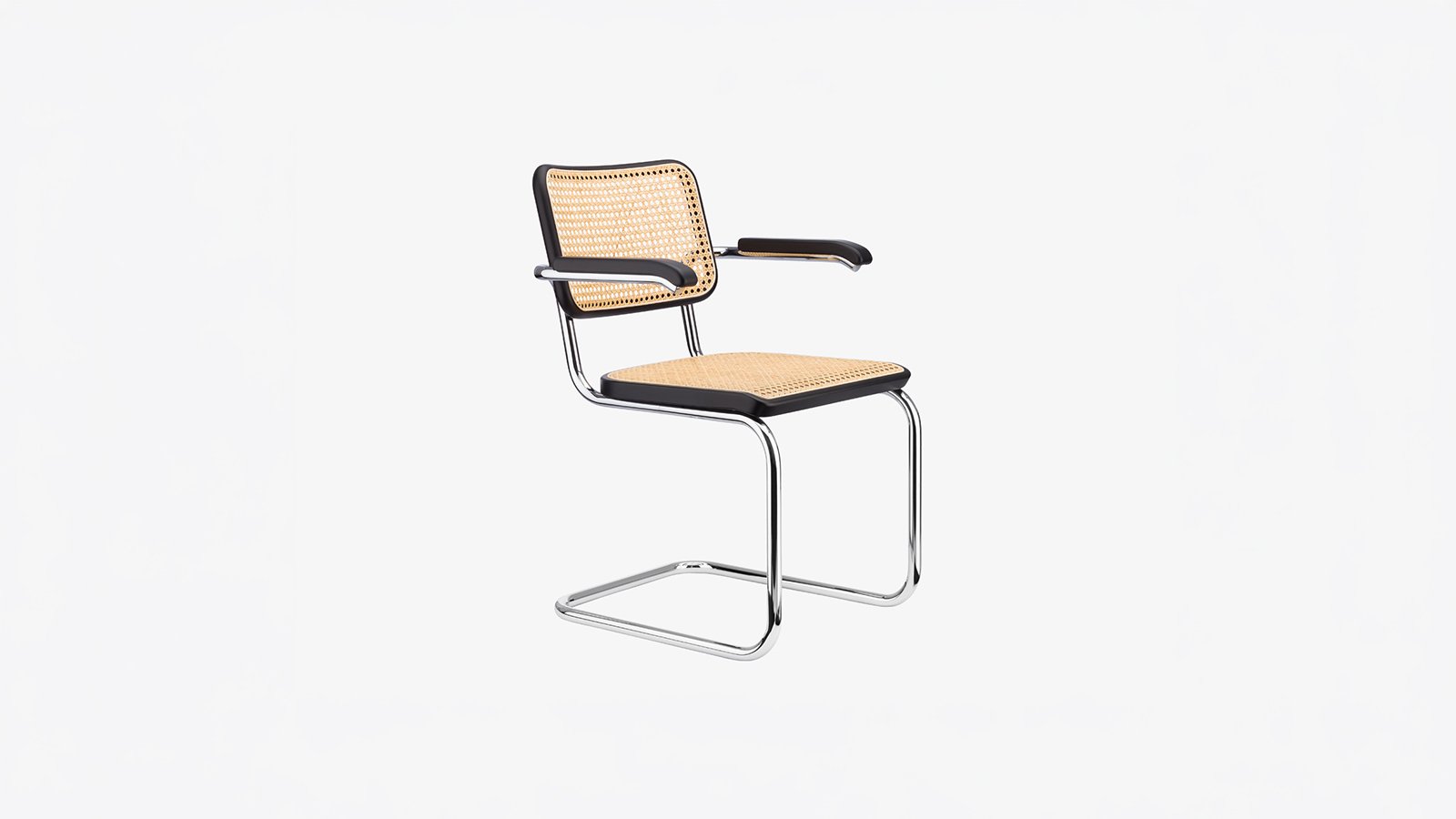
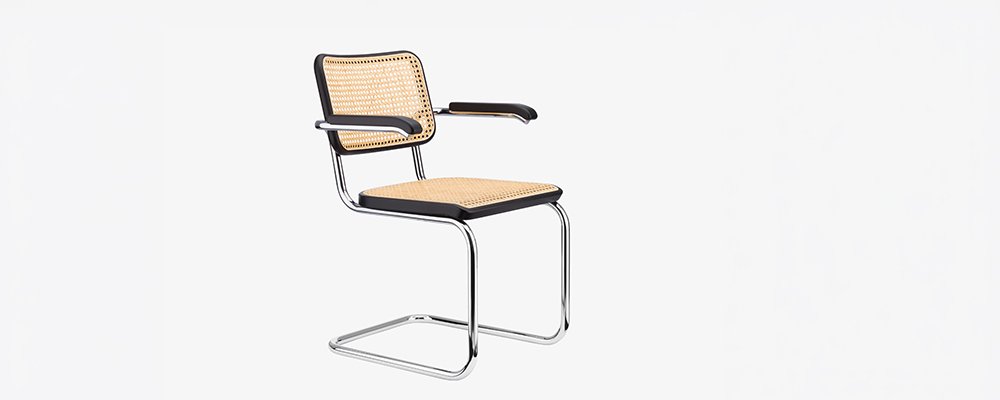
Thonet's familiar Vienna cane has a darker counterpart in the Edition Herkner: the seat and back of the S 32, and of the S 64 with armrests, are woven in a shade Thonet calls DARK MELANGE, again over a supporting synthetic mesh. Bent solid wood, open weave and tubular steel stay as they are; only the tone of the cane changes. We include both in our seating for meeting rooms for offices that want the weave without the pale natural colour.
The S 32 and the S 64 are the work of Marcel Breuer, who designed them in 1928, during his Berlin years; production at Thonet began in 1930, and Thonet attributes their artistic copyright to Mart Stam. Stam's own cantilevers, the S 33 and its armchair version S 34, date from 1926 and drew attention at the Weissenhof exhibition in Stuttgart the following year.
So the family counts four chairs. S 32 and S 64 can have natural or DARK MELANGE cane, mesh, full padding, or padding on the seat only with cane or mesh above it; S 33 and S 34 are covered with leather, fabric or mesh. Thonet places them anywhere from the conference room and the waiting area to the restaurant and the home; we see them first in conference rooms and boardrooms, where in our view the darker cane suits dark wooden tables. La Mercanti shows the client both tones of cane side by side, natural and DARK MELANGE, against the wood of the table they already own.

The Werkbund held its exhibition there, in Stuttgart, and the S 33 and S 34 caused a sensation. Mart Stam took part both as an architect and as a designer experimenting with tubular steel. Thonet still builds the two chairs and counts them among the very first cantilevers in furniture history.
Yes. Thonet manufactures each piece individually as required, through its online configurator: the chair is configured, the configuration saved and the order placed with a retail partner. Architects and planners use the same tool to generate CAD data for their drawings. A saved configuration can be shared with La Mercanti together with the floor plan.
Thonet uses butt leather, a thick leather, on the S 33 and on the S 34 with armrests; the alternatives on both are fabric (V) and synthetic mesh (N). In the photographs the leather appears in black, brown and light tan, and in our reading it gives a meeting room a more formal look than cane.
Thonet writes Design Marcel Breuer, 1929/30, with an asterisk that reads “artistic copyright Mart Stam”; the same note appears on the pages of the S 33 and S 34. Thonet gives no further explanation on those pages, so we report the credit exactly as it stands, and in a tender specification both names should appear.
Two: the S 64, 58 cm wide, and the S 34, 57 cm wide, both with armrests at 67 cm from the floor. The S 32 and S 33 have none. Our suggestion is to place the armchairs at the head of the table and wherever meetings last longest, and the narrower side chairs along the length, where places sit closer together.
In our view a cantilever chair lasts as long as its seat and back can be renewed. Five steps on what Thonet makes replaceable on the S 32 and S 64, and how to keep a whole room consistent when parts are renewed.
On the V versions of the S 32 and S 64 the Vienna cane rests on a supporting synthetic mesh, and the Edition Herkner in DARK MELANGE is built the same way. Knowing this matters before any repair: the visible weave and the mesh beneath it work together on the seat and on the back.
Thonet publishes a tutorial for replacing the cane seat and backrest of the S 32 and S 64. The bent wood parts come away from the tubular frame, so a chair that has worked hard in a busy room can return to service with new cane and the same steel.
A second Thonet tutorial shows how to fit the feet of a cantilever chair. The feet are where the steel runner meets the floor, so we suggest checking the feet whenever chairs are moved to a new room or a new type of floor.
Beyond the tutorials, Thonet runs its own repair service. For damage to the frame, or for a group of chairs that all need attention at once, we suggest sending them there rather than improvising locally with parts of a different kind.
When seats or backs are renewed, our advice is to order exactly the same version as before: natural cane, DARK MELANGE, mesh or upholstery. In a meeting room one odd chair stands out at once, while a uniform set keeps the table calm for years.