Already have something in mind?
Trade terms for professionals and design studios
Already have something in mind?
Trade terms for professionals and design studios
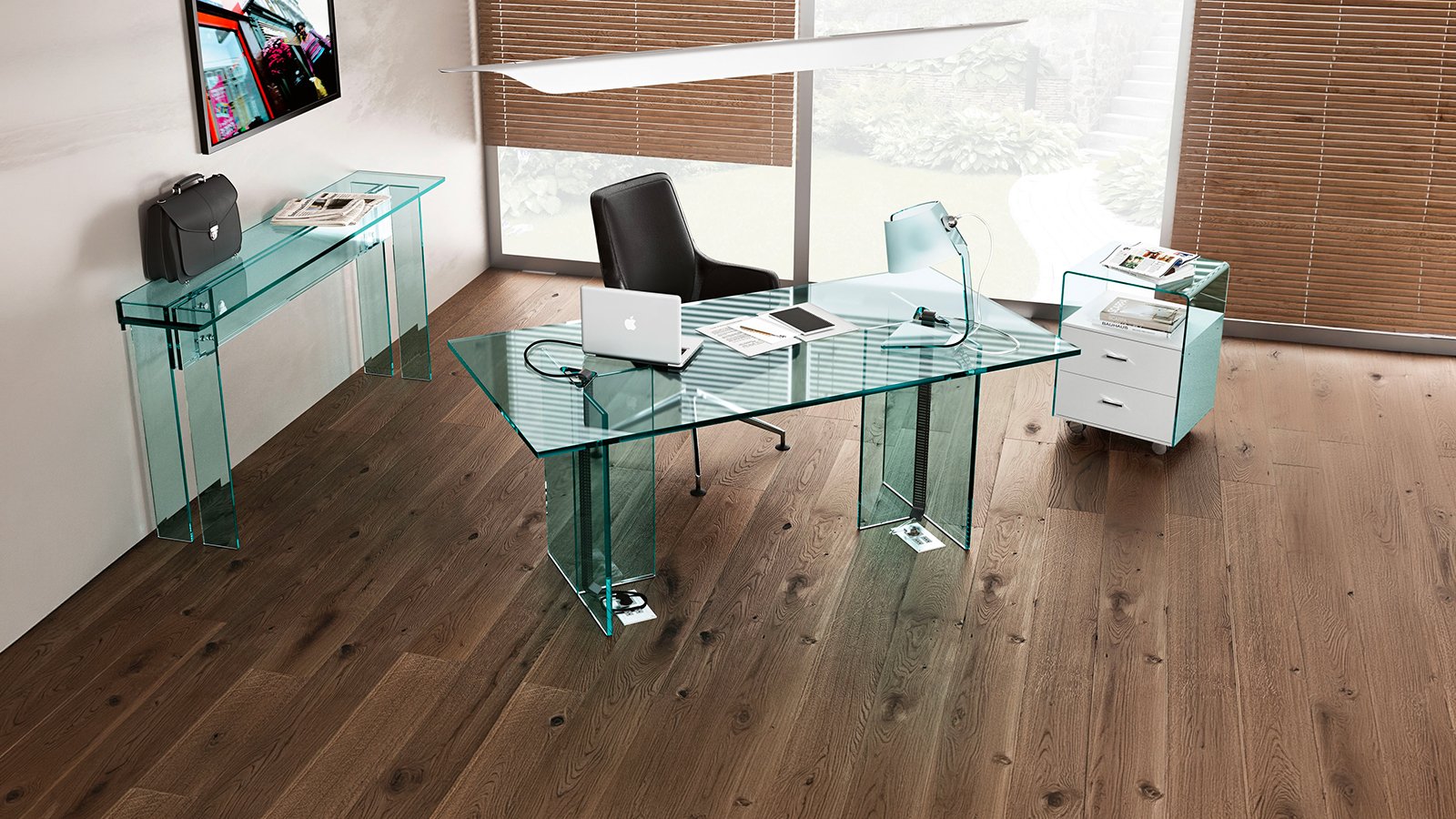
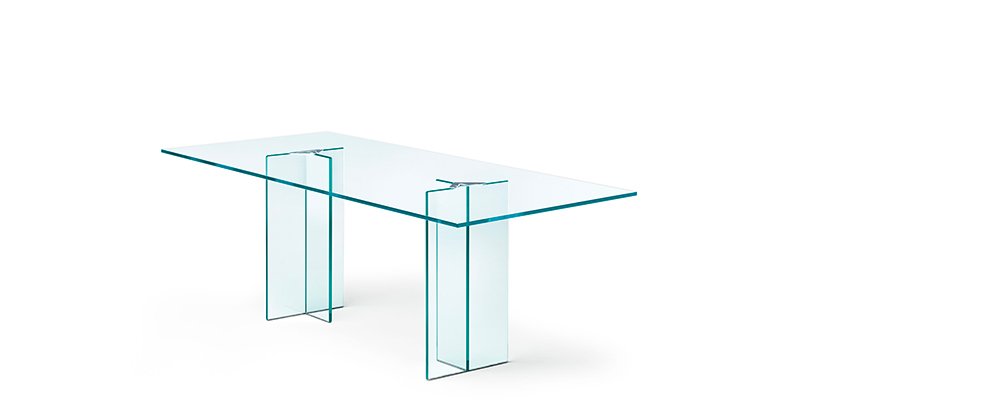
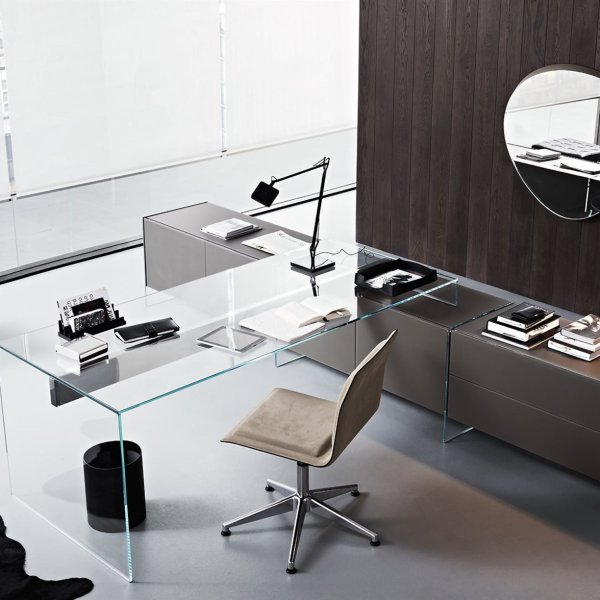
Three and a half metres. LLT ofx meeting is a single top of 350 × 120 cm in 19 mm glass, standing on three bases, with 200 kg on the top declared by Fiam. It is the largest piece of the collection, and the reason to begin with it is simple: the desk on this page, LLT ofx executive, a design by Dante O. Benini and Luca Gonzo, is built the same way and from the same glass. Few designer tables for the cabin come with a boardroom partner of this size.
On both pieces the clear top rests on bases of glued glass, and the holes above the bases are there for the cables: three on the meeting table, two on the desk. In Fiam's drawings the outer bases are T-shaped and the central one is a cross. As glass-top office tables go, this one is long: the two outer bases stand 283 cm apart, and the glass carries on for 33 cm past each.
From the boardroom outwards, then. LLT ofx meeting holds the centre; the executive desk, 180 or 260 cm long, takes the director's cabin. Further out, for working from home, comes LLT home office, whose glass is tempered and 15 mm thick; the LLT table suits dining or a smaller meeting room; and LLT wood puts a wooden top on glass legs wherever wood is wanted on the surface. La Mercanti asks how the board actually sits, at the head or along the sides, before the size is fixed.

Share the finishes you wish to evaluate
Because the two families are built differently, and Fiam keeps its own word for each. On the executive desk and the meeting table the top rests on bases of glued glass. On LLT home office and the LLT table the leg structure is in welded glass, with fixing details in stainless steel. Fiam goes no further than those words, and we keep to them as well: in a tender document we would quote them exactly as written.
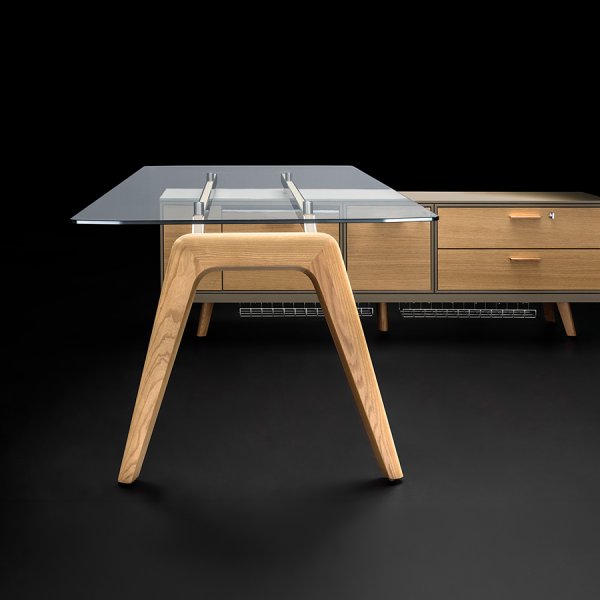
A top of 40 mm marine plywood, veneered in Canaletto walnut or «old» oak, or hand-trowelled with Ecomalta in Tabacco or Nero Assoluto. Beneath it sit a structure of 30 mm laminated glass and legs of 19 mm glass, Standard or Extralight. Sizes are 200 × 100, 240 × 100 and 300 × 110 cm, all 74 cm high, with made-to-measure tops as well, and 150 kg on the top. It suits a room where papers should land on wood.
Each one is made of vertical glass sheets joined in a T. In Fiam's drawings the sheet set crosswise is 55 cm wide, under a top 90 cm deep, and the second sheet, 27 cm long, points towards the middle of the desk. The cable hole sits right above the joint. In practice the long sides of the top stay free, so a visitor's chair comes close without meeting a leg.
Yes, and below them as well. Fiam makes custom tops from 140 × 70 cm up to 260 × 90 cm. We would decide the size from the cabin rather than from the catalogue: the wall behind the chair, the passage in front of the desk and the door, measured before anyone talks about lengths.
Two of them: LLT home office and the LLT table. Fiam describes their tops with a bevelled edge on the two short sides, and their glass legs bevelled along the edge too. The ofx pieces, desk and meeting table, are described in other terms: a 19 mm top resting on glued bases. If the edge is a deciding detail for you, it is worth asking to see the short end of each family before choosing.
Every LLT piece is offered in two glasses, Standard and Extralight, and Fiam leaves the choice to the buyer. Five steps to make it, starting from the floor of the room.
LLT is offered in Standard or Extralight across the whole collection, from the executive desk to LLT wood. Our advice is to start low: the edge of the top and the bases stand close to the floor, so the flooring, whether marble, wood or vitrified tile, is the first thing the choice has to sit with.
In Fiam's photographs the face of the top is clear, while the cut edge shows a blue-green tone. That edge is what changes between the two options: in our experience Extralight is the clearer one, with an edge that reads less green. Judge it from the side, at the eye height of a seated person.
Once the floor is settled, compare the edge with the wall colour and the window frames. A strongly coloured wall makes the green of a Standard edge more noticeable; a white or pale room lets it read as a deliberate accent. Either can be right, and the room is what decides.
The same two options apply to every LLT piece, so a director's desk and the table in the next room can share one glass. We would keep a single choice through the whole project: the edges are seen side by side by every visitor who walks from one room to the other.
On LLT wood the glass is below the top: a 30 mm laminated structure and 19 mm legs, both in Standard or Extralight. Here the edge sits under walnut, oak or Ecomalta, a different pairing from glass on glass, and one worth judging on its own.