
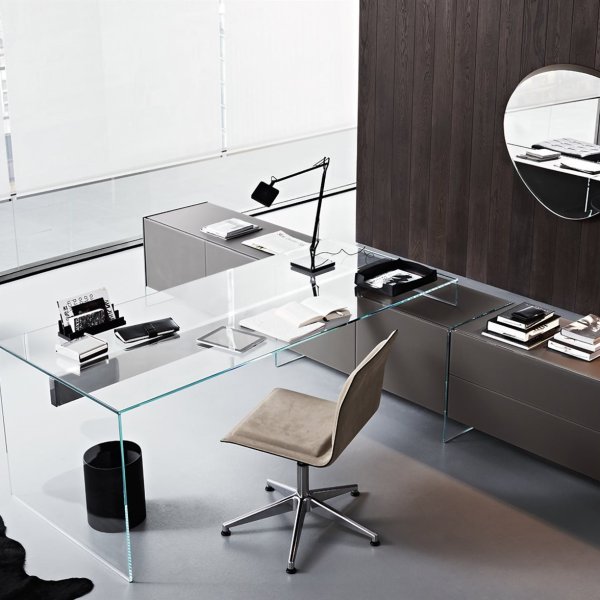
Air Desk
₹ 698.760
An architect judges a supplier by where its work has already gone. Gallotti&Radice pieces appear in apartments in Paris, in The Mermaid Apartments in Taiwan, in a residence on Frunzenskaya Street in Moscow and in the Ella di Rocco Spa in London — private homes, hospitality interiors and offices that share one requirement: a material that has to look deliberate under every light.
Behind those references is a company that has worked glass at Cermenate, near Como, since 1956, and that today draws a full office range alongside its home collection. For a practice in India this matters at specification stage: the same detail can run through a boardroom, a reception and a chairman's office, with drawings and finishes coming from a single manufacturer. La Mercanti is the point of contact for Indian studios and corporate clients, from the first finish schedule to delivery on site.
It does, and this is where a project either holds together or falls apart. Alongside desks and meeting tables the collection includes bookcases, storage units, drawer units, seating and desk accessories, so the wall behind the chairman's desk is designed rather than filled with whatever was available. Bookcases and boiserie also appear in the home collection, which is useful when a residence and an office are designed together.
They travel vertically, on dedicated frames and in crates built around the piece, because a horizontal top is far more vulnerable in transit than an upright one. Consignments are inspected against the packing list before signing, and any note made at that moment is what protects the client afterwards. La Mercanti follows the shipment from the factory to the site rather than to the port.
What a design practice needs to hand over so the client, the contractor and the factory read the same document. Five steps drawn from real specification work.
Decide whether the room needs a desk family, a meeting family or a storage family. Choosing the family first keeps the metal finish and the edge detail consistent when the model changes later in the job.
Tone and treatment belong in the schedule: clear, extralight or smoked, and whether the surface is painted bright or satin. A line that says only glass will come back as a question three weeks later.
Polished steel, satin steel, anodised aluminium or lacquered metal: state it once, at the top of the schedule, and reference it for every item. It is the fastest way to avoid a mixed floor.
Dimensioned drawings let the contractor check clearances and the electrician plan the floor boxes before the furniture is ordered, not after. La Mercanti requests them from the factory with the quotation.
Set out which rooms are needed first and confirm the dates in writing at order stage. On a fit-out the sequence matters as much as the schedule itself.