Already have something in mind?
Trade terms for professionals and design studios
Already have something in mind?
Trade terms for professionals and design studios
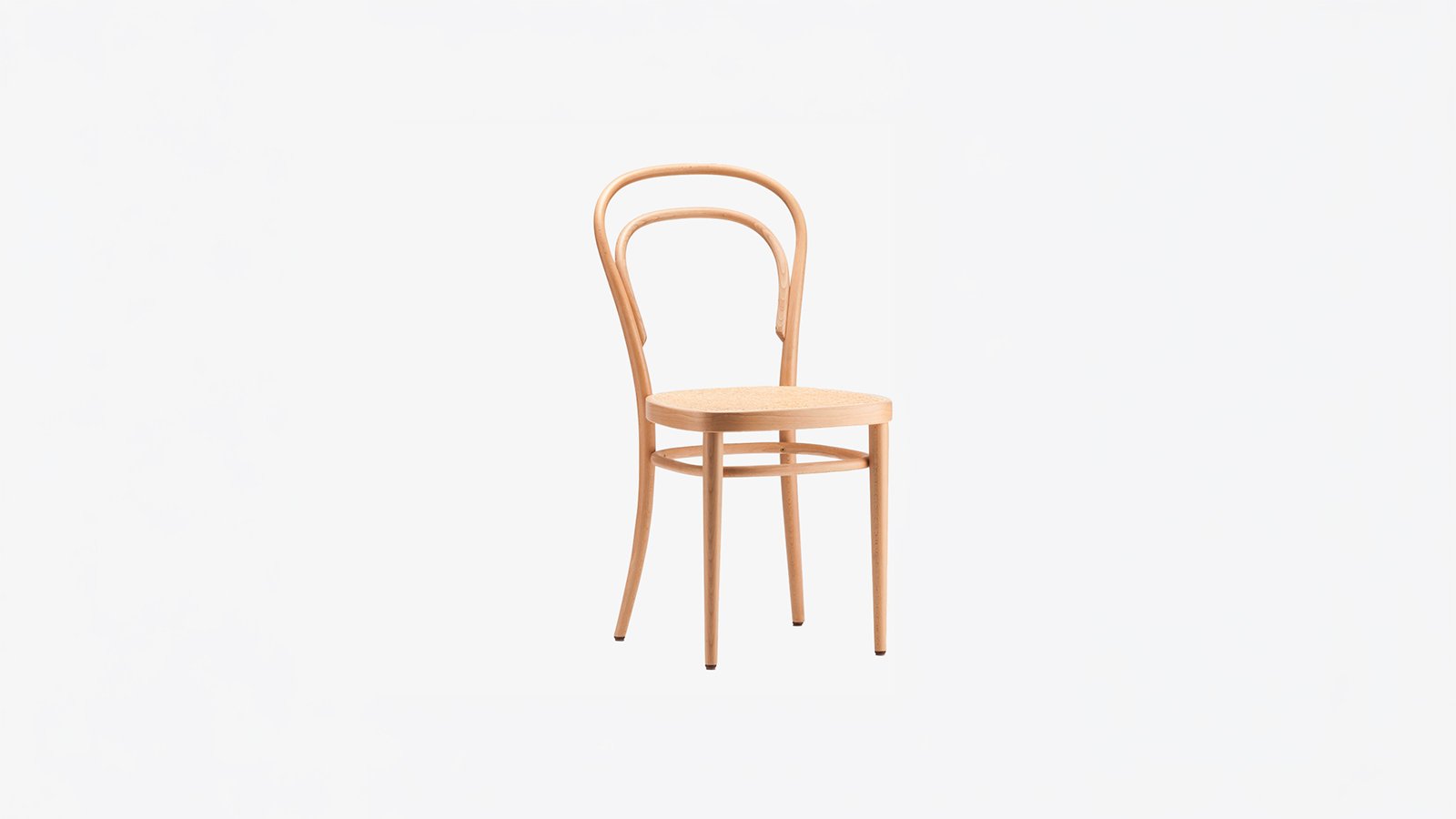
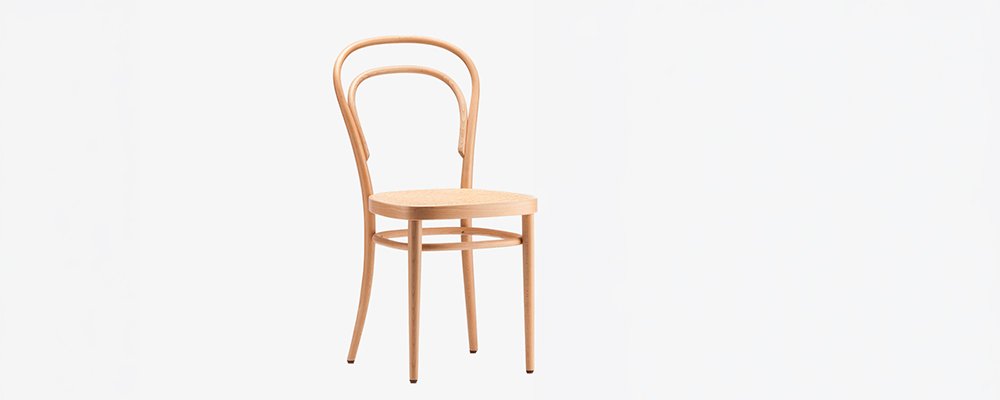
Count the parts of a Thonet 209 armchair and you arrive at six, exactly as many as in the 214 chair. Six is a short list for furniture meant to last, and in our view it is the most persuasive line a specification can carry. The 214 came first: Michael Thonet designed it in 1859, after developing a way of bending solid wood that made serial furniture production possible, and it has served for more than 150 years. Beside other curated designer chairs, it still reads as the plainest answer to the question of what a chair needs.
The sons came next. In 1900 Gebrüder Thonet applied the same economy to an armchair. The projecting frame of the 209, which forms backrest and armrests, is bent from one piece of solid beech; Thonet describes the result as almost a sculpture. We place it where a seat should hold its occupant a little more, in the host’s place at a dining table, or among boardroom seating, with 214s along the sides.
Across the nine versions the seat changes: cane on the 214, 209, 215 R and 210 R; moulded plywood on the 214 M; upholstery on the 214 P, 215 P, 209 P and 210 P. The 215 and 210 pairs add an oval back. We see them in residences, clubs and restaurants where a long table sets the tone of the space. La Mercanti asks how long people stay seated at that table, because the answer settles cane or upholstery.

Disassembled. Thonet records that 36 chairs, taken apart, fitted into a box of one cubic metre, were shipped across the world and then assembled on site. For a project today it is a useful piece of history to share with a client: the 214 has been travelling the world since its earliest years.
The projecting frame that forms both the backrest and the armrests is bent from a single length of solid beech. Thonet calls the 209 a masterpiece of construction and production, and says its reduced, organic form makes it look almost like a sculpture. For an interior designer, that continuous line is a reason to place the armchair where it will be seen from more than one side.
Le Corbusier. He was fascinated by the armchair and used it in many of his buildings, for instance at the Weissenhof estate in Stuttgart in 1927, and he once remarked that the chair “possesses nobility”. The design itself remains the work of Gebrüder Thonet, from 1900. For an architect presenting a scheme, it is a reference that explains the choice with no sales talk at all.
Thonet writes that it can make the furniture individually, as required, and production takes place at Frankenberg, in Germany. In practice version, seat and quantity are set at the time of ordering. For a hotel or a corporate dining room, that is a reason to settle the mix of chairs and armchairs on the plan first, so that every chair is made for its place.
It is the woven seat Thonet calls cane work. It appears on the 214, the 209 and the 215 R, and on the 210 R, which adds a woven oval to the back and which Thonet describes as wickerwork. A client who wants cane throughout a room can therefore still choose between four different backs, from the twin arches of the 214 to the open arc of the 209.
From the first decision, with or without arms, to the last, the seat and the back: five steps for matching every place at a table with the right one of Thonet’s nine bentwood versions.
Thonet’s 214 is a side chair; the 209 adds arms, formed by the same bent frame as its back. We use the 214 wherever many seats must fit around a table, in a café, a canteen or a family dining room, and the 209 where a seat should hold its occupant more, or at the head of the table.
Each design offers three kinds of seat. Vienna cane suits rooms where lightness and the historic look matter; the moulded plywood of the 214 M suits places that are cleaned many times a day; upholstery, on the P versions, suits long sittings at a dinner or a meeting.
The 215 R and 215 P give the chair an oval back, in cane or padded; the 210 R and 210 P do the same within the arc of the armchair. A room that wants a more formal note can take the oval throughout, while a relaxed one keeps the open backs of the 214 and the 209.
The armrests of the 209 and 210 sit at 70 cm. Before deciding on armchairs around a whole table, confirm on the plan that they slide under the top; when they do, the armchair can be drawn right in and every place keeps the same distance from the table.
In a specification or a presentation, the 214 belongs to Michael Thonet, 1859, and the 209 to Gebrüder Thonet, his sons, 1900. Naming the right author for each version keeps the documents accurate and gives the client a story to tell about a family that drew two classics forty-one years apart.