
At Fatehpur Sikri, the red sandstone city that Akbar made his capital, the Hall of Public Audience is ringed by porticoes, and on its western side the line of arches breaks. There, as UNESCO's description of the site puts it, the emperor's seat takes the form of a small raised chamber, set apart from the hall by perforated stone screens under a pitched stone roof, and it opens directly into the palace behind. North of the hall stands a second building, popularly known as the Diwan-i-Khas, the Hall of Private Audience. The ensemble went up between 1571 and 1585, the year the capital moved to Lahore.
Two halls, and a seat for the emperor designed as a room in its own right. I start in Uttar Pradesh because India, which sells more office furniture abroad than it buys, is a market where the trade figures make my argument sharply. Other countries supply the offices of the world. Italy is asked for something narrower: the room where decisions are made, and an idea Italy named centuries ago, that this room ought to portray the person at its centre.
India exports nearly twice the office furniture it imports
UN Comtrade's customs data split office furniture into a wooden heading and a metal heading. Seating and other materials sit elsewhere, and neither heading distinguishes a director's table from a filing cabinet. Inside that perimeter, and in US dollars, India imported 42.3 million worth in 2023 and exported 79.7 million, a little under twice as much; the United States alone took 28.6 million of those exports. China supplied 18 million of the imports, and Malaysia came second under both headings. Italy's contribution was 2.8 million, about 6.7% of the total. In wood that made it eighth among suppliers, with 2.2%; in metal fourth, with 8.5%, behind China, Malaysia and the United Kingdom and just ahead of Finland. The figures are UN Comtrade's for 2023; the totals and the percentages are mine.
The export tables tell a similar story from the other end. Counting countries only, Italy was the fifth largest exporter of wooden office furniture in 2023, behind China and Canada, then Poland and Vietnam. In metal it was fourth, after only Germany and the two leaders, China and Canada. A solid position, some distance from the volume leaders.
I have found no public statistic that counts where executive desks are made, country by country, and I would treat any confident claim on the subject with caution.
Our forms from abroad ask for a desk roughly three times in four
lamercanti.in is too young to have a record of its own: the request file we last updated in September holds no entries from this site yet. The evidence comes instead from the requests that have reached our forms from outside Italy since 2017: 6,694 of them, of which 3,028 concern a specific category of our catalogue. An executive desk is the subject of 42.6% of that subset; add every other type of desk and the figure climbs to 74.2%. Seating trails at 15.3%. The mix shifts sharply from one site to the next. Requests on lamercanti.us are concentrated on the desk, 93.6% of 1,142, and on the executive desk in particular, 72.5%, while requests on our German site put the executive desk at 18.6% and desks overall at 59.5%.
A desk, then, is what the foreign forms most want to talk about. The reason has less to do with trade than with how people read a room.
Visitors read a cabin before they read its owner
Samuel Gosling's research group tested this in a 2002 paper called A room with a cue that appeared in a journal of the American Psychological Association. They recruited observers with no acquaintance with the occupants, showed them offices and bedrooms, and collected their judgements of personality. Judgements made separately converged, turned out partly accurate, and rested on trustworthy clues found in the spaces. What the team measured was perceived personality; status and authority lay beyond the study.
For whoever occupies the cabin, the finding is practical. A banker kept waiting for ten minutes and a candidate called back for a second round will both leave with a view of you taken from the room, and their views are likely to resemble each other. The room briefs your visitors in consistent terms, even during the weeks you spend at a plant in Pune or with a client in Dubai. Since it will be read with some accuracy, it deserves to be composed with care.
At Fatehpur Sikri two buildings, at Urbino one room
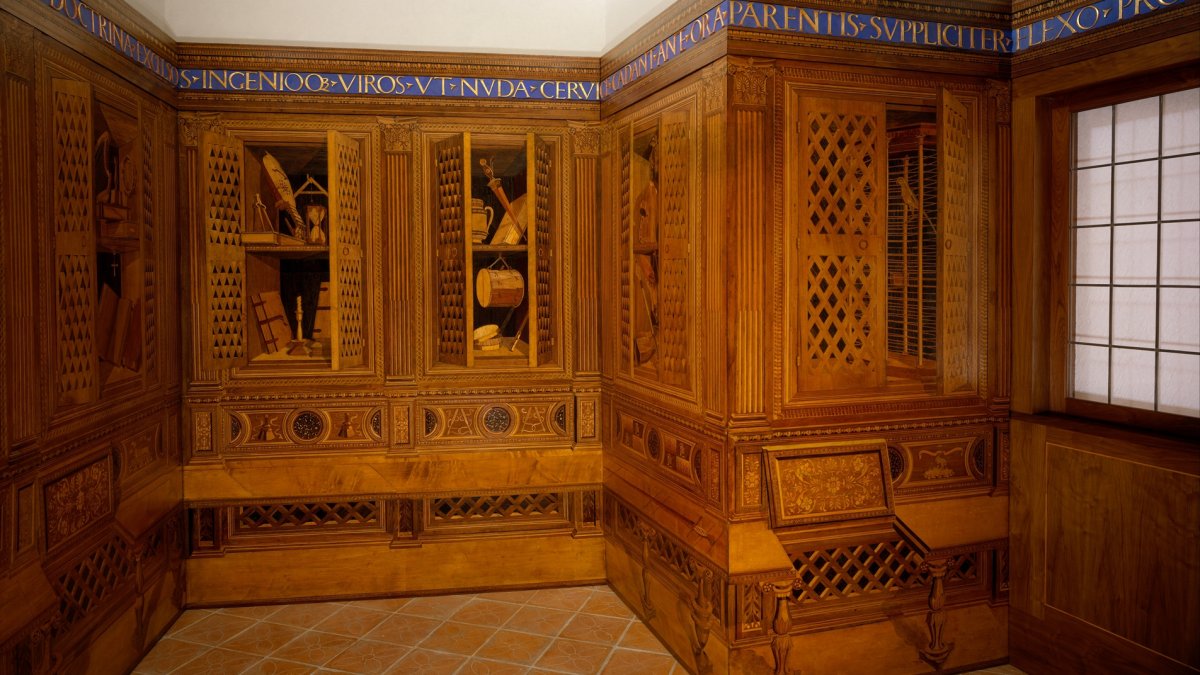
Studiolo is the Italian word for a small room kept for study and reflection, the kind that many fifteenth-century houses and palaces made space for. According to the Italian Renaissance Learning Resources, a series that the National Gallery of Art in Washington helped to produce, whoever had one was presenting himself as a person of learning and refinement, the qualities the Renaissance prized. Federico da Montefeltro commissioned such a room for his palace at Gubbio in about 1478-82. The design was by Francesco di Giorgio Martini, the workshop of Giuliano da Maiano built it in walnut, oak, beech, fruitwood and rosewood, and since 1939 it has belonged to New York's Metropolitan Museum. Another one is at Urbino, inside the Ducal Palace. Artribune, the Italian arts magazine, reported its reopening on 30 May 2025 and wrote that it was the innermost room of Federico's apartment and also the one that most fully expressed his public figure.
Set Urbino beside Fatehpur Sikri, raised in the century that followed, and the two courts meet the same problem from opposite directions. Akbar's builders gave the Hall of Public Audience a building of its own, with a second, popularly known as the Hall of Private Audience, to its north, and placed the emperor's seat behind stone screens with a passage straight into the palace. Federico's study, on Artribune's reading, held the private man and the public figure within the same walls.
The cabin of a managing director, in Mumbai as in Bengaluru, belongs to the Urbino arrangement. One room has to hold the closed door behind which a board note is read line by line and the chair across the table where a partner sits down to negotiate. As I read it, that is the tradition behind the table that requests from abroad ask us for, whether or not the word studiolo has ever come their way.
A ledger for the MD's cabin
Fatehpur Sikri
A Hall of Public Audience and, to its north, a building popularly known as the Hall of Private Audience, raised between 1571 and 1585 (UNESCO).
India, office furniture of wood and metal, 2023, in US dollars
Imports 42.3 million, exports 79.7 million (UN Comtrade; the totals are mine).
Italy's place in those Indian imports
2.8 million, about 6.7%; fourth in metal, eighth in wood (UN Comtrade; the division is mine).
Italy's rank among exporting countries, 2023
Fifth for wood, fourth for metal (UN Comtrade).
Requests from outside Italy on La Mercanti's forms that concerned a catalogue category, 2017-2026
A total of 3,028, with executive desks at 42.6% and desks of every type at 74.2%.
Read down the ledger. A country that sells nearly twice the office furniture it buys has little reason to look to Italy for volume, and in 2023 it did not; Italy supplied under 7% of a modest import bill. What our forms show, across the requests that reach us from abroad, is that people who write to an Italian distributor mostly ask for a desk, and very often for the director's table, the table at the centre of one room. The history of that room is where Italy has something of its own to offer.
Choose the table from the doorway
La Mercanti distributes furniture and manufactures none of it. We choose each piece from manufacturers we know well and follow its journey until it is installed where its user will work. Among our product pages, the one from which requests from abroad most often start is the Jera director table by Las Mobili: 789 requests, or 11.8% of all we have received from other countries. The number tells us where visitors stopped to write, and nothing about what they typed to get there.
My advice to an MD browsing our director and MD tables begins at the door of the cabin rather than in the catalogue. Stand where a visitor stands on the way in and note what meets the eye first: the depth of the top, the grain or the leather, the finish of the edge, what lies on the surface and what is kept out of sight. Choose the table for that view, and let the size of the room settle the length of the top.
Akbar's builders put a screen of pierced stone between the emperor and the hall. A director's table does its own version of that work, deciding what a visitor is shown and what stays behind the screen, and it is the first decision worth taking.
Quick answers
Who supplies India's office furniture imports?
In 2023, according to UN Comtrade, India imported 42.3 million US dollars of office furniture in wood and metal (our total). China was the largest supplier with 18 million and Malaysia second under both headings. Italy ranked fourth in metal office furniture and eighth in wooden.
Does India export more office furniture than it imports?
Yes, in wood and metal. UN Comtrade records 79.7 million US dollars of exports in 2023 against 42.3 million of imports, and the United States took 28.6 million of those exports (totals and division are ours).
What do requests from abroad ask La Mercanti for?
Of the 3,028 requests from outside Italy since 2017 that concerned a specific catalogue category, 42.6% were for an executive desk; counting every desk, 74.2%. lamercanti.in is new and does not yet have figures of its own.
What are the Diwan-i-Am and the Diwan-i-Khas at Fatehpur Sikri?
The Hall of Public Audience, where the emperor's seat is a small raised chamber behind perforated stone screens, and a building to its north popularly known as the Hall of Private Audience. UNESCO dates the city's buildings to 1571-1585.
Is any country known to produce the bulk of executive desks?
We know of none. The customs data record office furniture only by material (wood, metal) and never by type, so an executive desk is counted together with everything else.
Can a visitor learn anything about you from your office?
Something, yes. In Gosling's 2002 study, observers who did not know the occupants formed similar impressions from their offices, with some accuracy, relying on trustworthy clues found there.