
For Chandigarh, the new capital, its architects designed, in the words of the Victoria and Albert Museum, “details from street fittings to furniture tailored specifically to each building”. More than fifty years earlier Victor Horta had done the same for one house in Brussels: for his own home and studio on rue Américaine, today the Horta Museum, he drew the light fittings, the handles on its doors and even the hooks for coats. I went there on Sunday, 25 October.
Those two places, a city and a single house, hold the whole argument of this piece. The person who shapes a room ought to shape its chairs too, or at least work at the same desk as whoever does. An office comes out right when its furniture is drawn in at the same sitting that settles where daylight will fall; furniture picked once the plaster has dried, on a layout prepared by another hand for other purposes, turns up late, however handsome it may be.
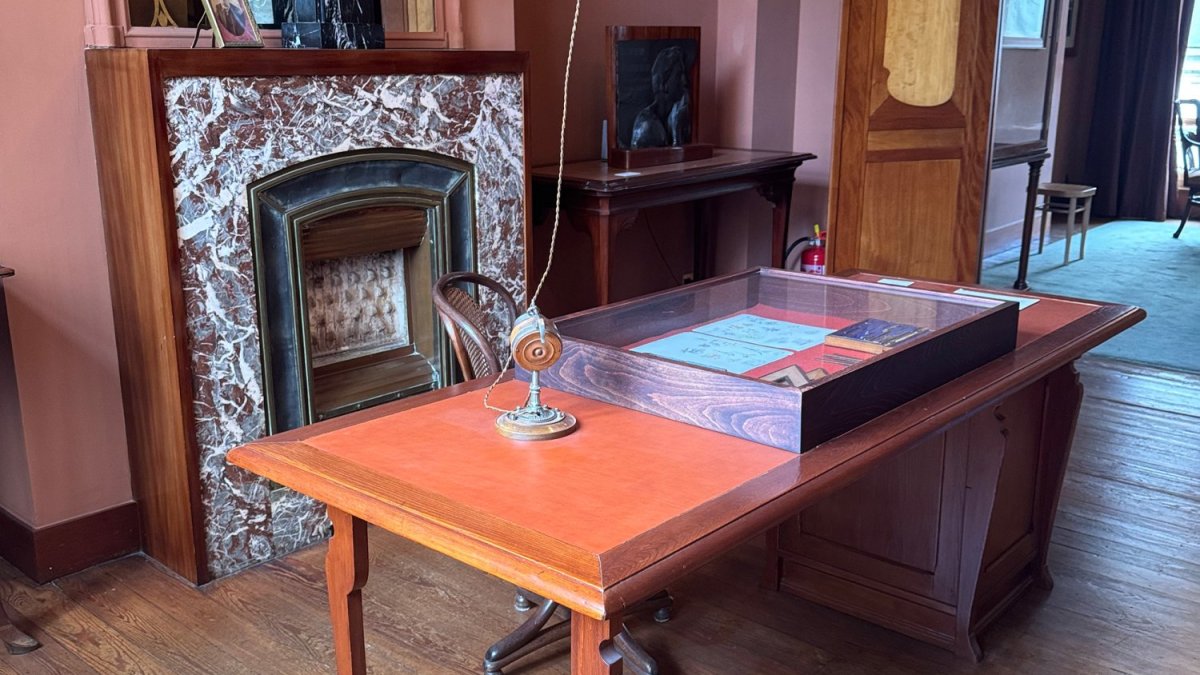
Horta put up this building on rue Américaine in Saint-Gilles over three years, from 1898 to 1901, on two adjacent plots: his home on one, his studio on the other. He kept working there until 1919, when the property was sold. It became a museum in 1969, and in 2000 UNESCO placed it on the World Heritage list together with three more of his Brussels town houses, van Eetvelde, Solvay and Tassel. The card in his office tells you that its walls were originally lined with fitted cabinetry, which also surrounded the hearth, and that the hearth alone has survived from that arrangement. At the Hôtel Solvay his pencil reached all the way to the doorbell. Reading those walls, I find it hard to say where the architecture stopped and the joinery began. Of all the rooms in the house, the one I keep going back to in my head is the model room: a wooden chair on a red-draped table, its seat still waiting for upholstery, the backrest beside it as a model in white. No label I read said who made it.
Sketch, scale, cast, craftsman: Horta’s chain of hands
On the studio floor a panel describes how the work moved, and to my eye it could pass for a factory’s quality procedure. It tells of some nights when Horta could not sleep and, carried by inspiration, filled sheet after sheet. A sketch made that way was sent down to this floor, to his draughtsmen, who numbered nineteen in 1901; there one of them scaled it to size. Next it descended to the basement, to three sculptors who turned it into a cast. Horta kept a close watch on every stage, and once a cast had passed muster it left for the craftsman, whose task was to reproduce it with no liberties taken.
I spend my working life between Italian makers and the people who buy from them, so the link that catches me is the cast. As I see it, the cast marked the moment in the studio’s chain when a drawing became something one could hold and turn over in the hands, before any craftsman started on it. Furniture projects today still have that moment, and we call it the sample or the prototype: a chair someone has actually sat on for a while, a finish carried into the room it is meant for and seen against that room’s window. The cast was where Horta’s studio could still change its mind; the sample is where an office still can.
Chandigarh, where this piece began, rewards a closer look. In its article on the furniture of the city, the V&A explains that Le Corbusier took on the furniture of the major buildings, in particular the High Court, while Pierre Jeanneret designed much of the rest. Its chairs of teak and cane were made from local materials in workshops around the city and installed in its buildings. According to the museum, the architects’ office “comprised a lot of people”, among them Eulie Chowdhury, a young Indian architect who joined in 1951 and designed some of Chandigarh’s wooden furniture. I see in it rue Américaine enlarged to the size of a city, with the drawing office and the workshops answering to the same buildings.
If your layout includes Designer Chairs, have one placed in the actual room before you sign for the whole set, and look at it at the hour of the day when that room is fullest.
Before the purchase order: a checkpoint for each pair of hands
All of this matters to whoever sits in the room every morning, years after the architect has handed over the keys. Daylight lands on the desktop because desk and window were settled in a single conversation. The guest chair sits at a comfortable distance for talking since somebody fixed that distance on paper, and storage planned for the side wall leaves the finest wall clear. Whenever I enter a room put together that way, I read it as one composition and I credit the order to the person who works there. Last month I wrote about the director table and what an MD’s cabin tells people about its occupant; to my mind, Horta’s house shows that this telling starts on the drawing.
So when a company is planning new offices, furniture should already be in the minutes of the very first design review. Practices specifying Italian pieces for Indian projects can come to us through the trade program for architects in India, where a written Spec Pack sets out each item piece by piece; the time to use it is while the drawings can still move. A company going ahead without a designer can keep the same order by itself, borrowing from Horta’s studio one checkpoint for every pair of hands its drawings passed through.
The sketch. Is the furniture already on the plan, drawn to scale, before walls and power points are frozen?
The scale drawing. Has anyone tested that plan against the room as it will truly stand, columns included, and against the windows that will put light on a desk at nine and somewhere else by four?
The cast. Which pieces will you have seen and sat on before you order them? The chair someone occupies through the whole working day deserves a sample first of all, and an upholstery fabric tells you more under your own ceiling than in a swatch book.
The craftsman. Does the order spell out precisely the sample you signed off, finish and covering included? Horta’s craftsmen were held to the cast, and a purchase order should give the maker no more freedom than they had.
One last object from the boudoir. The chair displayed there was designed by Horta for his own home in roughly the years the house went up, and between the two world wars he personally chose its cut-velvet upholstery to match the residence he had moved into. As I read it, the house around the chair had changed, and the chair was dressed to follow it. My advice to any MD preparing a move: put the furniture discussion in the diary for the week the architect shows the first layout. By the week the painters pack up, it is too late.
Quick answers
Where is Victor Horta’s house and what can visitors see there?
The Horta Museum is the house and studio that Horta built for himself and his practice at 23-25 rue Américaine in Saint-Gilles, Brussels, between 1898 and 1901; he worked in it until the sale of 1919. It became a museum in 1969, joined UNESCO’s World Heritage list in 2000 along with his Hôtels van Eetvelde, Solvay and Tassel, and today displays furniture, utensils and art objects by Horta and other designers of the period.
What path did a design follow inside Horta’s studio?
The museum’s panel describes it: a sketch by Horta, scaled to size by one of his draughtsmen (nineteen in 1901), turned into a cast by three basement sculptors, with every stage closely supervised by Horta, and once the cast had passed muster sent to a craftsman bound to follow the cast to the letter.
Why mention Chandigarh in a piece about Horta?
Because there too furniture was drawn for particular buildings. The Victoria and Albert Museum records that Chandigarh’s architects designed furniture tailored to each building, with Le Corbusier responsible for the major ones such as the High Court, Pierre Jeanneret for much of the rest and Eulie Chowdhury for some of the wooden pieces, made in workshops around the city.
At what stage of an office project should the furniture be decided?
I would say at the very first design review, while light and circulation are being settled, so that desks and chairs are part of the plan. Before ordering, a sample you have tried does the job the cast did in Horta’s studio.