Already have something in mind?
Trade terms for professionals and design studios
Already have something in mind?
Trade terms for professionals and design studios
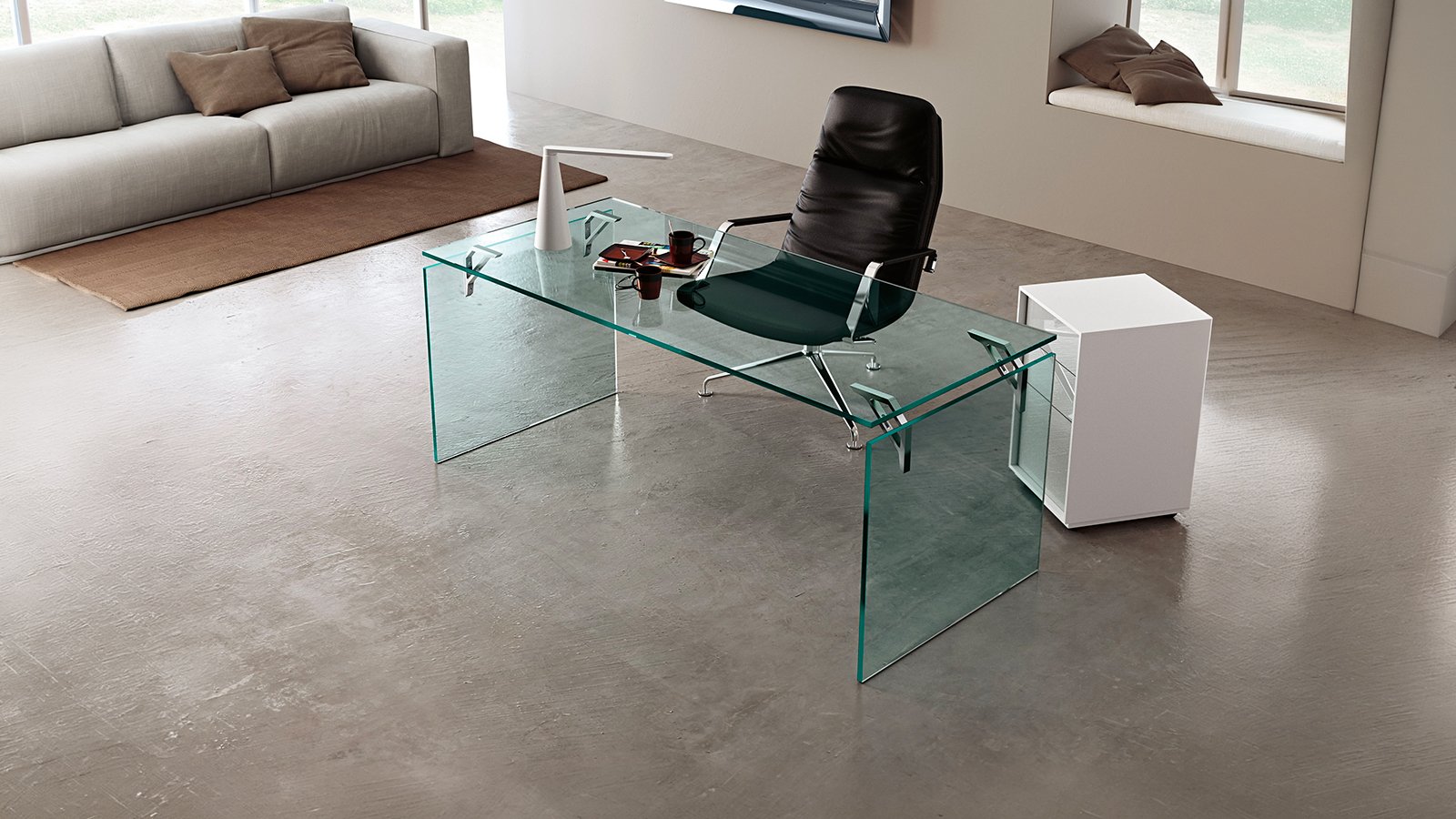
Five sizes, one height. Bright begins at 120 × 60 cm and ends at 180 × 80 cm, and all five stand 73 cm from the floor, so the choice is settled by the room around it. Fiam files it under Home Office in its catalogue; we would put it just as readily in a director's cabin. Anyone shortlisting designer tables for home offices will find in it a Valerio Cometti design built around glass.
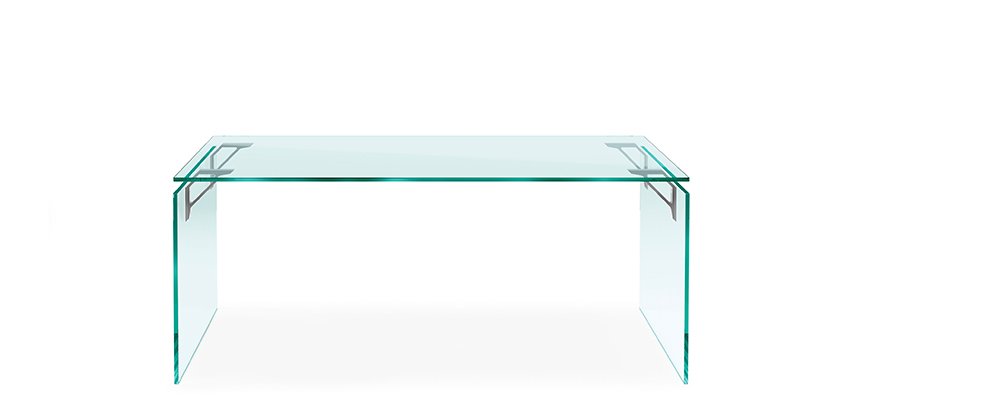
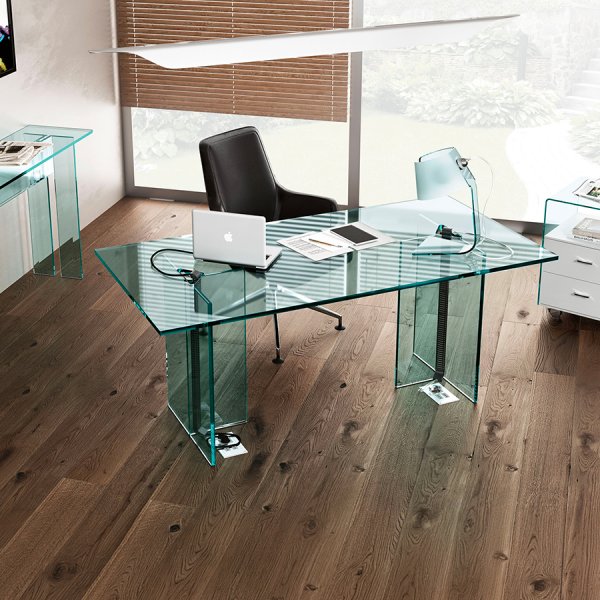
The glass is tempered, 15 mm in section, and cut into three panes, one for the work surface and two standing as legs, which Fiam joins with fixing supports of aluminium and steel and describes as demountable. On glass office tables the edge is where a sheet shows its character, and here the photographs give it a green-blue tone. In our opinion that edge deserves as much thought as the size.
Size it by the room, then. A study at home or a small cabin takes the 120 × 60 or the 130 × 60. A working office with a guest chair suits the 140 × 70 or the 160 × 70. A director's cabin, where meetings happen across the glass, calls for the 180 × 80, and a larger room can go further still, with a top made to measure up to 240 × 120 cm. Two grades of glass complete the range: Standard and Extralight. La Mercanti draws the swing of the cabin door on the client's plan and rules out every size it cuts across.

Share the finishes you wish to evaluate
Yes. Fiam will cut the top to order, as large as 240 × 120 cm, and the English text of its data sheet says it is ordered by the centimetre. The length can therefore match an alcove or a wall exactly, rather than stopping at the nearest standard step. In the same drawing the depth goes to 120 cm, enough for a proper meeting across the table in a large cabin.
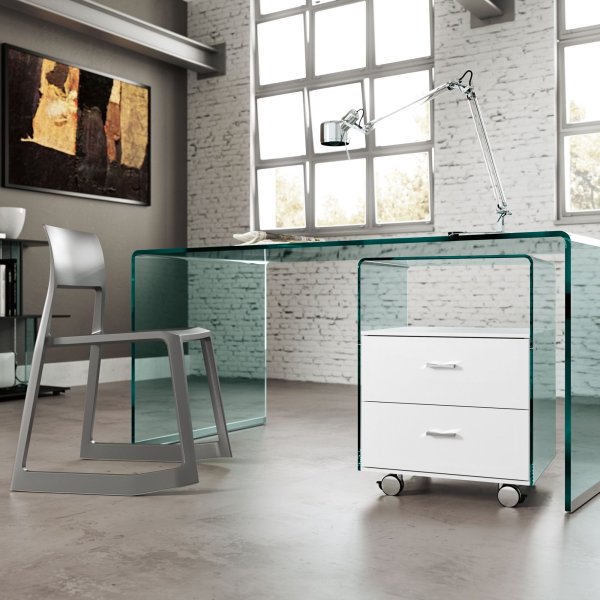
No more than 180 cm, according to Fiam's custom drawing. Up to that length the legs stand level with the ends; from 181 cm they move inwards, and the surface runs on past them. Between the legs sits whoever works there. Beyond them, at each end, a stretch of surface stays clear, and in our view that is the natural place for a mobile pedestal or a second chair.
It is Fiam's own word, and the sheet adds nothing to it. The photographs show three separate sheets of tempered glass, one top and two legs, held together at the corners by small metal fixings. In practice, for an office on an upper floor, the pieces can go up by stairs or lift one at a time, and leave the same way if the company relocates.
Fixing supports of aluminium and steel. In Fiam's photographs each one is a small, shiny triangular bracket, screwed to the glass just beneath the work surface, at the point where the leg rises. Nothing else in the piece is metal, so we suggest matching them to the other metals in the cabin: door handles, the lamp, the base of the chair.
73 cm is the height Fiam gives for all the standard sizes, and it is the height at which one sits to work. Our advice is to try it with the chair that will actually be used, armrests included, before confirming. For work on a stool, or reading on your feet while leaning on the desk, ask for more: Fiam allows up to 90 cm on request.
Bright is made in two grades of tempered glass, Standard and Extralight, which Fiam names without describing. Five steps to choose between them, starting with the metal that sits against the glass.
On Bright the glass meets metal at the corners, where fixing supports of aluminium and steel tie each leg to the work surface, the aluminium given a polished finish. That metal sits right against the edge of the glass, so it is the first colour the glass will be seen next to. Look at the two together.
The face of a clear sheet says little. Its edge says more: in Fiam's photographs it shows a green-blue tone, 15 mm deep, running along the top and down both legs. From a visitor's chair that line is what registers, so compare the two grades by their edges, not by their faces.
We find the Extralight edge paler than the Standard one. The difference is easiest to judge in daylight, so hold the two samples side by side near a window, at roughly the height of the finished surface, rather than under the spotlights of a showroom.
Next, lower the samples to the floor and set them against the walls of the room. Stone, timber, a pale wall or a dark one: each changes how much of that green-blue line is noticed. The legs stand directly on the floor, so the floor deserves the closest look.
Write the grade down only once metal, daylight, floor and walls have been seen together. Fiam offers Standard and Extralight on Bright without stating a preference, so the room, not the catalogue, should settle it, and the same choice should then hold for the top and both legs.