What did you have in mind?
Trade terms for professionals and design studios
What did you have in mind?
Trade terms for professionals and design studios
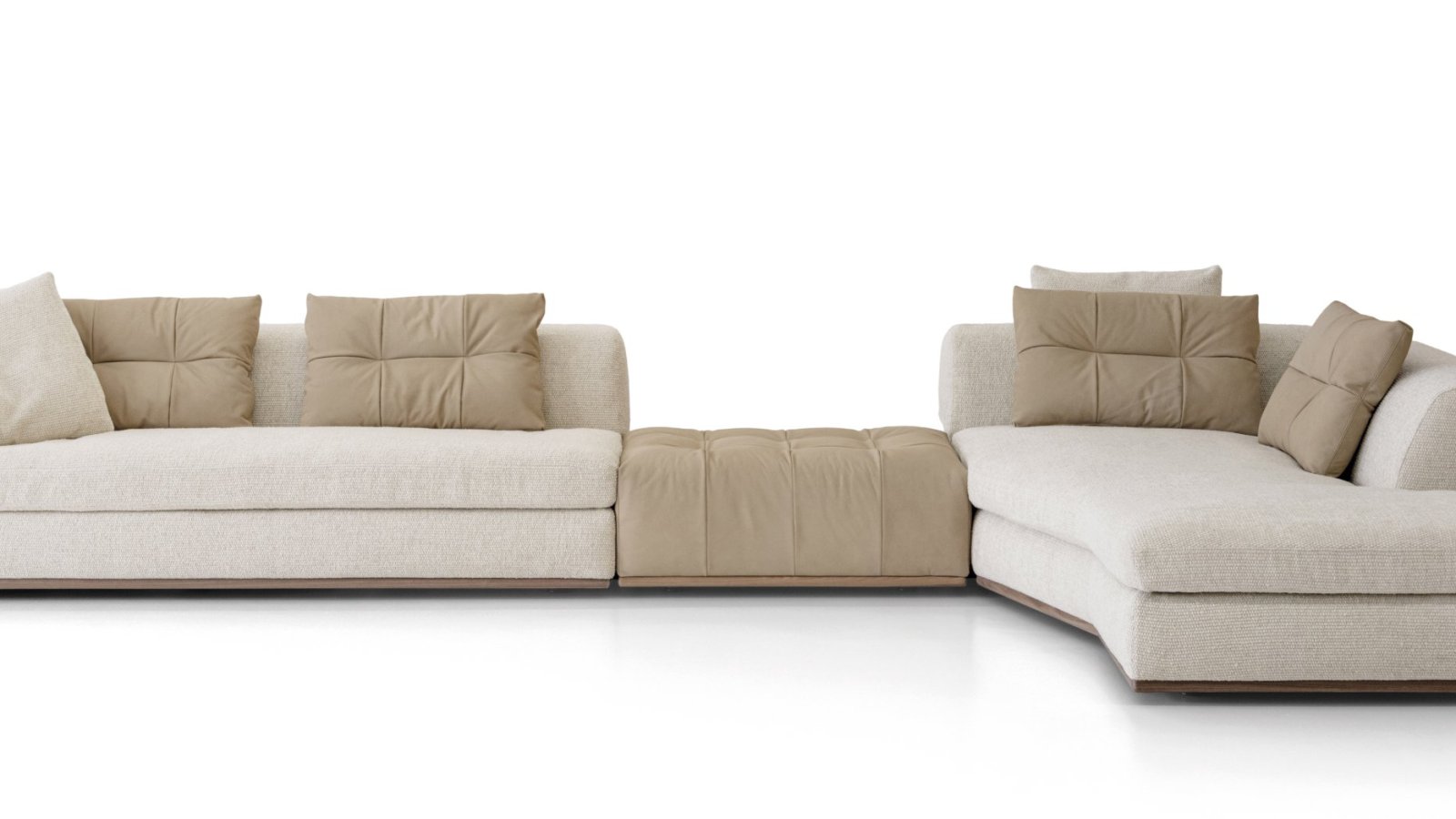
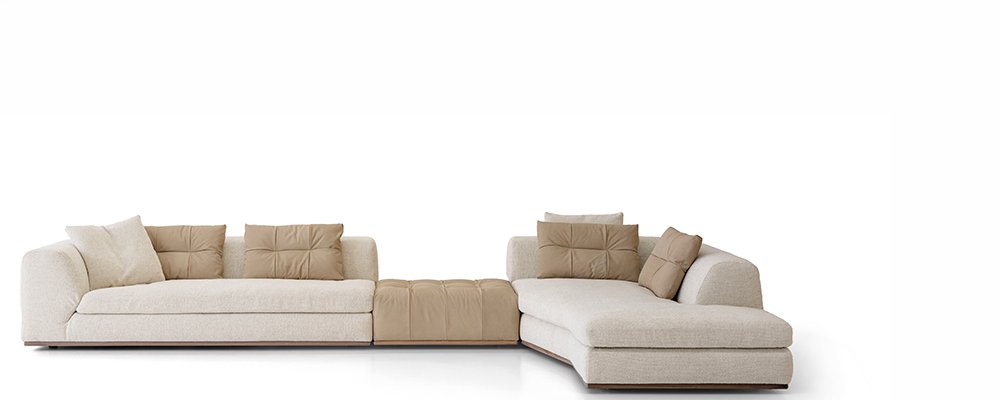
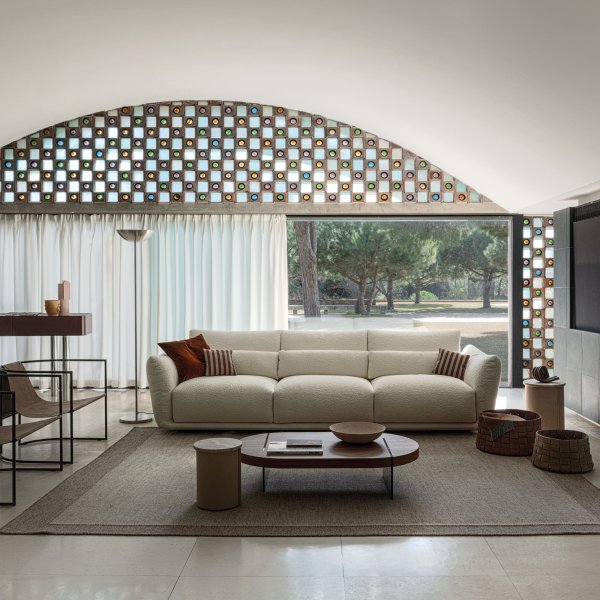
At 65 cm from the floor, the body of Montgomery stops. Arm and back finish at that same height, and only the loose cushions rise above it, to 75 cm on the elements with an arm and 70 cm on the armless ones. Cierre describes the result as “low, sleek, and understated”, and here the figures say exactly what the adjectives do. We put it forward whenever a client asks for design sofas and armchairs that leave a window or a wall of books in full view.
Below that line runs a solid wood base, 3.5 cm high, in bleached Canaletto walnut or black ash. The design is by Gianmaria and Stefano Conficconi, 2025. Our place for it is the executive cabin, set against the glass or under a painting: from the desk, the eye passes over the sofa instead of stopping on it.
Read the family from the floor upwards. Lowest is the wooden base. At seat level come the square pouf, flush with the cushions, and the quilted poufs carrying a flat top. At the 65 cm line sits every element with a body: side units with one arm, armless centre units, corners, the chaise unit, whose seat runs long, the end unit with a half-length back, the side units with a small table let into one end. Most of them are also made in a quilted version, stitched in squares. La Mercanti stands at the cabin door and checks what remains visible above the back.

Share the finishes you wish to evaluate
A wooden frame, with elastic webbing as its support: that is how Cierre's technical sheet describes the structure of the whole range. The seat cushion and its padding rest on it, and the solid wood base runs beneath. For an architect writing a specification, it means both the hidden structure and the visible base are timber, each named by the maker, with nothing left to assume.
A square of 160 × 160 cm. The chaise unit is a side element with a long seat, made left or right, standing 75 cm tall like the other pieces with an arm. Cierre also makes it quilted and draws it at the end of a row of side units, as in a composition of 343 × 160 cm. In a cabin we see it as the seat for whoever takes a long call with their legs along the cushion.
Acrylic fibre treated with silicone, Cierre writes: a light filling for cushions that lean against the sofa rather than belonging to it. That makes them the easiest thing on Montgomery to rearrange. Move one behind someone working on a laptop, take one away for a tall visitor, put them back in a row once the room empties. The sofa changes posture without changing a single element.
Two: Gianmaria and Stefano Conficconi, for 2025. Conficconi is also the name of the family that founded Cierre, so the drawing comes from inside the company that builds the sofa. When a client asks who stands behind a piece, that is a straightforward answer to give, and an easy one to check against the maker's own story.
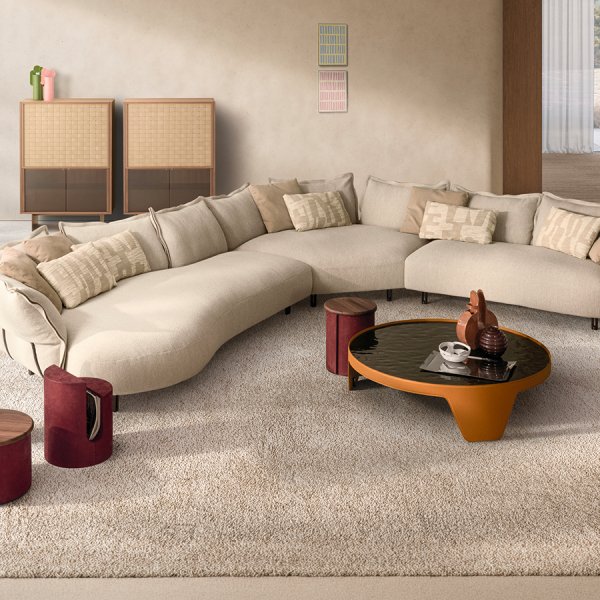
Yes, with the oblique side unit: 235 × 147 cm, left or right, either plain or with a small table at its far end. Its seat swings round at a wide angle rather than ninety degrees. Cierre's largest drawn composition, 395 cm across, combines the version with table and a quilted 160 cm corner. In a long cabin, it lets the sofa follow a window or turn gently towards the desk.
Montgomery has poufs of two kinds: one large square pouf and three quilted ones with a flat top. Here is how to group them, working from the middle of the room towards the sofa.
Place the large Montgomery pouf first: 110 × 110 cm, the only element in the range without a back, so it can be approached from all four sides. Put it where the centre of the room falls, not where the sofa happens to end, and let everything else follow from it.
Three more poufs, made only quilted, are 72, 95 and 118 cm wide and 110 cm deep, with a flat top 38 cm deep along one side. Turn that top towards the armchairs or the desk, where a cup or a file is most likely to be put down.
Every pouf stands 41 cm tall, the same as the sofa seat. Pushed against the sofa, a pouf reads as an extension of the cushion; pulled away by a metre, it becomes a seat of its own. Decide which of the two roles each one plays before fixing its place.
Each sofa element is 114 cm deep. Measure the passage from that front edge to the poufs, not from the back wall, and keep enough room for a visitor to reach the sofa without stepping over anything. In a cabin, that walkway matters more than one extra pouf.
The large square pouf is plain; the three with a top come only quilted. In Cierre's photographs the camel quilting sits beside a light fabric with a coarse weave, so a mixed group looks intended rather than accidental. Choose the finish of the poufs after the sofa, not before.