Let's discuss your project
Trade terms for professionals and design studios
Let's discuss your project
Trade terms for professionals and design studios
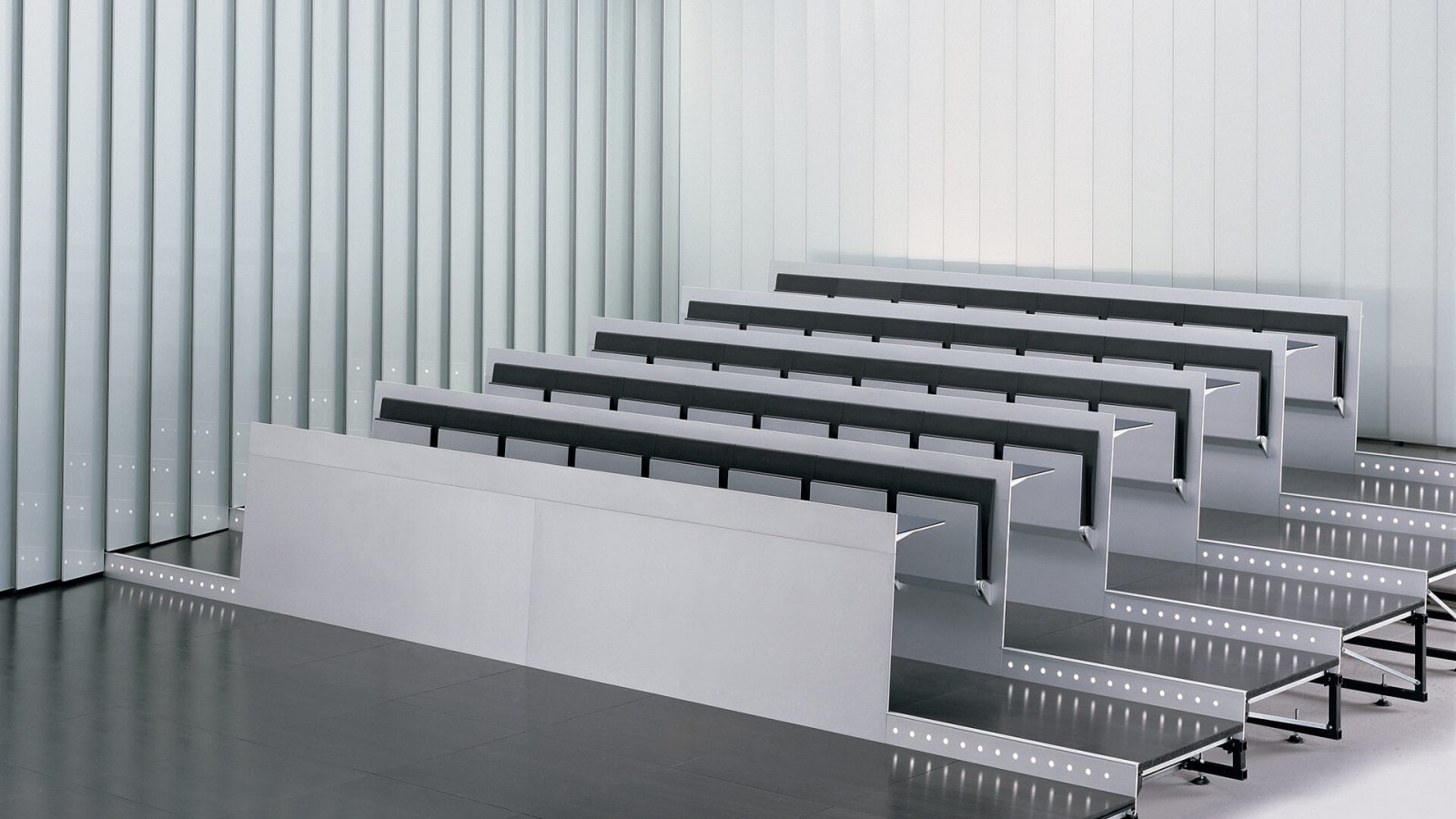
The question that settles an order of lecture hall furniture is rarely about the bench. It is about what is under it. Lamm answers it in three ways, and the same Blade bench serves all three.
On an existing level floor and on an existing step, installation is by special steel feet with an aluminium covering, screwed straight into the existing slab. The building keeps whatever levels it has; nothing is poured, nothing is raised. On a Lamm platform or modular terraced system, supplied together with the benches, the support uprights are instead anchored directly to the metal structure underneath — a different fixing, through a concealed joint, and a different set of possibilities, because the volume below the floor becomes usable.
That third case is the one that buys the most. The platform is built from tubular iron reticular beams assembled on site, and its flooring is made of removable panels: cables for power and data travel inside it and come up to each position, and the finish layer can be natural wood, laminate, fitted carpeting or another material on request. The steps above it are drawn with variable height and depth, and their risers can be arranged to carry step-marking lighting or an aeration system.
Alongside the teaching rooms of a university, the manufacturer lists auditoriums and conference halls. The study bench may be ordered by itself, and the teacher's desk is produced to the dimensions asked for.
Range: Blade System
Manufacturer: Lamm — Lamm S.p.A., Italy
Design: Dante Bonuccelli
What it is: study bench system for university lecture rooms, conference halls and auditoriums, integrating study bench, structure, raised platform and risers; every project developed on demand
Three installation conditions: existing level floor — steel feet with aluminium covering, fixed directly to the floor · existing step — the same direct floor fixing · Lamm platform or modular terraced system — support uprights anchored to the metal structure below
Elements: study bench · teacher's desk on project · raised platform · modular terraced step system · side or intermediate passage risers
Bench structure: extruded aluminium panels, 10 mm thick, fitted together by joints and fixed to support uprights
Writing surface: extruded aluminium coated with 4 mm scratchproof stratified HPL — silver, anthracite, black
Seat: support in thick extruded structural aluminium, internal spring tip-up mechanism with automatic return
Padding: Class 1 integral polyurethane, CertiPUR® certified, colour printed in depth — silver, anthracite, black
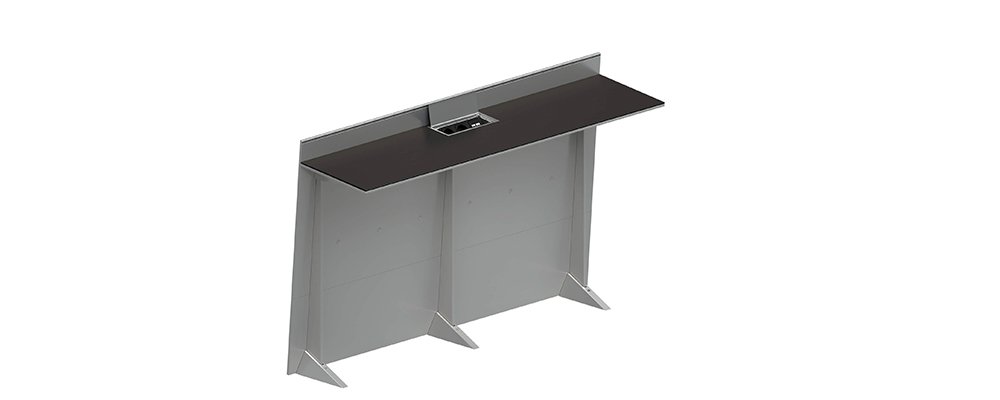
Power and data: provision for cable transfer from the raised platform to the working surface; sockets under the surface, reached through anodized aluminium covers; socket on demand
Raised platform: tubular iron reticular beams assembled on site, light and fully demountable, special joints for coupling the uprights; metal adjustable feet with rubber support surfaces
Flooring: removable fireproof chipboard panels, finish layer in natural wood, laminate, fitted carpeting or other materials on request; inspectable
Steps: variable height and depth; passage risers in extruded aluminium with non-slip horizontal finish, able to incorporate step-marking lighting or aeration
Teacher's desk: extruded aluminium panels, 10 mm scratchproof stratified HPL surface; dimensions as requested
Aluminium finish: liquid coating in black, silver or anthracite
Accessories: provision for power and data cabling (socket on demand); direct floor fixing feet
Overall height: 82 cm
Writing surface: 74 cm
Seat: 46 cm
Bench depth: 35 cm closed, 42 cm with the seat open
Centre to centre: min. 51 cm, reducible by up to 6 cm to a compact 45 cm
Side shoulder: 8 cm
Row depth on the step: 90 cm
Testing: tested according to European standards (no standard numbers declared)
Awards: Grand Design 2005, International Award, Milan · Work & Emotion 2004, Intelligent Space category, Eimu, Milan

Share the finishes you wish to evaluate
Yes, and no platform is needed. The manufacturer provides for installation on pre-existing flooring, both level and stepped, using steel feet under an aluminium cover, anchored into the slab itself. The alternative — benches on a Lamm platform, with uprights anchored to the metal structure below — is chosen when levels have to be created or when services must run under the seating.
Inside the raised platform and up to the surface. The system is arranged for the transfer of network connection cables from the platform to the working surface, with sockets positioned underneath it and reached through anodized aluminium covers on the desk. Provision is standard; the socket itself is supplied on demand, so it has to be specified.
No. The manufacturer allows the bench alone, for a level surface or for tiers that are already built. Buying the complete package instead — with structure, platform and risers — is what opens the under-floor cable route and the modular tiers; the bench itself is the same either way.
90 cm on the step. That is the figure to design the tier against, and it already includes the circulation behind the bench: the bench itself accounts for 35 cm when the seat is up and 42 cm when it is down.
By 7 cm per row. The bench measures 35 cm deep with the seat closed and 42 cm with it open. Because the seat has an internal spring with automatic return, the row recovers those centimetres on its own as the hall empties, without anyone folding the seats back.
Nothing about the bench needs explaining to a student, but a facilities team is often asked. Here is the whole sequence, in five moves.
The seat tips down on a support in extruded structural aluminium. It carries an internal spring mechanism, so it moves under hand pressure and stops where it is meant to.
The writing surface is extruded aluminium faced with scratchproof stratified HPL, at 74 cm from the floor, with the seat at 46 cm. Both heights are fixed by the system and need no adjustment.
Where the position is served, a cover in anodized aluminium on the desk lifts to expose the outlets held under the surface. It is the only part of the cable route that is ever visible.
The cover returns flush with the writing surface. Closed, the plane is continuous again — which is also what keeps the surface easy to wipe down between sessions.
On standing, the automatic return takes the seat back up and the bench goes from 42 cm to 35 cm of depth. The aisle widens again without anyone being asked to tidy the row.