
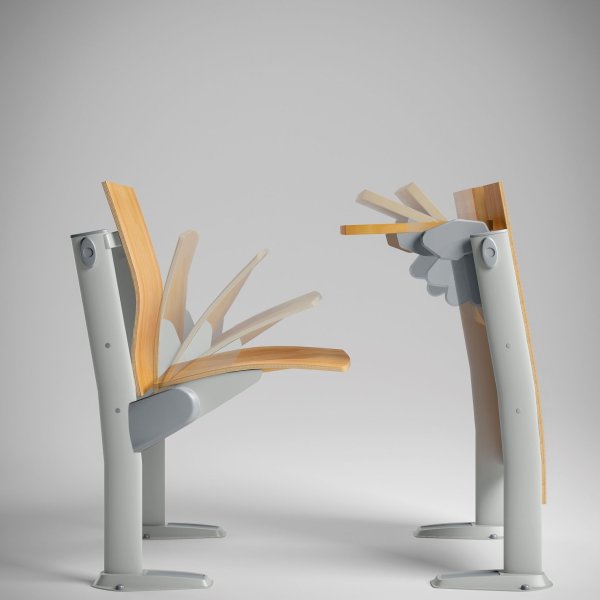
Omnia Evolution
₹ 120
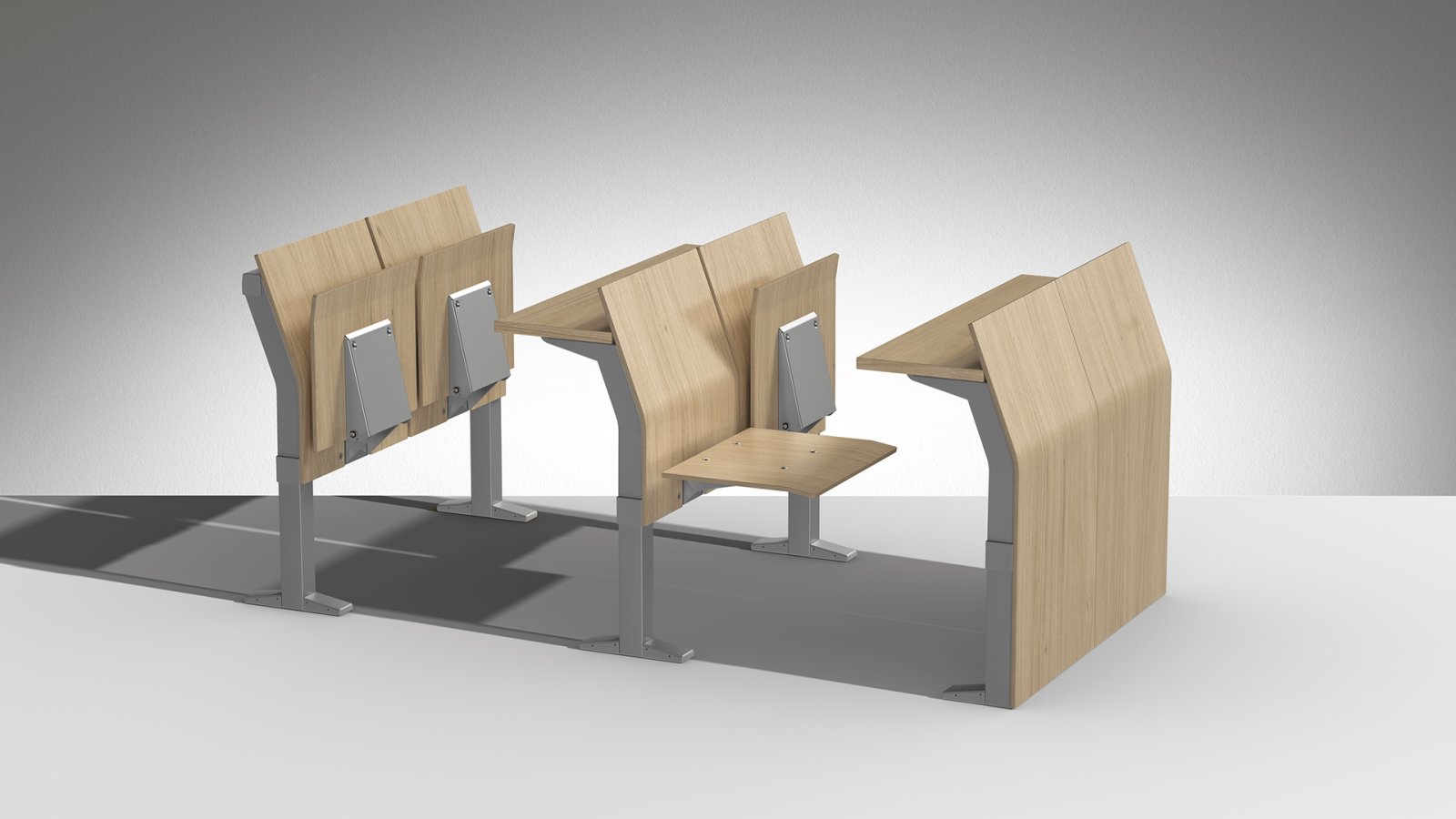
Straight rows are a habit, not a requirement. In a room where the speaker stands at the front, a curved row puts more people at a workable angle to the same point, and the E5000 is built to take that shape: compositions run in a straight line, on a curve with a minimum radius of 500 cm, on tiers or on sloping floors.
The curve is possible because of how the system is built rather than because of a special part. The load-bearing beams are continuous extrusions with internal ribs and external grooves, so uprights and tables attach where the geometry asks rather than at a fixed module — and the tip-up writing table stays fixed to that same continuous beam on curved runs too.
The rest follows the room: three bench types for front, intermediate and end rows, three versions of the writing table, and front panels running to the floor that are available for straight and curved layouts alike. La Mercanti supplies E5000 across Indian campuses, with samples and the finish schedule agreed before the order.
Collection: E5000
Manufacturer: Lamm — Lamm S.p.A., Italy
Design: Orlandini Design
What it is: a continuous, integrated system of seats and tables that can be composed in a straight line, on a curve, on tiers or on sloping floors; an evolution of the E4000 system, from which it inherits its main features
The three versions: fixed writing table · tip-up writing table · tip-up table with arms (arms are available on this version only)
The three bench types: front row, with tip-up or fixed writing table; intermediate row, with tip-up or fixed table and tip-up seat; end row, with tip-up seat only
Structure: load-bearing beams in anodised extruded aluminium, black or silver; upper and lower bars with a rounded square section, internal ribs and external grooves that allow uprights, tables and feet to be positioned without pre-set drilling; uprights in pressed and painted sheet steel; feet in pressed sheet steel prepared for floor fixing, with technopolymer covers in silver or black; the feet at the start and end of each row always align with the uprights; epoxy-polyester scratch and corrosion-resistant coating in semi-matt silver or semi-matt black RAL 9005. In the fixed-table version the bench has no upper horizontal bar and the table is carried on painted metal brackets
Dimensions and geometry: adjustable seat pitch, minimum 51 cm; the drawings for the version with arms show a 57 cm pitch; minimum curve radius 500 cm; dimensioned drawings for tiers up to 10 cm, up to 24 cm and from 24 to 50 cm. On tiered installations the backrest height varies with the height of the tier
Tip-up writing table: retractable, with anti-panic movement and a slowed, damped closing system (Patent Pending) that takes the table from use to rest position in a controlled and silent way; top in HPL double-laminate chipboard in beech, oak, grey oak, eucalyptus, graphite, silver or black, matching ABS edge, 14 mm thick, 45 × 30 cm (deeper on request); technopolymer supports and slide guides; fixed to the continuous extruded beam, including on curved runs
Fixed writing table: HPL double-laminate chipboard in the same finishes, ABS edge with rounded corners, 30 mm thick, 30 cm deep (deeper on request)
Front-row panels: single vertical panels running to the floor, for straight or curved layouts: plywood with HPL double-laminate finish in beech, oak, grey oak, eucalyptus, graphite or silver, or plywood in beech or oak treated with a clear polyurethane coating that is anti-glare, anti-slip and scratch-resistant
Seats and backs: plywood with HPL finish, beech or oak with clear polyurethane coating, or upholstered with the increased padding supplied as standard: back with internal plywood support and non-deforming, flame-retardant polyurethane foam; seat in cold-foamed polyurethane; CertiPUR® certified padding. Tip-up seat mechanism with damped automatic return
Accessories: arms with painted tubular and sheet-steel frame and armrest in solid beech or oak, or upholstered (tip-up table version only); storage basket in 2 mm steel flat bar; inter-row bar for installations without floor fixing; seat numbering; row identification element; provision for electrification and data cabling, with socket on request
Materials and testing: wooden components with low formaldehyde emission; tested to European standards; technical documentation Rev. 2 dated 06/2024
Not declared by the manufacturer: load ratings, warranty terms, lead times and references to specific standards
Five steps that belong to the plan, not to the sample board.