Technical information based on data declared by the manufacturer.
Collection: E4000
Manufacturer: Lamm — Lamm S.r.l., Italy
Design: Lucci e Orlandini
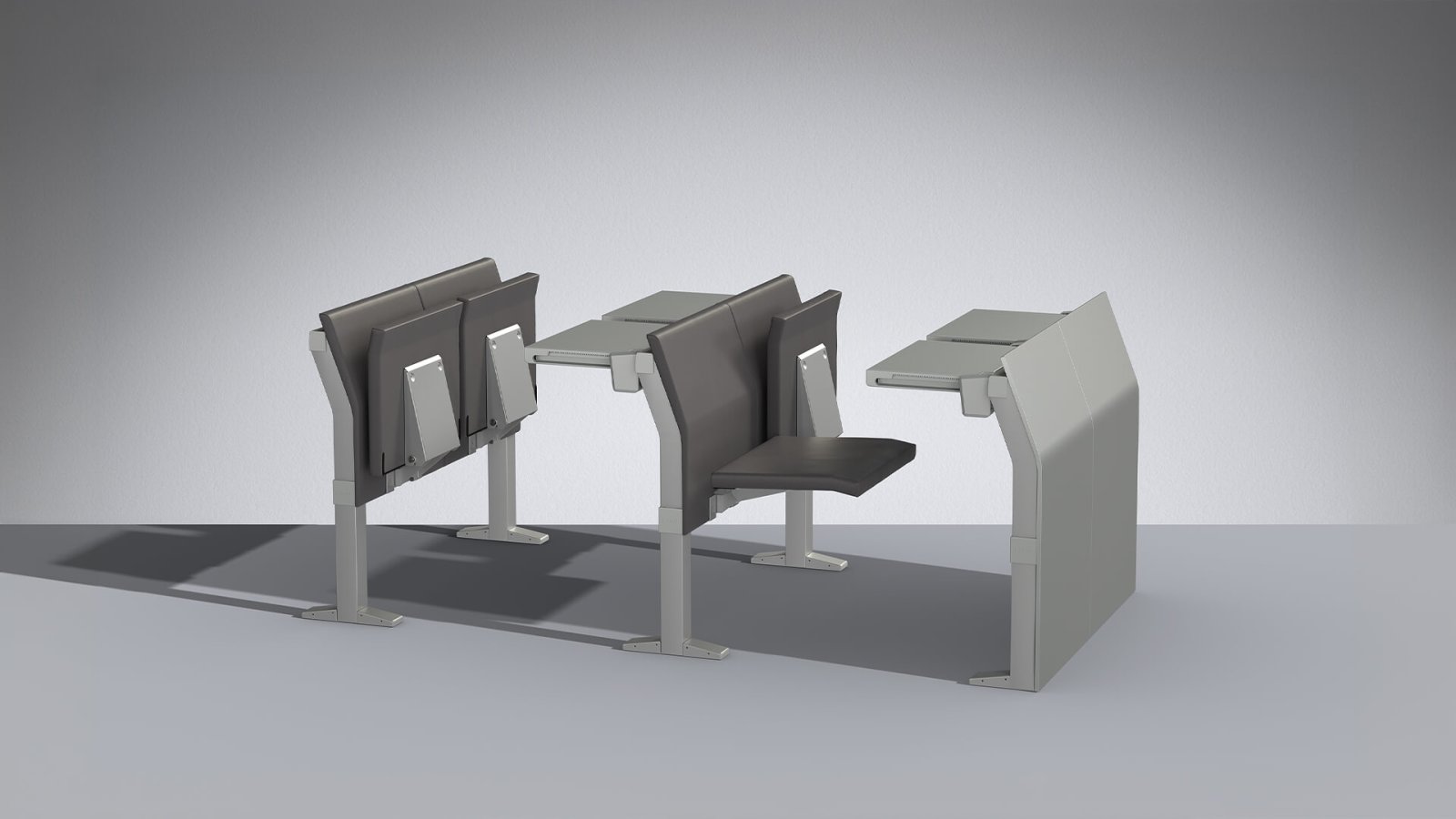
What it is: continuous integrated system of seats and tables for lecture halls, configurable straight or curved, on wide steps or on sloping floors; components answer the functional needs of a teaching room and take technological and multimedia equipment
The three bench types: front row, with fixed or tip-up writing top · middle row, with fixed or tip-up top and tip-up seat · end row, with tip-up seat only
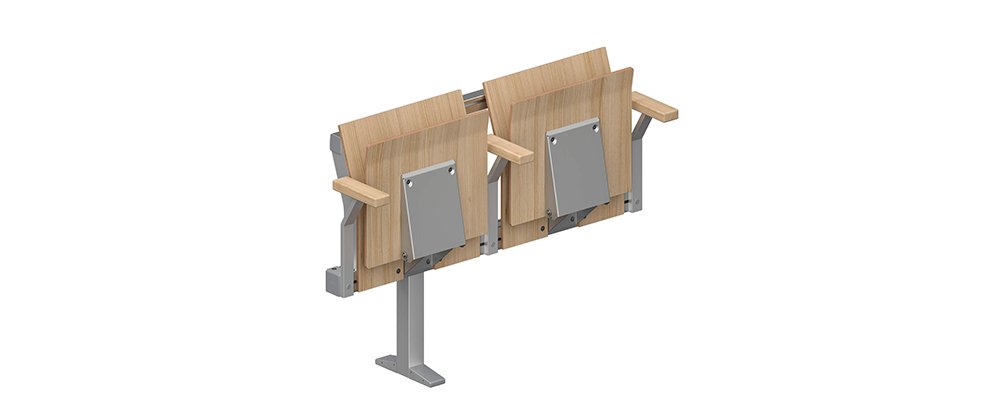
The three executions of seat, backrest and panel: plywood faced with HPL on both sides · beech or oak plywood with clear polyurethane coating, anti-glare, anti-slip and scratch resistant · upholstered, with inner plywood support and fabric or faux leather cover
Beams: extruded anodised aluminium, coated black or silver; upper and lower bar in rounded square section, with internal ribs and external grooves that locate and fix uprights, tops and feet with no preset drilling and at variable pitch
Uprights: pressed and coated sheet steel, with plates at the ends for connection to the beams
Feet: pressed sheet steel, prepared for floor fixing, with technopolymer foot cover in silver or black
Coating of steel structures: epoxy-polyester powder, scratch and corrosion resistant, semi-matt silver or semi-matt black RAL 9005
Front-row panels: single vertical panels, tall enough to cover the lower bar, for straight or curved layouts; the front row can also be combined with conference armchairs
Backrest: ergonomic, follows the anatomical curve of the spine
Seat: tip-up with automatic return; support plate and beam connection plate in pressed sheet, rotation devices; damped automatic return available on request
Padding: backrest with inner plywood support and polyurethane foam; seat in cold-foamed polyurethane; padding CertiPUR® certified
Tip-up writing top: anti-panic action, slow damped closing (Patent Pending), controlled, safe and quiet travel from use to rest position; particleboard faced with HPL on both sides, matching ABS edge 14 mm, 45 × 30 cm (deeper on request); fixed on a continuous extruded rod, including the curved version; technopolymer supports and sliding guides
Fixed writing top: particleboard faced with HPL on both sides, ABS edge with bevelled corners, thickness 30 mm, depth 30 cm (deeper on request); in the fixed-top version the bench has no upper horizontal bar; supported on coated metal brackets
HPL finishes: beech, oak, grey oak, eucalyptus, graphite, silver, black
Fabrics: Inca, King, Trevi CS, Silvertex, Extrema Au collections
Wood components: low formaldehyde emission
On steps: backrest height varies with step height; declared bands H up to 18 cm and 18 to 50 cm
Centre distance: adjustable, minimum 51 cm; 55 cm on rows with armrests
Module width: 48 cm; first stretch of the row 24,5 cm (29,5 cm with armrests)
Heights: panel 80 cm · writing top 75 cm · seat 46 cm · backrest 69 cm on rows with armrests
Row depth: 90/95 cm with fixed top · 80/90 to 85/90 cm with tip-up top
Curve: minimum radius 500 cm
Accessories: armrests, tip-up top version only, with tubular and coated sheet frame and solid beech or oak or upholstered armrest · seat damper · storage basket in 2 mm steel · inter-row bar for installation without floor fixing · seat numbering and row identification · wiring and data line provision (socket on request)
Environmental recognitions declared by the manufacturer: first study bench in Europe to receive the European EU Ecolabel ecological quality mark; B rating in the Éco-Impact analysis
Testing: tested to European standards (the manufacturer states no standard numbers)