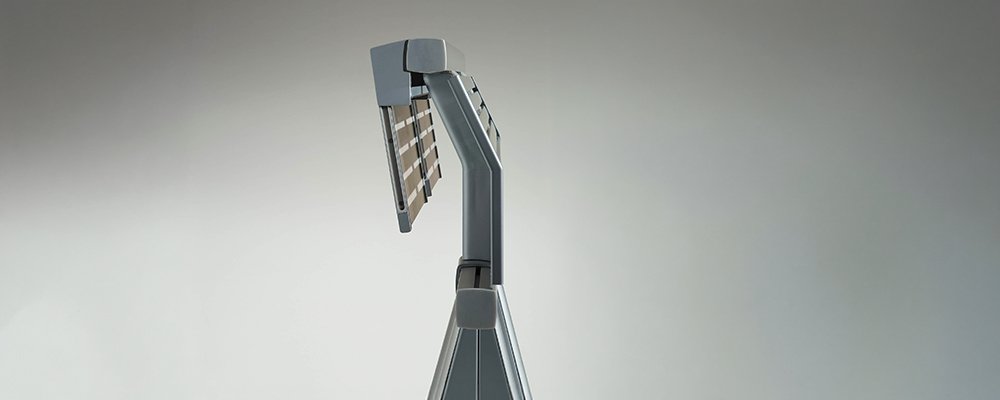
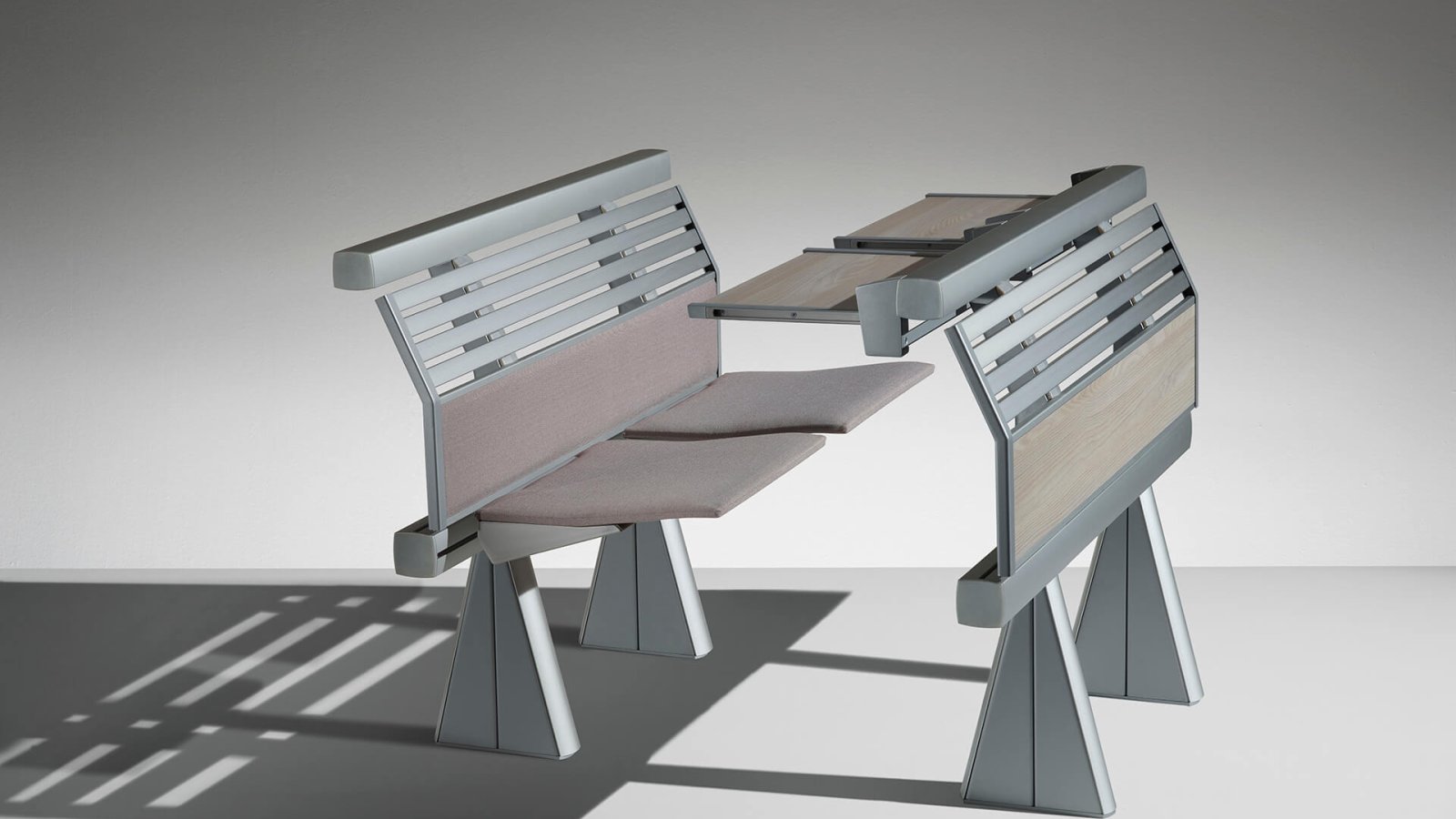
Lamm Runner benches installed across a tiered lecture hall

Two choices on Runner produce four different benches, and four sets of drawings

Lamm

Orlandini Design

Runner
Runner An icon of Italian design
From ₹ 2,500

Already have something in mind?

Trade terms for professionals and design studios

Specifying a lecture hall goes wrong at the drawing stage more often than at the ordering stage. Runner is a case where two independent choices multiply: the writing table is fixed or tip-up, the backrest continuous or single, and the manufacturer publishes four separate sets of dimensioned drawings for the combinations.

The pair that moves the plan is the table. With the fixed table a row occupies 95 cm; with the tip-up table 75/90 cm. Across twelve rows that difference is worth close to two more rows of seats, which is why the table is settled before the hall is divided up.

The pair that moves the elevation is the backrest. Continuous means slats and extruded anodised aluminium sections with MDF panels above and below; single means beech plywood, one per seat. The manufacturer is explicit that all other technical features remain the same, so this is a choice about how the row reads, not about what it can do.

Both pairs sit on the same structure: extruded aluminium bars that carry the load and form the backrest, with centres adjustable from 51 cm and a minimum curve radius of 500 cm.

Technical information based on data declared by the manufacturer.

Collection: Runner
Manufacturer: Lamm — Lamm S.r.l., Italy
Design: Lucci e Orlandini
What it is: integrated and continuous system of seats and tables for lecture halls, arranged in a straight line or in a curve, on large steps or on sloped flooring, with adjustable centre-to-centre distance
The three model types: front row desk, with tip-up or fixed writing table · intermediate row desk, with tip-up or fixed writing table and tip-up seat · end row desk, with tip-up seat
The two backrest versions: continuous, made of slats and extruded anodised aluminium sections with upper and lower part in bi-laminated or veneered MDF panels · single, in beech plywood. Both are also available padded and covered with fabric or eco-leather; all other technical features remain the same
The four dimensional families: fixed table with continuous backrest · fixed table with single backrest · tip-up table with continuous backrest · tip-up table with single backrest
Beams: anodised extruded aluminium; the load-bearing structure also constitutes the backrest of the system. Upper beam in rounded trapezoidal section with internal ribbing and external grooves that position and fix uprights and writing tables; lower beam in rounded square section with ribbing and grooves for uprights and feet. Complementary elements are fixed to the extrusions through couplings that require no drilling beforehand and no fixed-distance modular set-up
Uprights: pressed structural steel sheet, semi-matt silver scratchproof and anti-corrosion epoxy-polyester powder paint, with plates at the ends that connect to the beams and support the seat rotation components. The front of the uprights carries a patented connection system for fitting the backrest components
Ergonomics: the section of the backrest follows the anatomy of the spinal column, on flat floors, on large steps and in straight or curved rows
Seat: tip-up with automatic self-braking return and finish co-ordinated with the backrest; support plate in pressed steel; HPL bi-laminate or veneered plywood, or upholstered in expanded polyurethane foam. Rotation mechanism and support plate covered with a guard in pressed anodised aluminium sheet
Padding: CertiPUR® certified
Tip-up writing table (straight and curved rows): anti-panic movement; HPL bi-laminate chipboard with ABS edges and rounded corners, 14 mm thickness, 45 × 30 cm, increased depth on demand; supports and guides in die-cast aluminium with epoxy-polyester paint; the table slides on gaskets in self-lubricating material with rubber end-of-stroke shock absorbers
Fixed writing table: HPL bi-laminate chipboard with ABS edge and rounded corners, 30 mm thickness, increased depth on demand; supported on metal brackets with scratch- and corrosion-resistant epoxy-polyester powder coating
Feet: pressed steel sheet, set up for floor fixing, with closing guard in anodised extruded aluminium
HPL finishes: panels, seat and backrest in beech, oak, grey oak, eucalyptus; writing table also in black
Painted wood: beech, oak
Paint and anodised aluminium: silver
Fabrics: Inca, King, Trevi CS, Silvertex, Extrema Au, Revive 1 collections
Wooden components: low formaldehyde emission
Floor Technology: Runner can be installed with the manufacturer's Floor Technology system, for telescopic foldaway movement of the study desks (only for straight rows)
Teacher's desk: with the same technical, design and aesthetic features of the system, created on request according to specific needs
On steps: declared bands H min 6 – max 20 cm and H min 20 – max 35 cm
Centre to centre: adjustable, minimum 51 cm; first stretch of the row 25,5 cm, closing 5,5 cm
Heights: 82 cm overall · writing table 77 cm · seat 45 cm
Row depth: 95 cm with fixed table · 75/90 cm with tip-up table
Curve: minimum radius 500 cm
Accessories: inter-row bar for installations that are not fastened to the floor · electrification and data line predisposition (socket on demand), with cable channel in anodised aluminium · row identification element · seat numbering element
Recognitions: Silver Award, Educational Solutions category, The best of NeoCon 2006, Chicago
Testing: tested according to European standards (the manufacturer states no standard numbers)

La Mercanti Srl — trusted supplier for design and contract projects since 1997.
San Benedetto del Tronto (AP), Italy · +39 0735 753833 · info@lamercanti.com
Supply, quotations, specifications and project support across India and worldwide.

When it is the right choice

  • Hall where the number of rows is being counted and the table choice decides it.
  • Steps or sloped flooring already built.
  • Project that wants one structure under two different row elevations.

When another solution serves you better

  • Where armrests belong to the brief: Runner does not offer them, whereas Lamm's E5000 does.

Share the finishes you wish to evaluate

₹ 30,000

Amount adjusted against your first order

FAQ

What are the four dimensional families of Runner?

Fixed table with continuous backrest, fixed table with single backrest, tip-up table with continuous backrest and tip-up table with single backrest. The manufacturer publishes a separate set of dimensioned drawings for each combination.

Which of the two choices changes the plan?

The writing table. A row occupies 95 cm with the fixed table and 75/90 cm with the tip-up table; across a deep hall that difference decides how many rows fit.

What are the two backrests made of?

The continuous backrest uses slats and extruded anodised aluminium sections with upper and lower MDF panels, bi-laminated or veneered. The single backrest is beech plywood. Both can be padded and covered in fabric or eco-leather.

Can the desks be made to retract?

Lamm states that Runner can be installed with its Floor Technology system, for telescopic foldaway movement of the study desks, and limits that movement to straight rows. It is installed by the manufacturer.

What spacing and curve does the system allow?

Centre to centre is adjustable from a minimum of 51 cm, the first stretch of the row measures 25,5 cm and the closing 5,5 cm; the declared minimum curve radius is 500 cm.

Ordering the Runner teacher's desk to a drawing

The desk at the front is made to order. These steps set out what has to be agreed.

State what the desk has to hold

Lamm builds the teacher's desk on request according to specific needs, so the brief comes from the room: a lectern surface, space for a laptop and a monitor, a shelf for papers. Write that down before anything is drawn.

Keep it inside the system

The desk is made with the same technical, design and aesthetic features as the rest of Runner. That is the point of ordering it from the same maker rather than buying a loose table: the front of the hall belongs to the same family.

Fix its position against the first row

The first row works from a 25,5 cm first stretch and 51 cm centres. The desk has to sit clear of that line with room for the lecturer to pass, and the clearance is drawn, not estimated.

Carry the services across

If the hall is wired, the desk is where the feed usually arrives. The predisposition for electrification and the data line is specified here too, with the socket on demand.

Get the drawing confirmed

A made-to-order piece is confirmed with the manufacturer on the working drawing before the order. It is the only element of the hall without a catalogue dimension, so the drawing is the specification.