What did you have in mind?
Trade terms for professionals and design studios
What did you have in mind?
Trade terms for professionals and design studios
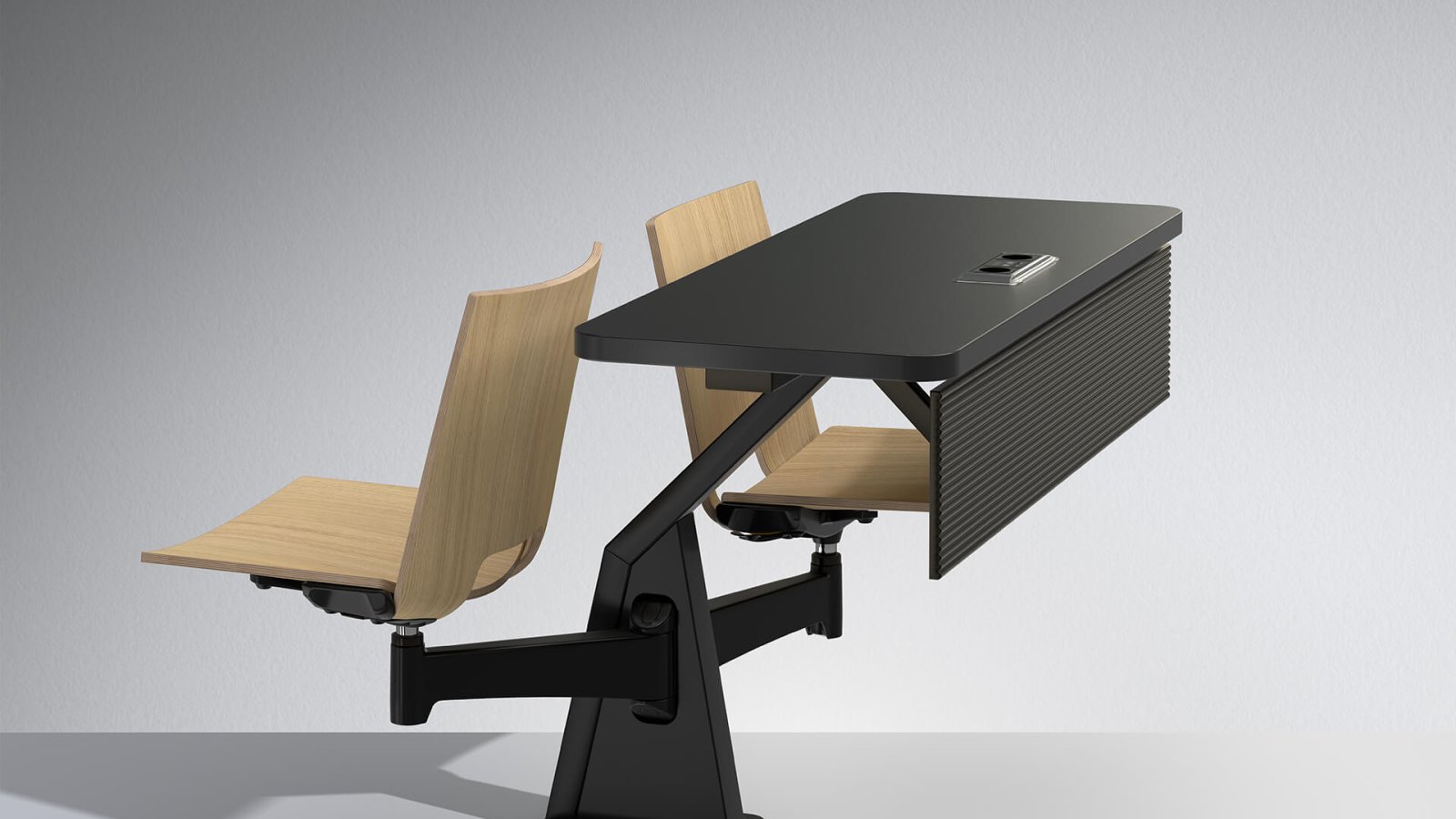
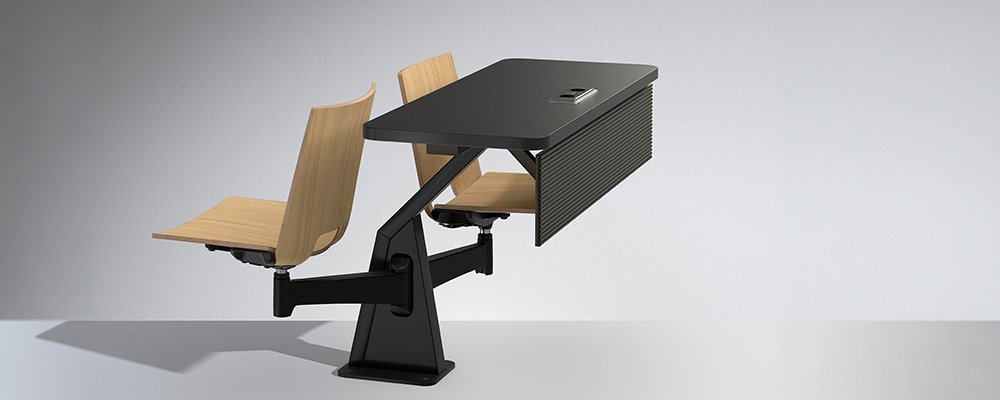
A lecture hall is reset several times a day, and in many rooms the reset is left to whoever happens to be passing. On ST12-13 by Lamm, designed by Orlandini Design, it is built into the arm. Each of the two seats on a bench is carried by a pivoting arm in die-cast aluminium, and that arm pivots under an automatic spring return through an excursion of 64°.
Release it and it comes back, so a row that students have left falls into order without anyone walking it. The seat swivels a full 360° and is pulled back by a calibrated automatic return; according to Lamm, that rotation allows people in neighbouring rows to share one table. That is why the system sits between university furniture and collaborative workspace furniture. The two movements are separate: the arm swings, the seat swivels.
Arm finishes are black RAL 9005 or silver, both semi-matt, or graphite with an embossed texture, and they may differ from the finish of the central steel structure. Two seats are offered, HL³ on ST12 and New Modulamm on ST13. Units are joined two seats at a time, in rows that run straight or curve, set on flat ground, an incline or steps, and benches can also face each other as an island seated from two sides.
On an Indian campus where one hall serves several batches in a day, a room that puts itself back in order is the detail that counts between sessions.
Collection: ST12-13 (ST12 and ST13 versions)
Manufacturer: Lamm — Lamm S.r.l., Italy
Design: Orlandini Design; HL³ seat by Lucci and Orlandini
Description: monoblock system for university lecture rooms and conference halls, made of a bench with a fixed writing top and two movable seats supported by pivoting arms; combined in multiples of two, in straight or curved rows; installed on flat or sloping floors or on steps; can also be arranged as an island with seats on both sides
ST12 — seat: HL³; seat and backrest in beech or oak plywood, or fully or partially upholstered and covered
ST13 — seat: New Modulamm; seat and backrest assembled with a tubular steel connector, tubular steel sides ø 25 mm; pressed and curved plywood in various woods, including oak, or upholstered and covered
ST12 — fabrics: ten collections, the six shared with ST13 (Inca, King, Trevi, Maya, Silvertex, Extrema Au) plus Ultra, Luna CS, Revive 1 and Remix 2
ST13 — fabrics: six collections, all shared with ST12
Padding: CertiPUR® certified
Movements: seat support arm with automatic spring-return rotation, 64° excursion; swivel seats with a 360° rotation device and calibrated automatic return
Structure: central load-bearing structure in tubular steel, with a steel sheet floor anchor plate
Seat support arms: painted die-cast aluminium
Finish of structure and arms: scratchproof, anti-corrosion epoxy-polyester powder coating in semi-matt black RAL 9005, semi-matt silver or embossed graphite; structure and arms can have different finishes
Writing top: HPL bi-laminate chipboard, 27 mm thick, 40 cm deep, matching ABS edges
Top finishes: black, white, tele-grey, graphite, eucalyptus, oak, grey oak, beech
Wooden components: low formaldehyde emission
Common dimensions (seat at rest): writing top 75 cm from the floor · seat 44 cm from the floor · front panel 21 cm high · two-seat bench 120 × 40 cm · depth with the seat rotated, in plan, 98 cm · curved rows with a minimum radius of 800 cm
ST12 — dimensions: bench and seat depth 60 cm · centre distance between the two seats 68.5 cm · row pitch 95 cm (30 + 60 + 35 on a step) · straight row of six seats 395 cm
ST13 — dimensions: 66 cm overall depth of each unit with its seat · 68 cm between the centres of its two places · rows spaced 100 cm apart (30 + 66 + 34 on a step) · 405 cm for six places in line
Accessories: painted extruded aluminium front panel, 21 cm high, in the same three paints as the structure and arms · floor-length front panel in the eight top finishes · electrification with sockets accessible on the top, or applied to the central load-bearing structure (socket on demand) · inter-row bar for installations not fixed to the floor
Testing: tested according to European standards (standard numbers are not stated)
Awards: ST12 — Best of Competition, Educational Spaces Innovation Awards 2015, New Orleans (USA); HL³ seat — Good Design 2010 and Silver Award, The Best of NeoCon 2010

Share the finishes you wish to evaluate
Yes. On ST12 the HL³ comes as bare plywood, in beech or oak, with full padding, or with padding on part of the shell only. On ST13 the New Modulamm seat comes in pressed and curved plywood or fully upholstered. In every case the padding is CertiPUR® certified.
Ten for ST12: Inca, King, Trevi, Maya, Silvertex, Extrema Au, Ultra, Luna CS, Revive 1 and Remix 2. Six for ST13: Inca, King, Trevi, Maya, Silvertex and Extrema Au. The wider choice therefore sits on the HL³ seat.
Yes, twice over. ST12 holds a Best of Competition title, Educational Spaces Innovation Awards 2015, New Orleans, USA. Its HL³ seat, the work of Lucci and Orlandini, collected a 2010 Good Design award (Chicago Athenaeum) plus a NeoCon 2010 Silver Award (The Best of NeoCon).
The central structure is fixed through a steel sheet floor anchor plate. For installations that are not fastened to the floor, Lamm offers an inter-row bar as an accessory, which is useful where the flooring should not be drilled.
According to Lamm, ST12-13 is tested to European standards, though the numbers of the individual standards are not listed. Any specific standards a project or tender calls for are confirmed project by project against the manufacturer's documentation.
The bench is identical in both versions, the seat is not. These are the figures that move on the drawing when the seat changes.
On ST12-13 the bench is the same in both versions: 120 cm wide for two seats, with the writing top at 75 cm and the seat at 44 cm from the floor. None of these change.
Bench and seat need 60 cm front to back on ST12, 66 cm on ST13. Every row on the plan grows by that difference.
Rows sit 95 cm apart with ST12 and 100 cm with ST13. On steps the tables break this down as 30 + 60 + 35 and 30 + 66 + 34, so the step depth has to be checked again.
Six seats in a straight line go from 395 to 405 cm, because the end sections grow from 60 to 65 cm on each side. Check that the ends still clear walls and aisles.
The centre distance between the two seats of a bench moves from 68.5 to 68 cm, and the fabric choice narrows from ten collections to six. Confirm both before the finish schedule is closed.