
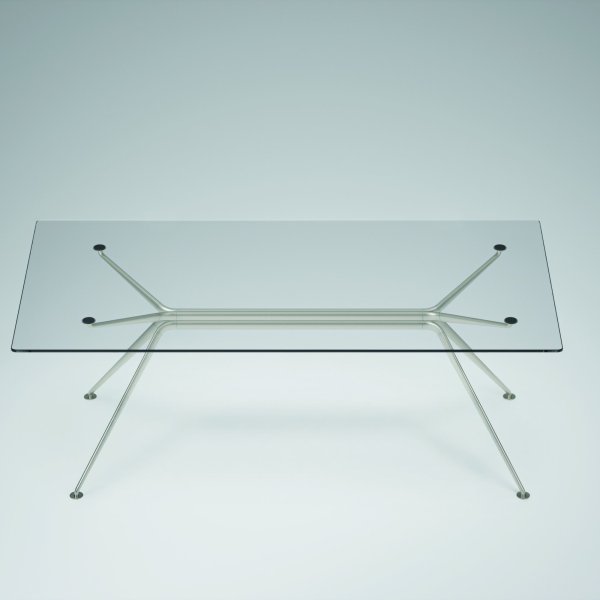
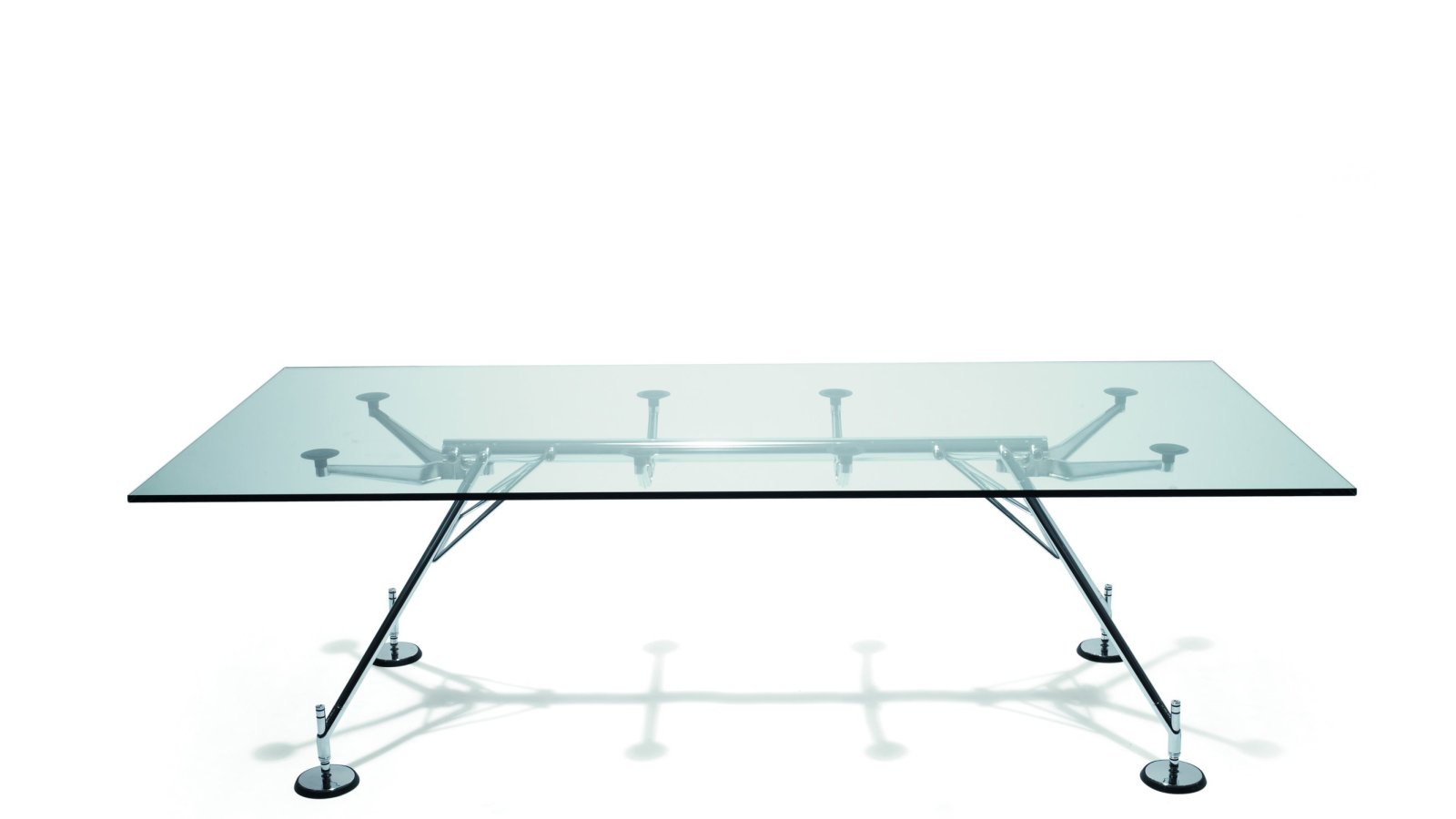
Nomos desk system by Tecno extended along one tubular backbone

Nomos by Tecno — one backbone for every desk length

Tecno

Norman Foster

Most desks are bought one size and stay that size. Nomos works differently: the structure is a tubular metal backbone, and length is a decision, not a limit. Compositions extend in different lengths and depths on the same spine — a single desk today, a shared bench when the team doubles, a meeting table cut to size when the new conference room opens. For an office that grows in phases, the furniture finally keeps pace with the org chart.

The engineering is the original 1986 project by Norman Foster — awarded the Compasso d'Oro in 1987 — and it shows in how the services are treated: cables climb from the floor through a black plastic vertebra fixed to the frame and travel in perforated-steel ducting under the tops. Extremely robust by Tecno's own description, the structure carries worktops, screens, shelves and supports without a wall in sight.

Tops come in HPL for the working floors, lacquer, wood veneers or back-painted tempered glass for the rooms that receive visitors. La Mercanti plans Nomos for Indian projects phase by phase — the first composition drawn with its future extensions already on the sheet, so growth is an order, not a redesign.

Technical information based on data declared by the manufacturer.

Collection: Nomos System
Manufacturer: Tecno S.p.A. (founded 1953)
Design: Norman Foster, 1986
Award: Compasso d'Oro 1987 (design Foster & Partners)
Structure: load-bearing tubular metal backbone; legs, feet, supports, worktops, superstructures and screens attach to the shared frame
Cable management: black plastic vertebra fixed to the frame for orderly cable access from the floor; modular painted perforated sheet-metal ducting beneath the worktops; cable tray and hooks
Tops: high-pressure laminate, white or dark grey lacquer, wood veneers, back-painted clear or ultra-clear tempered glass; top arranged for a leather desk pad available
Frames: chrome, or nickel paint in white, dark grey or gloss black
Variants: Nomos workstation, Nomos meeting, Nomos table
Components: end, intermediate and front screens, modesty panel, upper shelves, side return tops
Compositions: different lengths and depths, from individual workstations to large made-to-measure meeting tables

La Mercanti Srl — trusted supplier for design and contract projects since 1997.
San Benedetto del Tronto (AP), Italy · +39 0735 753833 · info@lamercanti.com
Supply, quotations, specifications and project support across India and worldwide.

Share the finishes you wish to evaluate

₹ 30.000

Amount adjusted against your first order

FAQ

Can Nomos desks be extended after installation?
Yes — that is the point of the shared structure. The tubular backbone accepts additional tops, legs, screens and shelves, so a composition grows in length and depth instead of being replaced. The first drawing can already mark the future phases.
Who designed the Nomos system and when?
Norman Foster, in 1986, for Tecno of Italy. The system won the Compasso d'Oro in 1987, credited to Foster & Partners, and Tecno regards it as the pioneer of shared-structure furniture.
Is the structure strong enough for daily intensive use?
Tecno describes Nomos as extremely robust: the backbone is load-bearing tubular metal, engineered to carry worktops, superstructures, screens and shelving as one frame.
How does cable management work on a growing bench?
Each riser point uses a black plastic vertebra fixed to the frame, bringing cables up from the floor; perforated-steel ducting under the tops carries them along the composition. Extending the bench extends the cable path with it.
Which top should we choose for a mixed office?
HPL where the work is heaviest, lacquer or wood veneer for cabins, back-painted tempered glass for the boardroom — different tops can share one backbone. La Mercanti draws the mix on a single composition sheet before the order is confirmed.

Planning a Nomos office that grows in phases

Five steps to buy the first desks and the fifth year at the same time.

Count the phases
Write down today's headcount and the realistic next two stages — the backbone will be drawn for the final length, even if only part is bought now.
Place the spine
Position the backbone where floor power already rises; every future extension inherits the same cable path through the vertebra.
Start with the core
Order the compositions the team needs today: single desks and one shared bench, each already detailed for extension.
Add by module
When the team grows, add tops, legs and screens to the existing spine — the new sections bolt onto the old ones.
Keep one drawing
Maintain a single master composition drawing and update it at every phase; the office stays one system instead of an archipelago of purchases.

You May Also Like